
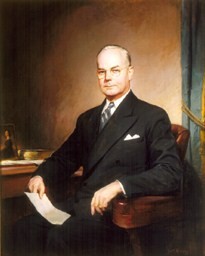
Historical · U.S. Department of the Treasury
John Wesley Snyder
Former United States Secretary of the Treasury · U.S. Department of the Treasury · 1946–1953
John Wesley Snyder served as United States Secretary of the Treasury (1946–1953). The page below collects sourced biographical facts, the appointment record, and provenance for Snyder.
Key facts
- Full name
- John Wesley Snyder
- Department
- U.S. Department of the Treasury
- Office
- United States Secretary of the Treasury
- Status
- Former secretary
- Appointment
- Senate-confirmed
- Tenure
- 1946–1953
- Confirmed
- —
- Born
- 1895
- Died
- 1985
- First year in office
- 1946
- Dataset version
- 1.20260703
Appointment & service record
United States Secretary of the Treasury · 1946–1953
- Department
- U.S. Department of the Treasury
- Appointment
- Senate-confirmed
- Appointing president
- —
- Confirmed
- —
Department, appointment type (Senate-confirmed, acting, recess, or designated), appointing president, confirmation status, and service dates are drawn from Wikidata and the White House Cabinet roster.[1][2][3]
Sources
- [1]https://www.wikidata.org/wiki/Q1702076Wikidata · retrieved 2026-07-03
- [2]https://www.whitehouse.gov/administration/cabinet/whitehouse.gov · retrieved 2026-07-03
- [3]https://www.wikidata.org/wiki/Q639738wikidata-cabinet · retrieved 2026-07-03
Biographical narrative
952 words · sourced from the Wikipedia REST extract
John Wesley Snyder was an American businessman who served as the United States Secretary of the Treasury from 1946 to 1953. A native of Jonesboro, Arkansas, he rose through a career in banking and federal financial administration before being appointed by President Harry S. Truman. During his tenure he focused on stabilizing the post‑war economy, reducing national debt, and managing fiscal policy amid the early Cold War period. Snyder’s conservative approach to economic management and his interactions with foreign governments left a lasting imprint on Treasury operations and U.S. financial diplomacy.
Early life and career
John Wesley Snyder was born on 21 June 1895 in Jonesboro, Arkansas, the third of six children of Jeremiah “Jerre” Hartwell Snyder and Ellen Hatcher. His father ran a small patent‑medicine manufacturing and distribution business in their hometown. Snyder completed his secondary education at the local high school before enrolling briefly at Vanderbilt University’s School of Engineering in 1914. Financial constraints forced him to leave the university after one year, and he returned to Arkansas where he moved to Forrest City. There he taught at a small country school while living with his sister Sula.
In 1915 Snyder enlisted in the United States Army, training as an artillery officer at Fort Logan H. Roots near North Little Rock. He served with the Thirty‑Second Artillery during World War I, seeing action on five different sectors of the Western Front and earning decorations from both the United States and France. While stationed in Europe he befriended several prominent Americans, including boxer Gene Tunney, pilot Eddie Rickenbacker, and future presidents Dwight Eisenhower and Harry S. Truman—both of whom also served in artillery units. After the war he was mustered out in 1919 but retained his commission as a captain, eventually attaining the rank of colonel in the Army Reserve.
On 5 January 1920 Snyder married Carrie Evlyn Cook; the couple had one daughter, Edith Cook “Drucie” Snyder Horton (born 1925). Initially planning to pursue electrical engineering, Snyder accepted a bookkeeping position at a bank in Forrest City, Arkansas. Over the next decade he advanced rapidly through banking ranks, holding officer positions in several banks across Arkansas and Missouri.
In the early 1930s Snyder relocated to Washington, D.C., bringing with him extensive experience from the private banking sector. He held a series of public appointments that combined financial oversight with wartime administration. Among these were National Bank Receiver for the Office of the Comptroller of the Currency, Federal Loan Administrator, and Director of War Mobilization and Reconversion. In his role as director he was instrumental in transitioning the United States economy from wartime to peacetime production after World War II. Critics, however, argued that he removed federal economic controls too rapidly, a move they said harmed consumers, delayed housing programs, and adversely affected small businesses.
Cabinet tenure
Snyder’s appointment as Secretary of the Treasury came in 1946 at the request of President Harry S. Truman, with whom he had maintained a close personal friendship from their shared artillery service. The Senate confirmed his nomination, though no specific confirmation date is recorded. At the time of his selection, Snyder was viewed by some observers as a “crony” and questioned for having a narrow range of experience relative to the breadth of responsibilities inherent in the Treasury Department.
As Secretary, Snyder’s primary mandate was to stabilize the United States’ postwar economy. He pursued policies aimed at maintaining confidence in U.S. government credit, reducing federal debt, keeping interest rates low, and encouraging public thrift through investment in U.S. Savings Bonds. A businessman by training, he believed that market forces would ultimately restore equilibrium without extensive state intervention. Under his stewardship the national debt was reduced while the Treasury balanced its budget.
Snyder’s fiscal conservatism extended to foreign aid programs; he expressed reluctance toward large expenditures for the Marshall Plan, which sought to rebuild Europe after the war. His limited diplomatic experience surfaced during negotiations with British officials over the United Kingdom’s need for U.S. dollars in 1949. Snyder’s remarks were perceived as undiplomatic and caused friction with British counterparts, including Chancellor of the Exchequer Hugh Gaitskell. Gaitskell later characterized Snyder as “a pretty small‑minded, small‑town semi‑isolationist.” The situation was ultimately resolved by Secretary of State Dean Acheson, whose approach proved more accommodating to Britain’s concerns.
The outbreak of the Korean War in 1950 required significant fiscal resources. Snyder financed the conflict primarily through tax increases. Throughout his tenure he engaged in frequent disputes with the Federal Reserve System, which gained greater independence in 1951 under new legislation. These tensions reflected differing views on monetary policy and fiscal responsibility. Snyder stepped down from government service at the conclusion of Truman’s second term in 1953.
Legacy
John Wesley Snyder remains notable as the first native‑born Arkansan to hold a United States Cabinet position, marking a milestone for his home state. His tenure is remembered for its emphasis on debt reduction and balanced budgets during a period of rapid economic change. The fiscal policies he implemented helped shape postwar American financial stability and set precedents for subsequent Treasury administrations.
Snyder’s approach to international monetary negotiations highlighted the challenges faced by U.S. officials in balancing domestic priorities with global diplomatic responsibilities. His interactions with British leaders, while criticized at the time, underscored the importance of diplomacy in managing foreign currency demands during the early Cold War era. Additionally, his conflicts with an increasingly independent Federal Reserve foreshadowed evolving relationships between fiscal and monetary authorities.
After leaving public office he lived until 8 October 1985, passing away on Seabrook Island, South Carolina at the age of 90. He was interred in Washington National Cathedral, a final honor reflecting his long service to the nation’s financial institutions.
Sources & provenance
Every quantitative or attributable claim above carries a per-section [N] marker that resolves to the corresponding URL below. Each entry records the upstream provider, the canonical URL, and the timestamp at which the underlying source was retrieved.
Key facts
- https://www.wikidata.org/wiki/Q1702076Wikidata · retrieved 2026-07-03
- https://www.whitehouse.gov/administration/cabinet/whitehouse.gov · retrieved 2026-07-03
- https://www.wikidata.org/wiki/Q639738wikidata-cabinet · retrieved 2026-07-03
Biographical narrative
- https://en.wikipedia.org/wiki/John_Wesley_SnyderWikipedia · retrieved 2026-07-03
Explore the Cabinet
The Cabinet includes the Vice President and the heads of the 15 executive departments. Browse the full roster of current and former secretaries, or explore how the Cabinet fits into the federal government.