
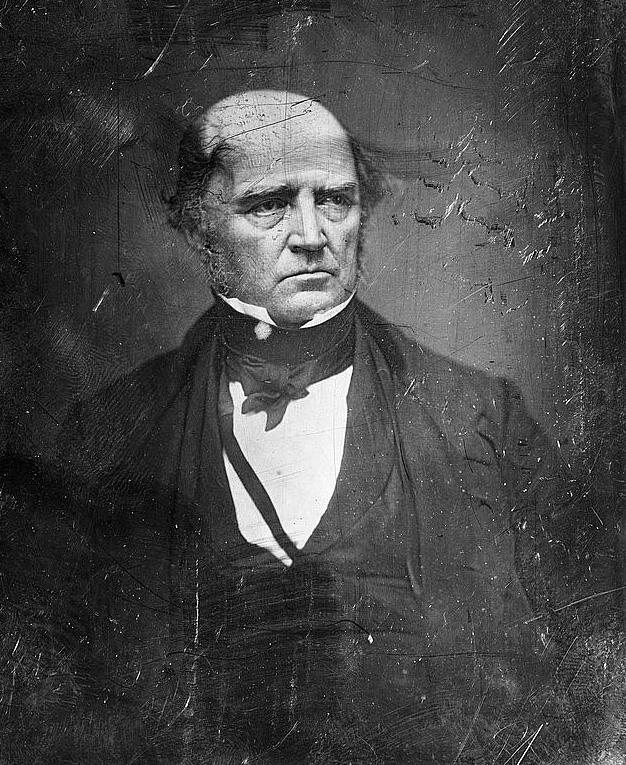
Historical · U.S. Department of the Treasury
Levi Woodbury
Former United States Secretary of the Treasury · U.S. Department of the Treasury · 1834–1841
Levi Woodbury served as United States Secretary of the Treasury (1834–1841). The page below collects sourced biographical facts, the appointment record, and provenance for Woodbury.
Key facts
- Full name
- Levi Woodbury
- Department
- U.S. Department of the Treasury
- Office
- United States Secretary of the Treasury
- Status
- Former secretary
- Appointment
- Senate-confirmed
- Tenure
- 1834–1841
- Confirmed
- —
- Born
- 1789
- Died
- 1851
- First year in office
- 1834
- Dataset version
- 1.20260703
Appointment & service record
United States Secretary of the Treasury · 1834–1841
- Department
- U.S. Department of the Treasury
- Appointment
- Senate-confirmed
- Appointing president
- —
- Confirmed
- —
Department, appointment type (Senate-confirmed, acting, recess, or designated), appointing president, confirmation status, and service dates are drawn from Wikidata and the White House Cabinet roster.[1][2][3]
Sources
- [1]https://www.wikidata.org/wiki/Q579228Wikidata · retrieved 2026-07-03
- [2]https://www.whitehouse.gov/administration/cabinet/whitehouse.gov · retrieved 2026-07-03
- [3]https://www.wikidata.org/wiki/Q639738wikidata-cabinet · retrieved 2026-07-03
Biographical narrative
878 words · sourced from the Wikipedia REST extract
Levi Woodbury (December 22 1789 – September 4 1851) was an American lawyer and public servant whose career spanned more than four decades. He served as a United States Senator from New Hampshire, the ninth governor of that state, and held two cabinet posts under President Andrew Jackson: Secretary of the Navy (1831‑1834) and Secretary of the Treasury (1834‑1841). After his tenure in Washington he returned to the Senate, was appointed an associate justice of the United States Supreme Court in 1845, and remained on that bench until his death. Woodbury also emerged as a leading candidate for the Democratic nomination for president in 1848.
Early life and career
Woodbury was born in Francestown, New Hampshire, to Mary and Peter Woodbury. He received his early education at Atkinson Academy before enrolling at Dartmouth College, where he graduated Phi Beta Kappa in 1809. After a brief period of study at Tapping Reeve Law School in Litchfield, Connecticut, he read law under the guidance of local attorneys and was admitted to the New Hampshire bar in 1812. That same year he established a private practice in his hometown, becoming the first justice of the United States Supreme Court to have attended law school.
While practicing law, Woodbury began to engage in public affairs. He authored the Hillsborough Resolves, a defense of the Madison administration’s conduct during the War of 1812, which brought him into contact with state officials and helped launch his political career. In 1816 he was appointed clerk of the New Hampshire State Senate, serving until 1817 when he received an appointment to the Superior Court of Judicature (the state’s highest court). He remained on that bench until 1823.
In 1823 Woodbury was elected governor of New Hampshire, a position he held for one year. His election followed a contested party convention in which he defeated Samuel Dinsmoor; his administration sought to reconcile factions within the state but ultimately did not achieve lasting political unity. After completing his term as governor, Woodbury served as Speaker of the New Hampshire House of Representatives in 1825.
Woodbury’s reputation for legal acumen and moderate politics led to his election to the United States Senate in 1825, where he represented New Hampshire until 1831. During that period he chaired the Senate Commerce Committee from 1827 to 1831. His service in Washington was marked by a strong alignment with President Andrew Jackson’s policies, particularly regarding banking and fiscal matters.
Cabinet tenure
In 1831 Woodbury resigned his Senate seat when President Jackson appointed him Secretary of the Navy. He served in that capacity until 1834, during which time he facilitated the appointment of Edmund Roberts as special agent and envoy to the Far East, thereby expanding American diplomatic engagement with Asia.
Woodbury’s next cabinet role was as Secretary of the Treasury, a position he held from 1834 through 1841 under Presidents Andrew Jackson and Martin Van Buren. He was confirmed by the United States Senate for this office, though the exact confirmation date is not recorded in the available sources. As Treasury secretary, Woodbury worked closely with Jackson to dismantle the Second Bank of the United States, favoring an “independent” treasury system and a hard‑money policy over reliance on paper money issued by private banks.
The financial Panic of 1837, which followed the collapse of speculative land prices, occurred during Woodbury’s tenure. In response, he advocated for a more secure administration of federal funds and supported legislation that established an Independent Treasury System. The act was passed by Congress in 1840, laying the groundwork for a system that would be fully realized under President James K. Polk in 1846.
After completing his service as Treasury secretary, Woodbury returned to the United States Senate, representing New Hampshire from 1841 until 1845. During this second term he served briefly as chairman of the Senate Committee on Finance during a special session of the 29th Congress; his tenure was notably short, lasting only ten days.
Legacy
Woodbury’s career left an imprint on several facets of American governance. As a legal scholar, he was the first Supreme Court justice to have attended law school, setting a precedent for formal legal education among the nation’s highest judges. His judicial service from 1845 until his death in 1851 included opinions on significant constitutional issues such as the Contract Clause, slavery, the political question doctrine, and the Commerce Clause.
In fiscal policy, Woodbury’s advocacy for an independent treasury system contributed to a lasting institutional shift. Although the system he helped establish was not fully implemented during his lifetime, the framework he supported eventually led to the creation of a Treasury that operated independently of private banking institutions.
Politically, Woodbury’s alignment with President Jackson’s administration and his role in dismantling the Second Bank reflected a broader movement toward populist economic reforms. His candidacy for the Democratic nomination in 1848, while not successful, underscored his prominence within the party and the national political arena of the era.
Woodbury died on September 4 1851, leaving behind a legacy characterized by service across multiple branches of government—legislative, executive, and judicial—and by contributions to the evolving structure of American fiscal policy. His career exemplifies the interconnected nature of 19th‑century public service and the enduring impact that individual officeholders can have on national institutions.
Sources & provenance
Every quantitative or attributable claim above carries a per-section [N] marker that resolves to the corresponding URL below. Each entry records the upstream provider, the canonical URL, and the timestamp at which the underlying source was retrieved.
Key facts
- https://www.wikidata.org/wiki/Q579228Wikidata · retrieved 2026-07-03
- https://www.whitehouse.gov/administration/cabinet/whitehouse.gov · retrieved 2026-07-03
- https://www.wikidata.org/wiki/Q639738wikidata-cabinet · retrieved 2026-07-03
Biographical narrative
- https://en.wikipedia.org/wiki/Levi_WoodburyWikipedia · retrieved 2026-07-03
Explore the Cabinet
The Cabinet includes the Vice President and the heads of the 15 executive departments. Browse the full roster of current and former secretaries, or explore how the Cabinet fits into the federal government.