
Historical · U.S. Department of the Treasury
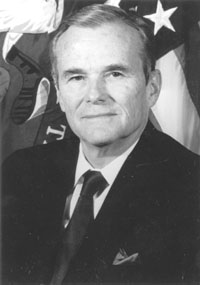
Nicholas F. Brady
Former United States Secretary of the Treasury · U.S. Department of the Treasury · 1988–1993
Nicholas F. Brady served as United States Secretary of the Treasury (1988–1993). The page below collects sourced biographical facts, the appointment record, and provenance for Brady.
Key facts
- Full name
- Nicholas F. Brady
- Department
- U.S. Department of the Treasury
- Office
- United States Secretary of the Treasury
- Status
- Former secretary
- Appointment
- Senate-confirmed
- Tenure
- 1988–1993
- Confirmed
- —
- Born
- 1930
- Died
- —
- First year in office
- 1988
- Dataset version
- 1.20260703
Appointment & service record
United States Secretary of the Treasury · 1988–1993
- Department
- U.S. Department of the Treasury
- Appointment
- Senate-confirmed
- Appointing president
- —
- Confirmed
- —
Department, appointment type (Senate-confirmed, acting, recess, or designated), appointing president, confirmation status, and service dates are drawn from Wikidata and the White House Cabinet roster.[1][2][3]
Sources
- [1]https://www.wikidata.org/wiki/Q723444Wikidata · retrieved 2026-07-03
- [2]https://www.whitehouse.gov/administration/cabinet/whitehouse.gov · retrieved 2026-07-03
- [3]https://www.wikidata.org/wiki/Q639738wikidata-cabinet · retrieved 2026-07-03
Biographical narrative
982 words · sourced from the Wikipedia REST extract
Nicholas Frederick Brady is an American banker who served as the 68th United States Secretary of the Treasury from September 1988 to December 1993, a period that spanned the final months of President Ronald Reagan’s administration and the entirety of President George H. W. Bush’s term. Prior to his cabinet appointment he held a brief tenure in the U.S. Senate representing New Jersey in 1982, filling an unexpired seat for eight months. Brady’s career has also encompassed extensive leadership roles in banking and investment firms, as well as participation in several presidential commissions.
Early life and career
Nicholas Frederick Brady was born on April 11, 1930, in Manhattan, New York City. He is the son of James Cox Brady Jr. and Eliot Chace; his family lineage includes notable figures such as businessman and philanthropist Nicholas Frederic Brady (his great‑uncle) and industrialist Anthony N. Brady (his great‑grandfather). His father was a prominent figure in thoroughbred horse racing across the United States and Europe. The family maintained an estate in Far Hills, New Jersey, where Brady spent his formative years.
After completing secondary education at St. Mark’s School in Southborough, Massachusetts, Brady pursued higher education at Yale University. He earned a Bachelor of Arts degree in 1952 and was a member of the Chi Psi fraternity during his undergraduate studies. He continued his academic pursuits at Harvard Business School, receiving a Master of Business Administration in 1954.
Brady entered the banking sector immediately after graduation, joining Dillon, Read & Co. in New York City in 1954. Over a span of thirty‑four years he rose through the organization’s ranks, ultimately becoming chairman of the board in 1970. His tenure at Dillon, Read & Co. was marked by leadership during a period of significant growth and transformation within the investment banking industry.
Following his departure from Dillon, Read & Co., Brady continued to hold prominent positions in finance and investment. Since 1994 he has served as chairman of Darby Overseas Investments Ltd. and Darby Technology Ventures Group LLC. He also chairs Franklin Templeton Investment Funds, an international investment management company, and sits on the boards of several corporations, including Hess Corporation, Holowesko Partners Ltd., and Weatherford International (the latter since 2004). His directorships have extended to companies such as NCR Voyix, Mitre Corporation, and Heinz.
In addition to his corporate roles, Brady has held chairmanships at former institutions, notably serving as chairman of the board for Dillon, Read & Co. from 1970 until its dissolution in 1988 and for Purolator Filters from 1971 to 1987.
Cabinet tenure
Brady’s entry into public service began with his appointment to the United States Senate in April 1982. He was selected by Governor Thomas Kean to fill the vacancy left by the resignation of Senator Harrison A. Williams, who had been convicted of bribery and whose resignation was delayed for several months. Brady served from April 12 to December 27, 1982, during which time he participated on the Senate Committees on Armed Services and on Banking, Housing, and Urban Affairs. He resigned before the end of the term so that the elected successor, Frank Lautenberg, could assume office early for seniority purposes.
In 1984, President Ronald Reagan appointed Brady as chairman of the President’s Commission on Executive, Legislative, and Judicial Salaries. Over subsequent years he served on a range of commissions and task forces, including the Presidential Commission on Strategic Forces (1983), the National Bipartisan Commission on Central America (1983), the Commission on Security and Economic Assistance (1983), the Blue Ribbon Commission on Defense Management (1985), and the Presidential Task Force on Market Mechanisms (1987). These appointments reflected his expertise in financial matters and policy analysis.
On September 15, 1988, Brady was confirmed by the Senate as the United States Secretary of the Treasury. His appointment coincided with the final months of President Reagan’s administration and continued through the entirety of President George H. W. Bush’s term until December 1993. During his tenure he addressed a range of fiscal challenges, including the management of national debt and economic policy coordination.
A significant achievement of Brady’s Treasury service was the development of a debt‑reduction framework for developing nations in 1989. In response to multiple defaults by countries such as Mexico, he designed an agreement that enabled these governments to issue United States dollar‑denominated bonds under revised terms. The resulting instruments became known as Brady Bonds and represented a novel approach to restructuring sovereign debt.
Brady’s leadership style was described at the time as measured and methodical. While early reports noted his cautious public speaking demeanor, he maintained close working relationships with senior officials in the Bush administration, thereby influencing key policy decisions throughout his tenure.
Legacy
Nicholas Brady’s legacy encompasses both his contributions to U.S. fiscal policy and his broader impact on international finance. As Secretary of the Treasury, he oversaw a period marked by significant debt restructuring initiatives that have had lasting effects on global financial markets. The Brady Bond framework introduced in 1989 remains a reference point for contemporary sovereign debt negotiations.
Beyond his cabinet service, Brady’s long-standing involvement in banking and investment has positioned him as a notable figure within the finance community. His leadership roles at Dillon, Read & Co., Darby Overseas Investments, Franklin Templeton Investment Funds, and various corporate boards illustrate a career that bridged private sector expertise and public policy implementation.
In the political realm, Brady’s brief Senate appointment in 1982 stands out as a unique moment in New Jersey’s congressional history. He remains the most recent Republican to hold the state’s Class 1 U.S. Senate seat, and following the passing of former Senator Daniel J. Evans, he became the oldest living former member of the United States Senate.
Overall, Nicholas Brady’s career reflects a sustained engagement with financial governance at both national and international levels, underscored by his role in shaping debt‑reduction strategies that continue to influence global economic policy discussions.
Sources & provenance
Every quantitative or attributable claim above carries a per-section [N] marker that resolves to the corresponding URL below. Each entry records the upstream provider, the canonical URL, and the timestamp at which the underlying source was retrieved.
Key facts
- https://www.wikidata.org/wiki/Q723444Wikidata · retrieved 2026-07-03
- https://www.whitehouse.gov/administration/cabinet/whitehouse.gov · retrieved 2026-07-03
- https://www.wikidata.org/wiki/Q639738wikidata-cabinet · retrieved 2026-07-03
Biographical narrative
- https://en.wikipedia.org/wiki/Nicholas_F._BradyWikipedia · retrieved 2026-07-03
Explore the Cabinet
The Cabinet includes the Vice President and the heads of the 15 executive departments. Browse the full roster of current and former secretaries, or explore how the Cabinet fits into the federal government.