
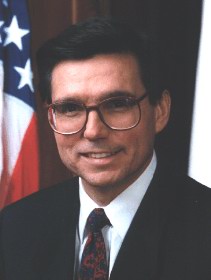
Historical · U.S. Department of Transportation
Federico Peña
Former United States Secretary of Transportation · U.S. Department of Transportation · 1993–1997
Federico Peña served as United States Secretary of Transportation (1993–1997). The page below collects sourced biographical facts, the appointment record, and provenance for Peña.
Key facts
- Full name
- Federico Peña
- Department
- U.S. Department of Transportation
- Office
- United States Secretary of Transportation
- Status
- Former secretary
- Appointment
- Senate-confirmed
- Tenure
- 1993–1997
- Confirmed
- —
- Born
- 1947
- Died
- —
- First year in office
- 1993
- Dataset version
- 1.20260703
Appointment & service record
United States Secretary of Transportation · 1993–1997
- Department
- U.S. Department of Transportation
- Appointment
- Senate-confirmed
- Appointing president
- —
- Confirmed
- —
Department, appointment type (Senate-confirmed, acting, recess, or designated), appointing president, confirmation status, and service dates are drawn from Wikidata and the White House Cabinet roster.[1][2][3]
Sources
- [1]https://www.wikidata.org/wiki/Q1400546Wikidata · retrieved 2026-07-03
- [2]https://www.whitehouse.gov/administration/cabinet/whitehouse.gov · retrieved 2026-07-03
- [3]https://www.wikidata.org/wiki/Q639738wikidata-cabinet · retrieved 2026-07-03
Biographical narrative
892 words · sourced from the Wikipedia REST extract
Federico Fabian Peña, born March 15 1947, is an American attorney and public servant who held two senior cabinet positions during President Bill Clinton’s administration: United States Secretary of Transportation from 1993 to 1997 and United States Secretary of Energy from 1997 to 1998. Prior to his federal service, Peña was the first Hispanic mayor of Denver, Colorado, serving from 1983 until 1991. His career has spanned legislative work in the Colorado House of Representatives, executive municipal leadership, national transportation and energy policy, private equity advisory roles, and board positions with major financial institutions.
Early life and career
Peña was born in Laredo, Texas, where he spent his early years before pursuing higher education at the University of Texas at Austin. He earned a Bachelor of Arts degree in 1969 and continued at the university’s School of Law, obtaining a Juris Doctor in 1972. After completing his legal studies, Peña relocated to Colorado, establishing himself as a practicing attorney.
In 1979, he entered elective office by winning a seat in the Colorado House of Representatives. During his tenure in the state legislature, Peña advanced to the position of Minority Leader, indicating a leadership role within the chamber’s opposition ranks. His legislative experience provided a foundation for subsequent executive responsibilities.
Peña’s most prominent municipal role began with his election as mayor of Denver in 1983. He defeated incumbent William H. McNichols Jr., who was then 74 years old, becoming the city’s first Hispanic mayor. Peña secured re‑election in 1987 and served until 1991. His mayoralty is noted for several key initiatives: he championed the relocation of Major League Baseball’s Colorado Rockies to Denver, a move that materialized in 1993; he oversaw the construction of Denver International Airport, including the development of Peña Boulevard—a freeway linking the airport to Interstate 70—named in his honor; and he promoted an urban revitalization program dubbed “Imagine a Great City,” which led to the establishment of a new convention center, modernization of the Cherry Creek Shopping Center, expansion of neighborhood retail, enlargement of library services, and enhancement of performing arts facilities.
Cabinet tenure
During the presidential transition of Bill Clinton, Peña advised Arkansas Governor Clinton on transportation matters. Following Clinton’s inauguration, Peña was appointed Secretary of Transportation, a position he held from 1993 until 1997. His appointment was confirmed by the United States Senate. While serving in this role, a preliminary investigation was initiated by the Justice Department in 1995 concerning a pension management contract awarded to a California transit agency that had been managed by Peña’s former investment firm. Peña had severed all ties with that company before the contract and prior to his cabinet appointment; the investigation was terminated on March 17 1995.
After completing a single term as Transportation Secretary, Peña continued in the Clinton administration as Secretary of Energy from 1997 through 1998. In this capacity he oversaw an organization of approximately sixteen thousand direct employees and managed a budget of about eighteen billion dollars. Peña contributed to the development of the Comprehensive National Energy Strategy for the administration and supervised the privatization sale of the Elk Hills Oil Field—formerly Naval Petroleum Reserve No. 1—for $3.654 billion, noted as the largest such transaction in U.S. government history at that time. He also formulated a strategy for oil and gas development in the Caspian Sea region and supported investments by U.S. energy companies abroad.
Legacy
Following his departure from federal service, Peña returned to Denver and entered the private sector. In August 1998 he joined Vestar Capital Partners as a senior advisor, where he has remained involved in investment activities. His influence on Colorado’s infrastructure is commemorated through Peña Boulevard, which connects Denver International Airport to Interstate 70; this roadway reflects his earlier vision for improved transportation links.
Peña’s broader impact extends beyond public office. He served as National Co‑Chair of the COMPETE Coalition, an organization that brings together energy stakeholders such as large power generators, major retail consumers, and groups focused on energy efficiency and smart grid technologies. His post‑government career has included service on corporate boards; he was elected to the Board of Directors of Wells Fargo on October 26 2011 and appointed to the University of Denver Board of Trustees in June 2015.
In the political arena, Peña publicly endorsed Senator Barack Obama during the 2008 presidential campaign and acted as Obama’s National Campaign Co‑chair. He was also named to the advisory board of the Obama–Biden Transition Project on November 5 2008. These activities illustrate his continued engagement with national policy discussions after leaving cabinet office.
On a personal level, Peña is the father of three children—Nelia, Cristina, and Ryan—and has been married twice. His first marriage to Ellen Hart Peña ended in divorce finalized on September 10 2001. He married Cindy Velasquez on September 2 2006; Velasquez is a former broadcast executive with experience at Denver television stations KMGH‑TV (Channel 7) and KUSA‑TV (Channel 9). Together they have a daughter, Pilar.
Peña’s career trajectory—from state legislator to mayor, from transportation secretary to energy secretary, and later as private equity advisor and corporate board member—reflects a sustained involvement in public policy, infrastructure development, and economic strategy. His contributions to Denver’s urban renewal, the expansion of national transportation networks, and the shaping of U.S. energy policy during the Clinton administration constitute key elements of his legacy within American governmental history.
Sources & provenance
Every quantitative or attributable claim above carries a per-section [N] marker that resolves to the corresponding URL below. Each entry records the upstream provider, the canonical URL, and the timestamp at which the underlying source was retrieved.
Key facts
- https://www.wikidata.org/wiki/Q1400546Wikidata · retrieved 2026-07-03
- https://www.whitehouse.gov/administration/cabinet/whitehouse.gov · retrieved 2026-07-03
- https://www.wikidata.org/wiki/Q639738wikidata-cabinet · retrieved 2026-07-03
Biographical narrative
- https://en.wikipedia.org/wiki/Federico_Pe%C3%B1aWikipedia · retrieved 2026-07-03
Explore the Cabinet
The Cabinet includes the Vice President and the heads of the 15 executive departments. Browse the full roster of current and former secretaries, or explore how the Cabinet fits into the federal government.