
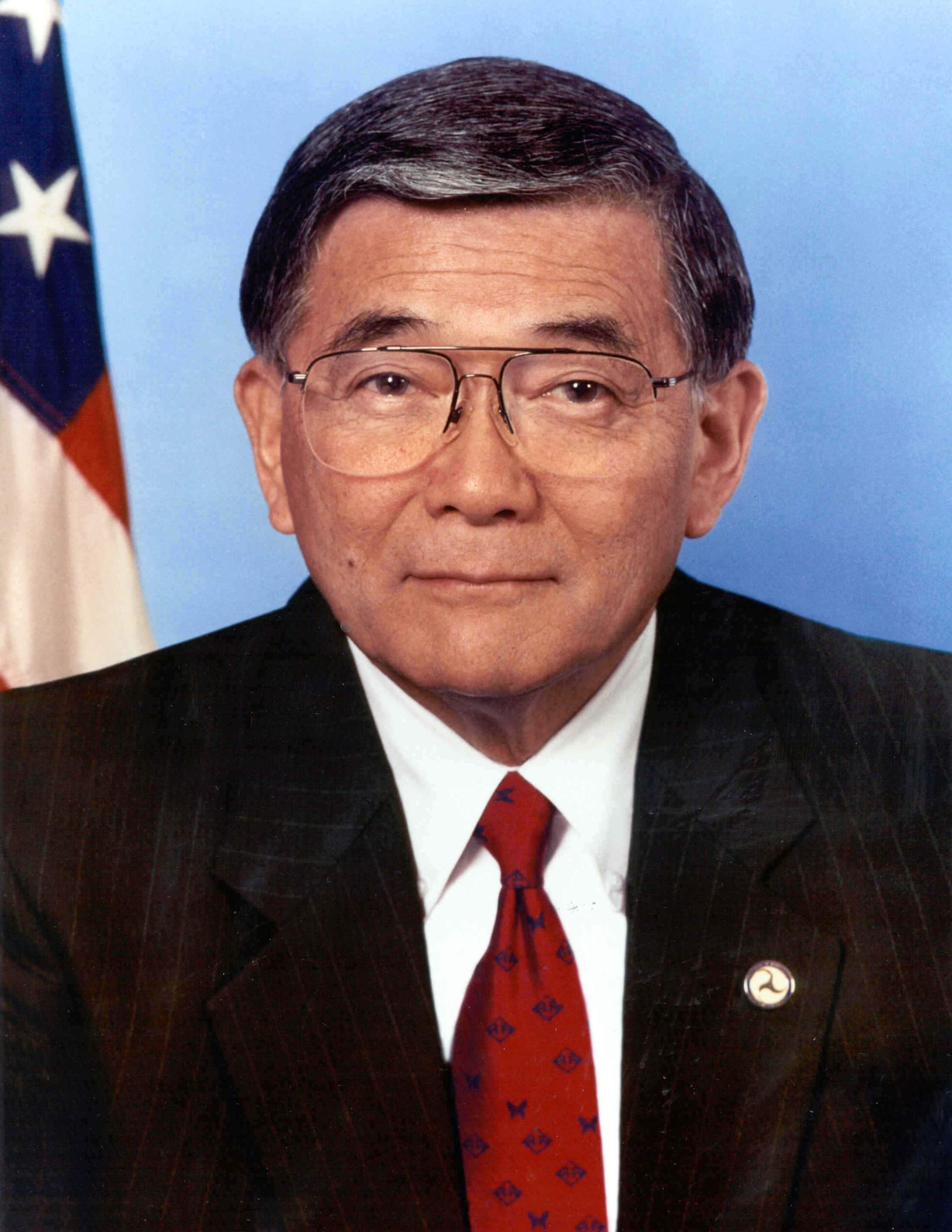
Historical · U.S. Department of Transportation
Norman Mineta
Former United States Secretary of Transportation · U.S. Department of Transportation · 2001–2006
Norman Mineta served as United States Secretary of Transportation (2001–2006). The page below collects sourced biographical facts, the appointment record, and provenance for Mineta.
Key facts
- Full name
- Norman Mineta
- Department
- U.S. Department of Transportation
- Office
- United States Secretary of Transportation
- Status
- Former secretary
- Appointment
- Senate-confirmed
- Tenure
- 2001–2006
- Confirmed
- —
- Born
- 1931
- Died
- 2022
- First year in office
- 2001
- Dataset version
- 1.20260703
Appointment & service record
United States Secretary of Transportation · 2001–2006
- Department
- U.S. Department of Transportation
- Appointment
- Senate-confirmed
- Appointing president
- —
- Confirmed
- —
Department, appointment type (Senate-confirmed, acting, recess, or designated), appointing president, confirmation status, and service dates are drawn from Wikidata and the White House Cabinet roster.[1][2][3]
Sources
- [1]https://www.wikidata.org/wiki/Q553502Wikidata · retrieved 2026-07-03
- [2]https://www.whitehouse.gov/administration/cabinet/whitehouse.gov · retrieved 2026-07-03
- [3]https://www.wikidata.org/wiki/Q639738wikidata-cabinet · retrieved 2026-07-03
Biographical narrative
1,050 words · sourced from the Wikipedia REST extract
Norman Yoshio Mineta was an influential American public servant whose career spanned local government, the U.S. House of Representatives, and two presidential administrations. Born to Japanese immigrant parents in San Jose, California, he rose from a city councilman to mayor, then to a long‑serving congressman, before being appointed as Secretary of Transportation under President George W. Bush. His tenure was marked by significant transportation reforms, the establishment of the Transportation Security Administration following the September 11 attacks, and a record length of service in that cabinet position. Mineta’s legacy includes pioneering roles for Asian Americans in federal government, contributions to aviation safety policy, and a lasting impact on national infrastructure planning.
Early life and career
Norman Yoshio Mineta entered the world on November 12, 1931, in San Jose, California. His parents, Kunisaku Mineta and Kane Watanabe, were Japanese immigrants who could not obtain U.S. citizenship because of the Immigration Act of 1924. During World War II, the family was relocated to the Heart Mountain Relocation Center near Cody, Wyoming, where they endured several years of internment alongside thousands of other Japanese Americans. In the camp, Mineta’s baseball bat—a personal hobby—was confiscated by authorities for security reasons. Years later, after his election to Congress, he received a baseball that had belonged to Hank Aaron; however, congressional regulations on gifts prohibited him from accepting it.
While at Heart Mountain, Mineta met fellow Boy Scout Alan Simpson, who would later serve as a U.S. Senator from Wyoming. The two maintained a friendship and political alliance throughout their careers. After the war, Mineta graduated in 1953 from the University of California, Berkeley’s School of Business Administration with a degree in business administration. He then joined the United States Army as a military intelligence officer, serving in Japan and South Korea before returning to San Jose to work with his father at the family insurance agency.
Mineta entered municipal politics in 1967 when he was appointed to fill a vacant seat on the San Jose City Council by Mayor Ron James. He was subsequently elected to the council, where he served as vice mayor during his term. In 1971, he ran for mayor against fourteen other candidates and secured more than sixty percent of the vote in every precinct, becoming the city’s first Japanese‑American mayor and its 59th mayor overall. During his four years in office, Mineta halted a long‑standing policy of rapid growth through annexation and established development‑free zones in East and South San Jose. His vice mayor, Janet Gray Hayes, succeeded him when he left the mayoralty in 1975.
In 1974, Mineta launched a campaign for the U.S. House of Representatives from California’s then‑13th congressional district, which had been represented by long‑time Republican Charles Gubser. He won the Democratic nomination and defeated Assemblyman George W. Milias with fifty‑two percent of the vote. Over the next twenty years, he was re‑elected eleven times, never receiving less than fifty‑seven percent of the vote in any election. During his tenure in Congress, Mineta co‑founded the Congressional Asian Pacific American Caucus and served as its first chair. He chaired the House Committee on Transportation and Infrastructure from 1992 to 1994, and earlier led both the aviation subcommittee (1981–1988) and the surface transportation subcommittee (1989–1991). His legislative work included authorship of the Intermodal Surface Transportation Efficiency Act and advocacy for increased funding for the Federal Aviation Administration. He also played a key role in the passage of the Civil Liberties Act of 1988, which formally apologized for the internment of Japanese Americans during World War II.
In 1995, Mineta resigned his congressional seat mid‑term to accept a position with Lockheed Martin. That same year he chaired the National Civil Aviation Review Commission, whose 1997 report recommended measures to reduce traffic congestion and lower aviation accident rates; many of these recommendations were adopted by the Clinton administration. In recognition of his contributions to aviation, Mineta received the L. Welch Pogue Award for Lifetime Achievement in Aviation in 1999.
Cabinet tenure
Mineta’s federal executive service began with a brief appointment as Secretary of Commerce during the final months of President Bill Clinton’s administration; specific dates are not provided. He was later nominated by President George W. Bush to serve as United States Secretary of Transportation, a position he held from 2001 until 2006 and which he confirmed through Senate approval. As the only cabinet secretary in the Bush administration with a background in the Democratic Party, Mineta brought a bipartisan perspective to transportation policy.
During his tenure, the September 11 attacks prompted a nationwide reevaluation of aviation security. In response, Mineta oversaw the creation of the Transportation Security Administration (TSA), establishing new protocols and agencies to safeguard air travel. His leadership extended beyond aviation; he guided broader transportation initiatives across all modes of travel. On June 23, 2006, Mineta announced his resignation, effective July 7, 2006, after more than five years in office. At the time of his departure, he had become the longest‑serving Secretary of Transportation in the history of the Department of Transportation.
Following his cabinet service, Mineta joined Hill & Knowlton as a partner in public relations. In 2010, he became vice chairman of L&L Energy, continuing to influence transportation and energy policy from the private sector.
Legacy
Norman Mineta’s career is distinguished by several firsts for Asian Americans in U.S. federal government. He was the first Japanese‑American mayor of a major American city and the first person of East Asian descent to serve as a cabinet secretary. Until the election of Vice President Kamala Harris in 2020, he held the distinction of being the highest‑ranking Asian American in the federal executive branch.
His impact on transportation policy is enduring. The Intermodal Surface Transportation Efficiency Act, which he helped author, remains a foundational piece of legislation for national infrastructure funding. The TSA, established under his guidance, continues to shape aviation security worldwide. In recognition of his service to San Jose and the broader region, the city’s international airport bears his name.
Mineta passed away on May 3, 2022, in Edgewater, Maryland, at the age of ninety, after a heart ailment. His death marked the loss of a pioneering public servant whose career bridged local governance, congressional leadership, and national executive responsibility, leaving a lasting imprint on American transportation policy and Asian‑American representation in government.
Sources & provenance
Every quantitative or attributable claim above carries a per-section [N] marker that resolves to the corresponding URL below. Each entry records the upstream provider, the canonical URL, and the timestamp at which the underlying source was retrieved.
Key facts
- https://www.wikidata.org/wiki/Q553502Wikidata · retrieved 2026-07-03
- https://www.whitehouse.gov/administration/cabinet/whitehouse.gov · retrieved 2026-07-03
- https://www.wikidata.org/wiki/Q639738wikidata-cabinet · retrieved 2026-07-03
Biographical narrative
- https://en.wikipedia.org/wiki/Norman_MinetaWikipedia · retrieved 2026-07-03
Explore the Cabinet
The Cabinet includes the Vice President and the heads of the 15 executive departments. Browse the full roster of current and former secretaries, or explore how the Cabinet fits into the federal government.