
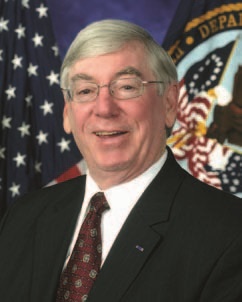
Historical · U.S. Department of Veterans Affairs
Gordon H. Mansfield
Acting
Former Acting United States Secretary of Veterans Affairs · U.S. Department of Veterans Affairs · 2007–2007
Gordon H. Mansfield served as Acting United States Secretary of Veterans Affairs (2007–2007). The page below collects sourced biographical facts, the appointment record, and provenance for Mansfield.
Key facts
- Full name
- Gordon H. Mansfield
- Department
- U.S. Department of Veterans Affairs
- Office
- United States Secretary of Veterans Affairs
- Status
- Former secretary
- Appointment
- Acting
- Tenure
- 2007–2007
- Confirmed
- —
- Born
- 1941
- Died
- 2013
- First year in office
- 2007
- Dataset version
- 1.20260704
Appointment & service record
United States Secretary of Veterans Affairs · 2007–2007
- Department
- U.S. Department of Veterans Affairs
- Appointment
- Acting
- Appointing president
- —
- Confirmed
- Not confirmed
Department, appointment type (Senate-confirmed, acting, recess, or designated), appointing president, confirmation status, and service dates are drawn from Wikidata and the White House Cabinet roster.[1][2][3]
Sources
- [1]https://www.wikidata.org/wiki/Q3110903Wikidata · retrieved 2026-07-04
- [2]https://www.whitehouse.gov/administration/cabinet/whitehouse.gov · retrieved 2026-07-04
- [3]https://www.wikidata.org/wiki/Q639738wikidata-cabinet · retrieved 2026-07-04
Biographical narrative
954 words · sourced from the Wikipedia REST extract
Gordon Hall Mansfield was an American military officer, lawyer, and public servant who dedicated much of his life to the welfare of veterans. Born in 1941, he served two tours in Vietnam before transitioning into a legal career and later holding senior positions within the Department of Veterans Affairs and other federal agencies. His work as Deputy Secretary of Veterans Affairs from 2004 until 2009, along with a brief period as Acting Secretary in late 2007, placed him at the center of national veterans policy during the Bush administration. Mansfield’s commitment to veteran advocacy continued through nonprofit leadership and board service until his passing in 2013.
Early life and career
Gordon H. Mansfield entered the world on September 15, 1941. He pursued higher education at Villanova University, where he earned an undergraduate degree before enlisting in the United States Army in 1964. His military service included two deployments to Vietnam with the 101st Airborne Division. During his second tour, Mansfield commanded a company and was wounded on February 4, 1968, amid the Tet Offensive. An enemy soldier feigning death shot him, resulting in a spinal cord injury. Despite the severity of his wounds, he remained with his unit until all injured soldiers were evacuated. He was subsequently transported by medical evacuation to a Navy Hospital and later to the National Naval Medical Center in Bethesda, Maryland, where he recuperated before being discharged from active duty in September 1968.
While recovering from his injuries, Mansfield resumed his academic pursuits, enrolling in law school at American University. After completing his studies there, he graduated from the University of Miami’s law program. His legal career began in Ocala, Florida, where he practiced privately until 1981. During this period, he also served as a legislative advisor to the Secretary of Veterans Affairs, representing the department’s programs and policy agenda before Congress.
In 1981 Mansfield joined the Paralyzed Veterans of America (PVA), an organization dedicated to supporting veterans with spinal cord injuries. He held several positions within PVA over nearly a decade, including its first associate executive director of Government Relations. In April 1993 he was appointed executive director of the national office in Washington, D.C., where he oversaw daily operations and continued to advocate for policies benefiting paralyzed veterans.
Mansfield’s federal service expanded when he became Assistant Secretary for Fair Housing and Equal Opportunity at the Department of Housing and Urban Development from 1989 to 1993 under President George H. W. Bush. In that role, he was responsible for enforcing fair housing laws and promoting equal opportunity initiatives across the United States.
Cabinet tenure
Mansfield’s most prominent federal appointments came within the Department of Veterans Affairs (VA). On August 1, 2001, he assumed the position of Assistant Secretary for Congressional and Legislative Affairs. In this capacity, he managed the VA’s relationships with Congress, coordinated legislative initiatives, and represented the department’s interests in congressional hearings and negotiations.
On November 3, 2003, President George W. Bush nominated Mansfield to serve as Deputy Secretary of Veterans Affairs. The United States Senate confirmed his nomination on January 22, 2004. As Deputy Secretary, he served under Secretary Jim Nicholson for nearly five years, overseeing the day‑to‑day operations of the VA and assisting in the implementation of national veterans policies.
Following Nicholson’s resignation, Mansfield stepped into the role of Acting Secretary of Veterans Affairs from October 1, 2007 until December 20, 2007. During this interim period he maintained continuity within the department while awaiting the appointment of a permanent successor. James Peake, a retired U.S. Army Surgeon General, was sworn in as the new Secretary on December 20, 2007.
Mansfield’s tenure as Deputy Secretary concluded in January 2009. After leaving federal office, he continued to contribute to veteran causes by joining the Board of Directors of the Disabled Veterans’ LIFE Memorial Foundation in February 2009, where he helped oversee initiatives honoring disabled veterans and supporting their families.
Legacy
Gordon H. Mansfield’s career is marked by a sustained focus on improving the lives of military veterans. His early experiences as a wounded combat veteran informed his later advocacy work, giving him firsthand insight into the challenges faced by service members returning from conflict. Through his leadership roles at PVA and within the VA, he helped shape policies related to spinal cord injury care, fair housing for veterans, and congressional relations.
His contributions were recognized through numerous honors. He received the Distinguished Service Cross for valor during combat, as well as the Bronze Star, two Purple Hearts, the Combat Infantryman Badge, and the Presidential Unit Citation for his service in Vietnam. In civilian life he was awarded the Presidential Distinguished Service Award and the Villanova University Alumni Human Relations Medal. His achievements were further commemorated by induction into the National Spinal Cord Injury Hall of Fame in 2006 and the U.S. Army Officer Candidate School Hall of Fame in 1997.
In October 2010, Mansfield was honored by the Veteran’s Group Soldier On during the official opening of the Gordon H. Mansfield Veterans Community in Pittsfield, Massachusetts. The community, dedicated to serving veterans, featured a bronze bas relief sculpture of Mansfield created by Andrew DeVries; his wife Linda and several dignitaries—including Congressman John Olver, Soldier On CEO Jack Downing, and VA Homeless Programs Director Peter Dougherty—unveiled the artwork.
Mansfield’s death on January 29, 2013, from an aortic disease in Washington, D.C., marked the end of a life devoted to public service. His legacy endures through the institutions he helped strengthen, the policies he influenced, and the many veterans who benefited from his advocacy. The breadth of his career—from battlefield leadership to legal practice, nonprofit administration, and federal cabinet service—illustrates a lifelong commitment to supporting those who have served in the United States armed forces.
Sources & provenance
Every quantitative or attributable claim above carries a per-section [N] marker that resolves to the corresponding URL below. Each entry records the upstream provider, the canonical URL, and the timestamp at which the underlying source was retrieved.
Key facts
- https://www.wikidata.org/wiki/Q3110903Wikidata · retrieved 2026-07-04
- https://www.whitehouse.gov/administration/cabinet/whitehouse.gov · retrieved 2026-07-04
- https://www.wikidata.org/wiki/Q639738wikidata-cabinet · retrieved 2026-07-04
Biographical narrative
- https://en.wikipedia.org/wiki/Gordon_H._MansfieldWikipedia · retrieved 2026-07-04
Explore the Cabinet
The Cabinet includes the Vice President and the heads of the 15 executive departments. Browse the full roster of current and former secretaries, or explore how the Cabinet fits into the federal government.