
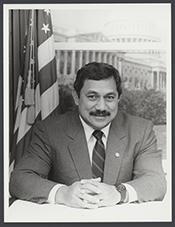
Historical · U.S. House · American Samoa · At-Large
Eni Faleomavaega
Former U.S. Representative · American Samoa At-Large · 1989–2015 · Democratic
Eni Faleomavaega represented American Samoa's At-Large in the United States House of Representatives (1989–2015) for the Democratic party. The page below collects sourced biographical facts, term history, committee roles, and provenance for Faleomavaega.
Bioguide ID: F000010
Key facts
- Full name
- Eni Faleomavaega
- State
- American Samoa
- District
- At-Large
- Party
- Democratic
- House service
- 1989–2015
- First House term
- 1989
- Status
- Left office
- Current term ends
- —
- Born
- 1943
- Bioguide ID
- F000010
- Committee assignments
- —
- Dataset version
- 1.20260605
Biographical narrative
976 words · sourced from the Wikipedia REST extract
Eni F. H. Faleomavaega was an American politician and attorney who served as the non-voting delegate to the United States House of Representatives for American Samoa from 1989 until 2015. A member of the Democratic Party, Faleomavaega was known for his advocacy for greater autonomy and self-determination for American Samoa, as well as his efforts to secure federal funding for essential services in the territory. His political career also included a term as the territory's lieutenant governor and a commitment to addressing issues related to American Samoa's economic dependency and political status.
Early life and career
Eni Faleomavaega was born on August 15, 1943, in Vailoatai, American Samoa. He spent his formative years on the islands of Tutuila and Swains before his family relocated to Lāʻie, Hawaii, following the withdrawal of the U.S. Navy from American Samoa in 1951. Faleomavaega's father, Eni, served in the Fitafita Guard and later worked as a communications specialist for the U.S. Navy, which influenced the family's moves within the Pacific region.
Faleomavaega's educational journey began at Kahuku High School in Hawaii. He initially attended the Church College of Hawaii, now known as Brigham Young University–Hawaii, where he completed an associate's degree. He then transferred to Brigham Young University in Utah, where he earned a Bachelor of Arts degree in political science and history in 1966. Following his undergraduate studies, he pursued a legal education, obtaining a Juris Doctor degree from the University of Houston Law Center in 1972 and a Master of Laws from the University of California, Berkeley, in 1973.
His military service began when he enlisted in the United States Army, serving from 1966 to 1969, including a tour in the Vietnam War. After leaving active duty, he continued his service as an officer in the United States Army Reserve from 1982 to 1989, achieving the rank of captain. Faleomavaega was also an active member of the Church of Jesus Christ of Latter-day Saints throughout his life.
Before entering politics, Faleomavaega held several legal and administrative positions. He served as the administrative assistant to American Samoa Delegate A. U. Fuimaono from 1973 to 1975 and later as staff counsel for the House Committee on Interior and Insular Affairs from 1975 to 1981. He also held the position of Deputy Attorney General of American Samoa from 1981 to 1984. His early experiences in these roles provided him with a foundation for his future political career.
House tenure
Faleomavaega entered the political arena as a candidate in the inaugural election for American Samoa’s Delegate to the U.S. Congress in 1978. He later ran for lieutenant governor in 1985, serving in that role until 1989. In 1988, he was elected as the Delegate to the U.S. House of Representatives, a position he held for 13 consecutive terms until January 3, 2015. As a non-voting delegate, Faleomavaega was able to participate in debates and serve on committees, but he was not permitted to vote on the final passage of legislation.
During his tenure in Congress, Faleomavaega focused on securing federal funding for American Samoa, particularly in areas such as healthcare and education. He was instrumental in advocating for scholarships that enabled American Samoan students to attend colleges and universities in the United States, securing approximately $4 million annually for this purpose. His efforts were aimed at diversifying the territory's economy and reducing its reliance on federal support.
Faleomavaega was also known for his opposition to free trade agreements that could negatively impact American Samoa's tuna industry, which employs a significant portion of the territory's population. He proposed legislation to allow residents of U.S. territories to vote in presidential elections if they were active-duty military members, reflecting his commitment to enhancing the political rights of American Samoans.
Throughout his congressional career, Faleomavaega was involved in various significant issues, including foreign affairs and environmental matters. He participated in a boycott of French President Jacques Chirac during a 1996 address to Congress, protesting French nuclear testing in the Pacific. His stance on international issues extended to his views on the civil war in Sri Lanka, where he advocated for a non-interventionist approach by the United States.
Legislative focus and committees
During his time in the House of Representatives, Faleomavaega served on several key committees that shaped his legislative focus. He was a member of the Committee on Foreign Affairs, where he held the position of Ranking Member on the Subcommittee on Asia, the Pacific, and the Global Environment. He also served on the Subcommittee on the Western Hemisphere. Additionally, he was a member of the Committee on Natural Resources, participating in the Subcommittee on Energy and Mineral Resources and the Subcommittee on Fisheries, Wildlife, Oceans, and Insular Affairs.
Faleomavaega's involvement in these committees allowed him to address a range of issues pertinent to American Samoa and the broader Pacific region. His legislative initiatives often centered on promoting the interests of U.S. territories and advocating for policies that would enhance their autonomy and self-determination. In 2012, he and the Governor of American Samoa called for discussions on the possibility of greater autonomy or independence for the territory, a proposal that received mixed reactions from the public.
Throughout his career, Faleomavaega was also an active member of the Congressional Asian Pacific American Caucus, which aimed to address issues affecting Asian American and Pacific Islander communities. His advocacy extended beyond American Samoa, reflecting a broader commitment to the rights and interests of Pacific Islanders.
Faleomavaega's long tenure in Congress was marked by his dedication to his constituents and his efforts to navigate the complexities of representing a non-voting territory. His legacy includes a focus on education, economic diversification, and the pursuit of greater political rights for American Samoans. After leaving office in 2015, he continued to be recognized for his contributions to American Samoa and the Pacific region until his passing on February 22, 2017.
Notable legislation
Sponsored and co-sponsored legislation for Eni Faleomavaega is pending operator curation. The biographical narrative above carries the same provenance trail until per-bill rows are written.
Sources
- [1]https://en.wikipedia.org/wiki/Eni_FaleomavaegaWikipedia · retrieved 2026-06-05
Notable quotes
Sourced quotes for Eni Faleomavaega are pending operator curation. Narrative-scope provenance remains attached below.
Sources
- [1]https://en.wikipedia.org/wiki/Eni_FaleomavaegaWikipedia · retrieved 2026-06-05
Key positions
Curated policy positions for Eni Faleomavaega are pending operator review. The biographical narrative above carries the same provenance trail until per-topic positions are written.
Sources
- [1]https://en.wikipedia.org/wiki/Eni_FaleomavaegaWikipedia · retrieved 2026-06-05
Terms served
- 1989–1991U.S. House · Term 1 · Democratic
- 1991–1993U.S. House · Term 2 · Democratic
- 1993–1995U.S. House · Term 3 · Democratic
- 1995–1997U.S. House · Term 4 · Democratic
- 1997–1999U.S. House · Term 5 · Democratic
- 1999–2001U.S. House · Term 6 · Democratic
- 2001–2003U.S. House · Term 7 · Democratic
- 2003–2005U.S. House · Term 8 · Democratic
- 2005–2007U.S. House · Term 9 · Democratic
- 2007–2009U.S. House · Term 10 · Democratic
- 2009–2011U.S. House · Term 11 · Democratic
- 2011–2013U.S. House · Term 12 · Democratic
- 2013–2015U.S. House · Term 13 · Democratic
Sources & provenance
Every attributable claim above carries a per-section [N] marker that resolves to the corresponding URL below. Each entry records the upstream provider, the canonical URL, and the timestamp at which the source was retrieved by the ingest pipeline.
Key facts
- https://bioguide.congress.gov/search/bio/F000010bioguide · retrieved 2026-06-05
- http://faleomavaega.house.govhouse.gov · retrieved 2026-06-05
Biographical narrative
- https://en.wikipedia.org/wiki/Eni_Faleomavaegawikipedia · retrieved 2026-06-05
Find your representative
Every U.S. state elects representatives by district. Browse American Samoa’s delegation, the full former-representative roster, or explore the role and term length.
Related on The Candidate
- Preceded by Fofó SuniaEarlier holder of the American Samoa At-Large House seat · Democratic.Open
- Democratic PartyFederal candidates and office holders on the Democratic line.Open
- Representatives from American SamoaEvery former U.S. Representative who has represented American Samoa.Open
- All former U.S. RepresentativesEvery individual who has served in the U.S. House and since left office.Open
- U.S. House of RepresentativesRole, term length, qualifications, and the full House candidate directory.Open