
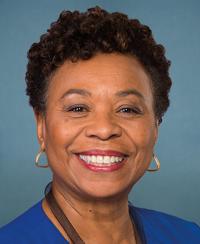
Historical · U.S. House · California · District 12
Barbara Lee
Former U.S. Representative · California District 12 · 1998–2025 · Democratic
Barbara Lee represented California's District 12 in the United States House of Representatives (1998–2025) for the Democratic party. The page below collects sourced biographical facts, term history, committee roles, and provenance for Lee.
Bioguide ID: L000551
Key facts
- Full name
- Barbara Lee
- State
- California
- District
- District 12
- Party
- Democratic
- House service
- 1998–2025
- First House term
- 1998
- Status
- Left office
- Current term ends
- —
- Born
- 1946
- Bioguide ID
- L000551
- Committee assignments
- —
- Dataset version
- 1.20260603
Biographical narrative
1,054 words · sourced from the Wikipedia REST extract
Barbara Lee is an American politician and member of the Democratic Party who served as a U.S. Representative for California's 12th congressional district from 1998 until January 3, 2025. Lee is recognized for her progressive stance on various issues and her significant contributions to legislative efforts, particularly in the realms of social justice, health care, and anti-war activism. After concluding her tenure in Congress, she transitioned to local politics, becoming the first Black woman to serve as mayor of Oakland in 2025.
Early life and career
Barbara Jean Lee was born on July 16, 1946, in El Paso, Texas. She was raised in a segregated environment, which profoundly shaped her early experiences with racial discrimination. Lee is the eldest of three daughters born to Mildred Adaire and Garvin Alexander Tutt, a lieutenant colonel in the United States Army. Her upbringing was marked by challenges, including her parents' divorce when she was nine years old. Following the divorce, Lee and her family moved to California, where she attended San Fernando High School in Los Angeles. During her high school years, she became involved with the NAACP and made history as the school's first African-American cheerleader.
Lee's early adulthood was tumultuous. At the age of 15, she underwent a back-alley abortion, an experience that highlighted the struggles many women face regarding reproductive rights. After graduating high school in 1964, she married Carl Lee, a member of the U.S. Air Force, and moved to England. The marriage was marked by difficulties, and after the couple divorced when Lee was 20, she faced homelessness while raising her two children.
In pursuit of education, Lee returned to California, where she attended Mills College. She became actively involved in student leadership, serving as president of the Black Student Union. Her academic journey continued at the University of California, Berkeley, where she earned a master's degree in social work. Throughout her college years, Lee balanced her studies with the responsibilities of single motherhood, often relying on public assistance and food stamps.
Lee's early career included roles in community service and advocacy. She worked for the Glendale Welfare Council and as a statistical clerk for the California Department of Labor Statistics. Her political engagement began in earnest when she worked on Shirley Chisholm's 1972 presidential campaign, where she served as a delegate at the Democratic National Convention. Inspired by Chisholm's leadership, Lee became motivated to pursue a career in public service. Additionally, she volunteered at the Oakland chapter of the Black Panther Party, where she contributed to community education initiatives.
After completing her education, Lee interned in the office of U.S. Representative Ron Dellums, who represented an Oakland-based district. This experience led to a full-time position as Dellums's chief of staff, making her one of the few African Americans and women in senior staff roles on Capitol Hill. Following her tenure in Dellums's office, Lee founded a facilities-management company before entering elected office.
House tenure
Barbara Lee was elected to the U.S. House of Representatives in a special election in 1998, succeeding Ron Dellums. Her congressional district, initially numbered as the 9th district and later as the 13th district, encompassed much of Oakland and northern Alameda County. The district is known for its strong Democratic leanings, with a Cook Partisan Voting Index rating indicating a significant Democratic advantage.
Throughout her 14 terms in Congress, Lee established herself as a prominent progressive voice. She chaired the Congressional Progressive Caucus from 2005 to 2009 and later led the Congressional Black Caucus from 2009 to 2011. Lee was also a founding member of the Congressional LGBTQ+ Equality Caucus and co-chaired the House Democratic Steering Committee and the Congressional Cannabis Caucus. Her legislative work often focused on issues such as civil rights, health care, and social justice.
Lee is particularly noted for her vocal opposition to military interventions. She gained national attention for being the only member of Congress to vote against the authorization of military force following the September 11 attacks in 2001. Her stance on the Iraq War further solidified her reputation as a leading figure in the anti-war movement. In addition to her anti-war activism, Lee played a significant role in health care initiatives, notably collaborating with President George W. Bush on the President's Emergency Plan for AIDS Relief, which aimed to combat the global HIV/AIDS epidemic.
In 2024, Lee announced her decision not to seek re-election to the House, opting instead to run for the U.S. Senate seat vacated by Dianne Feinstein. Despite her efforts, she did not advance past the jungle primary, losing to Republican Steve Garvey and fellow Democratic Representative Adam Schiff, who ultimately won the seat in the general election.
Legislative focus and committees
During her tenure in the House, Barbara Lee was involved in a wide range of legislative initiatives that reflected her commitment to progressive values. Her work on health care issues included advocating for expanded access to services and addressing health disparities, particularly in marginalized communities. Lee's focus on social justice extended to her support for legislation aimed at combating systemic racism and promoting equity in various sectors.
As a member of the Congressional Progressive Caucus, Lee championed policies that aligned with progressive priorities, including economic justice, environmental sustainability, and civil rights. Her leadership roles in various caucuses, such as the Congressional Black Caucus and the Congressional LGBTQ+ Equality Caucus, underscored her dedication to advocating for diverse communities and addressing their unique challenges.
Lee's involvement in the Congressional Cannabis Caucus demonstrated her commitment to reforming drug policy and addressing the impacts of the War on Drugs on communities of color. Her advocacy for cannabis legalization was part of a broader effort to promote social equity and justice in drug policy reform.
Throughout her congressional career, Lee served on several committees, where she contributed to discussions and legislation on critical issues facing the nation. Her work on these committees allowed her to influence policy decisions and advocate for the needs of her constituents and the broader American public.
After concluding her congressional service in January 2025, Lee transitioned to local government, successfully running for mayor of Oakland in a special election. Her election as the first Black woman to hold the mayoral office in Oakland marked a significant milestone in the city's history and reflected her enduring commitment to public service and community leadership.
Notable legislation
Sponsored and co-sponsored legislation for Barbara Lee is pending operator curation. The biographical narrative above carries the same provenance trail until per-bill rows are written.
Sources
- [1]https://en.wikipedia.org/wiki/Barbara_LeeWikipedia · retrieved 2026-06-03
Notable quotes
Sourced quotes for Barbara Lee are pending operator curation. Narrative-scope provenance remains attached below.
Sources
- [1]https://en.wikipedia.org/wiki/Barbara_LeeWikipedia · retrieved 2026-06-03
Key positions
Curated policy positions for Barbara Lee are pending operator review. The biographical narrative above carries the same provenance trail until per-topic positions are written.
Sources
- [1]https://en.wikipedia.org/wiki/Barbara_LeeWikipedia · retrieved 2026-06-03
Terms served
- 1998–1999U.S. House · Term 1 · Democratic
- 1999–2001U.S. House · Term 2 · Democratic
- 2001–2003U.S. House · Term 3 · Democratic
- 2003–2005U.S. House · Term 4 · Democratic
- 2005–2007U.S. House · Term 5 · Democratic
- 2007–2009U.S. House · Term 6 · Democratic
- 2009–2011U.S. House · Term 7 · Democratic
- 2011–2013U.S. House · Term 8 · Democratic
- 2013–2015U.S. House · Term 9 · Democratic
- 2015–2017U.S. House · Term 10 · Democratic
- 2017–2019U.S. House · Term 11 · Democratic
- 2019–2021U.S. House · Term 12 · Democratic
- 2021–2023U.S. House · Term 13 · Democratic
- 2023–2025U.S. House · Term 14 · Democratic
Sources & provenance
Every attributable claim above carries a per-section [N] marker that resolves to the corresponding URL below. Each entry records the upstream provider, the canonical URL, and the timestamp at which the source was retrieved by the ingest pipeline.
Key facts
- https://bioguide.congress.gov/search/bio/L000551bioguide · retrieved 2026-06-03
- https://lee.house.govhouse.gov · retrieved 2026-06-03
Biographical narrative
- https://en.wikipedia.org/wiki/Barbara_Leewikipedia · retrieved 2026-06-03
Find your representative
Every U.S. state elects representatives by district. Browse California’s delegation, the full former-representative roster, or explore the role and term length.
Related on The Candidate
- Preceded by Ernest KonnyuEarlier holder of the California District 12 House seat · Republican.Open
- Barclay HenleyFormer U.S. Representative · California District 1 · DemocraticOpen
- Charles ClaytonFormer U.S. Representative · California District 1 · RepublicanOpen
- Clarence LeaFormer U.S. Representative · California District 1 · DemocraticOpen
- Clement MillerFormer U.S. Representative · California District 1 · DemocraticOpen
- Democratic PartyFederal candidates and office holders on the Democratic line.Open