
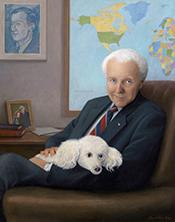
Historical · U.S. House · California · District 12
Tom Lantos
Former U.S. Representative · California District 12 · 1981–2008 · Democratic
Tom Lantos represented California's District 12 in the United States House of Representatives (1981–2008) for the Democratic party. The page below collects sourced biographical facts, term history, committee roles, and provenance for Lantos.
Bioguide ID: L000090
Key facts
- Full name
- Tom Lantos
- State
- California
- District
- District 12
- Party
- Democratic
- House service
- 1981–2008
- First House term
- 1981
- Status
- Left office
- Current term ends
- —
- Born
- 1928
- Bioguide ID
- L000090
- Committee assignments
- —
- Dataset version
- 1.20260605
Biographical narrative
1,062 words · sourced from the Wikipedia REST extract
Thomas Peter Lantos was a Hungarian-born American politician who served as a U.S. Representative for California's 12th congressional district from 1981 until his death in 2008. A member of the Democratic Party, Lantos was notable for being the only Holocaust survivor to serve in the United States Congress. His legislative career was marked by a strong commitment to human rights, foreign affairs, and social justice, which he pursued through various roles, including as Chair of the House Foreign Affairs Committee during his final term. Lantos's life and career were deeply influenced by his experiences during World War II, which shaped his advocacy for human rights and his dedication to preventing oppression.
Early life and career
Lantos was born on February 1, 1928, in Budapest, Hungary, into a Jewish family. His parents, Anna, a high school English teacher, and Pál Lantos, a banker, fostered an environment that valued education. Lantos's family background included relatives involved in academia, such as an uncle who was a professor at the University of Budapest and a grandmother who served as a high school principal. This educational foundation would later play a significant role in his professional life.
The political landscape in Hungary shifted dramatically with the rise of Nazi Germany. In 1938, following the annexation of Austria, Lantos began to grasp the implications of these events for Hungarian Jews. His life took a harrowing turn in March 1944 when German forces invaded Hungary. As a Jewish teenager, Lantos was arrested and sent to a forced labor camp. He managed to escape but was recaptured and subjected to severe beatings before being returned to the camp. Lantos escaped again and found refuge in Budapest, where he hid with an aunt in a safe house established by Raoul Wallenberg, a Swedish diplomat known for his efforts to save Jews during the Holocaust.
During this time, Lantos became part of Wallenberg's network, using his Aryan appearance to serve as a courier, delivering food and medicine to other Jews in hiding. The liberation of Hungary by Soviet forces in January 1945 marked a turning point in Lantos's life, but it came at a devastating cost. He returned home to find that his mother and many other family members had been murdered during the Holocaust.
After the war, Lantos pursued higher education. He enrolled at the University of Budapest in 1946 and, due to his proficiency in English, received a scholarship from the Hillel Foundation to study in the United States. He emigrated to the U.S. and attended the University of Washington in Seattle, where he earned a Bachelor of Arts degree in 1949 and a Master of Arts degree in 1950. Lantos continued his academic journey at the University of California, Berkeley, where he obtained a Ph.D. in economics in 1953. Following his education, he became a professor of economics at San Francisco State University and later worked as a business consultant and television commentator on foreign policy issues.
House tenure
Lantos's political career began in earnest when he was elected to the U.S. Congress in 1980. He took office in 1981, representing California's 11th congressional district until 1993, when redistricting led him to serve California's 12th congressional district. This district included significant portions of San Mateo County and parts of southwestern San Francisco. Over his 14 terms in Congress, Lantos became known for his strong advocacy on issues related to human rights, foreign affairs, and social justice.
Throughout his tenure, Lantos was an active member of various congressional committees, contributing to discussions and legislation that shaped U.S. policy both domestically and internationally. His experiences as a Holocaust survivor informed his legislative priorities, particularly in advocating for human rights and addressing issues of oppression around the world. Lantos's commitment to these causes was evident in his founding of the Congressional Human Rights Caucus in 1983, which sought to promote and defend internationally recognized human rights.
In his final term, Lantos served as Chair of the House Foreign Affairs Committee, a position that allowed him to influence U.S. foreign policy significantly. His leadership in this role underscored his dedication to international human rights and his belief in the importance of U.S. engagement in global affairs. Lantos announced in early January 2008 that he would not seek re-election due to a diagnosis of esophageal cancer. He passed away on February 11, 2008, before completing his term.
Legislative focus and committees
Lantos's legislative focus was deeply rooted in his personal history and experiences as a Holocaust survivor. His advocacy for human rights was a cornerstone of his work in Congress, where he consistently sought to address issues of injustice and oppression. He was particularly vocal about the need for the U.S. to take a strong stance against human rights violations around the world.
As a member of the House Foreign Affairs Committee, Lantos played a crucial role in shaping U.S. foreign policy, emphasizing the importance of human rights in international relations. His efforts included advocating for the recognition of the Armenian Genocide and promoting legislation aimed at protecting vulnerable populations globally. Lantos's commitment to human rights was further reflected in the renaming of the Congressional Human Rights Caucus to the Tom Lantos Human Rights Commission after his death, ensuring that his legacy would continue to influence future generations of lawmakers.
In addition to his work on human rights, Lantos was involved in various other legislative initiatives, including those related to economic policy and education. His academic background in economics informed his approach to these issues, allowing him to contribute meaningfully to discussions on economic development and educational reform.
Lantos's dedication to public service extended beyond his legislative work. In the final weeks of his life, he expressed a desire for a non-profit organization to be established to continue his advocacy for human rights. This led to the founding of the Lantos Foundation for Human Rights & Justice later in 2008, which aims to promote and defend human rights worldwide. Additionally, the Tom Lantos Institute was established in Budapest in 2011 to support minority issues and promote tolerance in Central and Eastern Europe.
Throughout his life and career, Lantos remained committed to the principles of justice and human dignity, drawing on his own experiences to advocate for those who could not speak for themselves. His legacy continues to influence discussions on human rights and foreign policy in the United States and beyond.
Notable legislation
Sponsored and co-sponsored legislation for Tom Lantos is pending operator curation. The biographical narrative above carries the same provenance trail until per-bill rows are written.
Sources
- [1]https://en.wikipedia.org/wiki/Tom_LantosWikipedia · retrieved 2026-06-05
Notable quotes
Sourced quotes for Tom Lantos are pending operator curation. Narrative-scope provenance remains attached below.
Sources
- [1]https://en.wikipedia.org/wiki/Tom_LantosWikipedia · retrieved 2026-06-05
Key positions
Curated policy positions for Tom Lantos are pending operator review. The biographical narrative above carries the same provenance trail until per-topic positions are written.
Sources
- [1]https://en.wikipedia.org/wiki/Tom_LantosWikipedia · retrieved 2026-06-05
Terms served
- 1981–1983U.S. House · Term 1 · Democratic
- 1983–1985U.S. House · Term 2 · Democratic
- 1985–1987U.S. House · Term 3 · Democratic
- 1987–1989U.S. House · Term 4 · Democratic
- 1989–1991U.S. House · Term 5 · Democratic
- 1991–1993U.S. House · Term 6 · Democratic
- 1993–1995U.S. House · Term 7 · Democratic
- 1995–1997U.S. House · Term 8 · Democratic
- 1997–1999U.S. House · Term 9 · Democratic
- 1999–2001U.S. House · Term 10 · Democratic
- 2001–2003U.S. House · Term 11 · Democratic
- 2003–2005U.S. House · Term 12 · Democratic
- 2005–2007U.S. House · Term 13 · Democratic
- 2007–2008U.S. House · Term 14 · Democratic
Sources & provenance
Every attributable claim above carries a per-section [N] marker that resolves to the corresponding URL below. Each entry records the upstream provider, the canonical URL, and the timestamp at which the source was retrieved by the ingest pipeline.
Key facts
- https://bioguide.congress.gov/search/bio/L000090bioguide · retrieved 2026-06-05
- http://lantos.house.govhouse.gov · retrieved 2026-06-05
Biographical narrative
- https://en.wikipedia.org/wiki/Tom_Lantoswikipedia · retrieved 2026-06-05
Find your representative
Every U.S. state elects representatives by district. Browse California’s delegation, the full former-representative roster, or explore the role and term length.
Related on The Candidate
- Preceded by Allan HunterEarlier holder of the California District 12 House seat · Republican.Open
- Barclay HenleyFormer U.S. Representative · California District 1 · DemocraticOpen
- Charles ClaytonFormer U.S. Representative · California District 1 · RepublicanOpen
- Clarence LeaFormer U.S. Representative · California District 1 · DemocraticOpen
- Clement MillerFormer U.S. Representative · California District 1 · DemocraticOpen
- Democratic PartyFederal candidates and office holders on the Democratic line.Open