
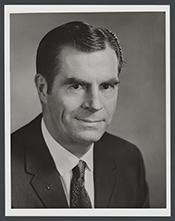
Historical · U.S. House · California · District 16
Burt Talcott
Former U.S. Representative · California District 16 · 1963–1977 · Republican
Burt Talcott represented California's District 16 in the United States House of Representatives (1963–1977) for the Republican party. The page below collects sourced biographical facts, term history, committee roles, and provenance for Talcott.
Bioguide ID: T000022
Key facts
- Full name
- Burt Talcott
- State
- California
- District
- District 16
- Party
- Republican
- House service
- 1963–1977
- First House term
- 1963
- Status
- Left office
- Current term ends
- —
- Born
- 1920
- Bioguide ID
- T000022
- Committee assignments
- —
- Dataset version
- 1.20260605
Biographical narrative
975 words · sourced from the Wikipedia REST extract
Burt L. Talcott was an American politician and veteran who served as a U.S. Representative from California's 16th congressional district. A member of the Republican Party, he held office in the House of Representatives for seven consecutive terms from 1963 until 1977. Talcott's career was marked by his experiences as a World War II bomber pilot and prisoner of war, as well as his subsequent political endeavors at both the local and national levels. His legislative contributions included support for significant civil rights legislation during a transformative period in American history.
Early life and career
Burt L. Talcott was born on February 22, 1920, in Billings, Montana. He pursued higher education at Stanford University, where he earned his degree in 1942. Shortly after completing his studies, Talcott enlisted in the United States Army Air Corps, a branch of the military that would later become part of the United States Air Force. During World War II, he served as a bomber pilot, flying missions over Europe. His military service was notable for its challenges; during one of his missions in a B-24 bomber over Austria, Talcott was shot down and subsequently captured by enemy forces. He spent 14 months in a German prisoner-of-war camp, enduring significant hardships during this period.
Upon his return to the United States in 1945, Talcott was recognized for his service and bravery with several military honors, including the Air Medal and the Purple Heart with clusters. These accolades reflected not only his commitment to his country but also the sacrifices he made during the war. After his military service, Talcott transitioned into public life, beginning his political career at the local level. He served on the Monterey County Board of Supervisors in California, where he eventually became president of the board. This role allowed him to gain valuable experience in governance and public service, laying the groundwork for his future political endeavors at the national level.
House tenure
Talcott's entry into national politics came when he was elected to the 88th United States Congress as a Republican representative for California's 16th congressional district. His first term began on January 3, 1963, and he would go on to serve a total of seven terms in the House of Representatives, concluding his service on January 3, 1977. Throughout his congressional tenure, Talcott was involved in various legislative initiatives and participated in the broader political discourse of the time.
During his time in Congress, Talcott faced a challenging political landscape marked by significant social change and legislative reform. He was a member of the House during a period characterized by the civil rights movement, which sought to address racial inequality and discrimination in the United States. Talcott's voting record indicates that he supported key civil rights legislation, including the Civil Rights Act of 1964 and the Voting Rights Act of 1965. His endorsement of these landmark laws demonstrated his alignment with the movement's goals, although he had a more complex stance regarding the Civil Rights Act of 1968, as he voted in favor of the initial House resolution but opposed the final Senate amendments.
Talcott's political career was not without its challenges. In the 1976 election, he faced a competitive race against Democratic challenger Leon Panetta. Ultimately, Talcott lost his seat, with Panetta securing a majority of the vote. This defeat marked the end of Talcott's congressional career, but it did not conclude his involvement in public service. Following his departure from Congress, he engaged in various private and public legislative work, continuing to contribute to the political landscape in different capacities.
Legislative focus and committees
Throughout his time in the House of Representatives, Burt Talcott focused on a range of issues that were pertinent to his constituents and the nation as a whole. His legislative priorities reflected the interests and needs of the people he represented in California's 16th congressional district. While specific details about the committees he served on during his tenure are not provided, it is common for members of Congress to participate in committees that align with their interests and the needs of their districts, such as those related to defense, education, or public works.
Talcott's support for civil rights legislation positioned him as a participant in the ongoing dialogue about equality and justice in America. The civil rights movement was a defining issue of the 1960s and 1970s, and Talcott's votes on related legislation indicated his engagement with the pressing social issues of the time. His backing of the Civil Rights Act of 1964 and the Voting Rights Act of 1965 illustrated his commitment to advancing civil rights, even as he navigated the complexities of political consensus and party alignment.
In addition to his legislative work, Talcott's experiences as a World War II veteran likely influenced his perspectives on defense and military issues. His background as a bomber pilot and prisoner of war may have informed his views on national security and veterans' affairs, although specific legislative actions in these areas are not detailed in the available information.
After leaving Congress, Talcott continued to be active in civic life. He was involved in local governance, serving on the Charter Review Commission for Pierce County, Washington, where he resided later in life. His commitment to public service extended beyond his congressional career, demonstrating a continued dedication to community engagement and governance.
Burt Talcott passed away on July 29, 2016, in Tacoma, Washington, at the age of 96. His remains were interred at Arlington National Cemetery, a testament to his military service and contributions to the nation. Talcott's legacy includes his role as a public servant, a veteran, and a participant in significant legislative developments during a transformative era in American history. His life and career reflect the complexities of American politics during the mid-20th century, as well as the enduring impact of civic engagement and public service.
Notable legislation
Sponsored and co-sponsored legislation for Burt Talcott is pending operator curation. The biographical narrative above carries the same provenance trail until per-bill rows are written.
Sources
- [1]https://en.wikipedia.org/wiki/Burt_TalcottWikipedia · retrieved 2026-06-05
Notable quotes
Sourced quotes for Burt Talcott are pending operator curation. Narrative-scope provenance remains attached below.
Sources
- [1]https://en.wikipedia.org/wiki/Burt_TalcottWikipedia · retrieved 2026-06-05
Key positions
Curated policy positions for Burt Talcott are pending operator review. The biographical narrative above carries the same provenance trail until per-topic positions are written.
Sources
- [1]https://en.wikipedia.org/wiki/Burt_TalcottWikipedia · retrieved 2026-06-05
Terms served
- 1963–1965U.S. House · Term 1 · Republican
- 1965–1967U.S. House · Term 2 · Republican
- 1967–1969U.S. House · Term 3 · Republican
- 1969–1971U.S. House · Term 4 · Republican
- 1971–1973U.S. House · Term 5 · Republican
- 1973–1975U.S. House · Term 6 · Republican
- 1975–1977U.S. House · Term 7 · Republican
Sources & provenance
Every attributable claim above carries a per-section [N] marker that resolves to the corresponding URL below. Each entry records the upstream provider, the canonical URL, and the timestamp at which the source was retrieved by the ingest pipeline.
Key facts
- https://bioguide.congress.gov/search/bio/T000022bioguide · retrieved 2026-06-05
- https://www.govtrack.us/congress/members/410612govtrack · retrieved 2026-06-05
Biographical narrative
- https://en.wikipedia.org/wiki/Burt_Talcottwikipedia · retrieved 2026-06-05
Find your representative
Every U.S. state elects representatives by district. Browse California’s delegation, the full former-representative roster, or explore the role and term length.
Related on The Candidate
- Preceded by Donald JacksonEarlier holder of the California District 16 House seat · Republican.Open
- Succeeded by Anna EshooLater holder of the California District 16 House seat · Democratic.Open
- Barclay HenleyFormer U.S. Representative · California District 1 · DemocraticOpen
- Charles ClaytonFormer U.S. Representative · California District 1 · RepublicanOpen
- Clarence LeaFormer U.S. Representative · California District 1 · DemocraticOpen
- Clement MillerFormer U.S. Representative · California District 1 · DemocraticOpen