
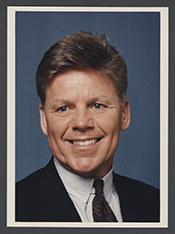
Historical · U.S. House · California · District 18
Gary Condit
Former U.S. Representative · California District 18 · 1989–2003 · Democratic
Gary Condit represented California's District 18 in the United States House of Representatives (1989–2003) for the Democratic party. The page below collects sourced biographical facts, term history, committee roles, and provenance for Condit.
Bioguide ID: C000670
Key facts
- Full name
- Gary Condit
- State
- California
- District
- District 18
- Party
- Democratic
- House service
- 1989–2003
- First House term
- 1989
- Status
- Left office
- Current term ends
- —
- Born
- 1948
- Bioguide ID
- C000670
- Committee assignments
- —
- Dataset version
- 1.20260605
Biographical narrative
1,006 words · sourced from the Wikipedia REST extract
Gary A. Condit is a former American politician who served as a Democratic U.S. Representative for California's 18th congressional district from 1989 until 2003. His political career was marked by a series of elections that saw him re-elected multiple times, but he gained significant national attention due to a scandal involving the disappearance of Chandra Levy, a young intern with whom he had an extramarital affair. This incident overshadowed his legislative work and ultimately contributed to his defeat in the 2002 Democratic primary.
Early life and career
Gary A. Condit was born on April 21, 1948, in Salina, Oklahoma, to Adrian Burl Condit and Velma Jean Tidwell. His father was a Baptist minister, which influenced Condit's upbringing in a religious household. He was raised in Oklahoma and completed his education at Nathan Hale High School in Tulsa. During his high school years, Condit worked in the oil fields of Oklahoma, gaining early work experience.
In 1967, Condit's family relocated to California when his father became the pastor of a Baptist church near Modesto. Following the move, Condit enrolled at Modesto Junior College, where he earned an Associate of Arts degree in 1970. He continued his education at California State University, Stanislaus, graduating with a Bachelor of Arts degree in 1972. Throughout his college years and early career, Condit held various jobs, including positions at a tomato cannery, a munitions factory during the Vietnam War, and in the paint department of a Montgomery Ward store.
Condit's political career began at the local level when he was elected to the Ceres City Council in 1972. He served on the council until 1976, during which time he was elected mayor, becoming the youngest individual to hold that position in the city's history at the age of 25. Following his tenure as mayor, Condit served on the Stanislaus County Board of Supervisors from 1976 to 1982. His political journey continued when he was elected to the California State Assembly in 1982, where he became known for his involvement in various legislative initiatives.
In 1988, Condit was part of a group known as the "Gang of Five," which attempted to unseat Willie Brown as Speaker of the State Assembly. Although their efforts were unsuccessful, this experience contributed to his growing prominence in California politics.
House tenure
Condit was elected to the U.S. House of Representatives in a special election in 1989, following the resignation of House Democratic Whip Tony Coelho. He successfully secured a full term in the 1990 general election and was re-elected five additional times, often without facing significant opposition. Notably, he did not have a Republican challenger during the general elections of 1992 and 1998, reflecting his strong support within his district.
During his time in Congress, Condit served on several important committees, with his most significant role being a senior member of the House Intelligence Committee. This position placed him at the forefront of national security issues, particularly in the lead-up to the September 11 attacks. Condit's political stance was somewhat more conservative than many of his Democratic colleagues from California, aligning him with the Blue Dog Democrats. He often voted against President Bill Clinton on various issues, demonstrating a willingness to break from party lines.
Condit's legislative record included opposition to the North American Free Trade Agreement (NAFTA), despite pressure from constituents in the wine industry and from the Clinton administration. He also voted against the repeal of Glass-Steagall protections, as well as against military interventions in Iraq and Kosovo. Following the conflict in Kosovo, Condit was an advocate for the prosecution of Slobodan Milošević, emphasizing his commitment to accountability in international affairs.
In the late 1990s, Condit gained further visibility during the Monica Lewinsky scandal, where he publicly urged President Clinton to be transparent about his relationship with Lewinsky. Ironically, this call for honesty came as Condit himself was embroiled in a scandal related to his affair with Chandra Levy, an intern with the Federal Bureau of Prisons.
Following the September 11 attacks in 2001, Condit maintained his position on the Intelligence Committee and retained access to sensitive information regarding national security. However, the media scrutiny surrounding the Levy case intensified, overshadowing his legislative work. On December 7, 2001, Condit announced his intention to run for re-election, but he faced significant challenges due to the ongoing scandal.
In March 2002, Condit lost the Democratic primary to Dennis Cardoza, a former aide, marking the end of his congressional career. His final months in office included a notable vote against the resolution to expel Congressman James Traficant, who had been convicted on corruption charges.
Legislative focus and committees
Throughout his tenure in the U.S. House of Representatives, Condit's legislative focus reflected a blend of local and national concerns. His position on the House Intelligence Committee allowed him to engage with critical issues related to national security, intelligence gathering, and counterterrorism. This role was particularly significant in the context of the post-9/11 environment, where intelligence oversight became a focal point for Congress.
Condit's voting record demonstrated a commitment to certain progressive populist principles, despite his more conservative leanings on some issues. His opposition to NAFTA highlighted his willingness to prioritize local economic interests over broader party lines. Additionally, his votes against military interventions in Iraq and Kosovo illustrated his skepticism regarding U.S. military engagement abroad, aligning him with a more isolationist perspective within the Democratic Party.
As a member of the House, Condit was involved in various legislative initiatives and discussions, contributing to debates on issues ranging from economic policy to social welfare. His background in local government and county supervision informed his approach to federal legislation, as he often sought to balance the needs of his constituents with national priorities.
Condit's career in Congress came to an end in January 2003, concluding a notable, albeit controversial, chapter in his political life. His legacy is marked by both his legislative contributions and the significant media attention surrounding his personal life, particularly the scandal involving Chandra Levy, which ultimately impacted his political trajectory and public perception.
Notable legislation
Sponsored and co-sponsored legislation for Gary Condit is pending operator curation. The biographical narrative above carries the same provenance trail until per-bill rows are written.
Sources
- [1]https://en.wikipedia.org/wiki/Gary_ConditWikipedia · retrieved 2026-06-05
Notable quotes
Sourced quotes for Gary Condit are pending operator curation. Narrative-scope provenance remains attached below.
Sources
- [1]https://en.wikipedia.org/wiki/Gary_ConditWikipedia · retrieved 2026-06-05
Key positions
Curated policy positions for Gary Condit are pending operator review. The biographical narrative above carries the same provenance trail until per-topic positions are written.
Sources
- [1]https://en.wikipedia.org/wiki/Gary_ConditWikipedia · retrieved 2026-06-05
Terms served
- 1989–1991U.S. House · Term 1 · Democratic
- 1991–1993U.S. House · Term 2 · Democratic
- 1993–1995U.S. House · Term 3 · Democratic
- 1995–1997U.S. House · Term 4 · Democratic
- 1997–1999U.S. House · Term 5 · Democratic
- 1999–2001U.S. House · Term 6 · Democratic
- 2001–2003U.S. House · Term 7 · Democratic
Sources & provenance
Every attributable claim above carries a per-section [N] marker that resolves to the corresponding URL below. Each entry records the upstream provider, the canonical URL, and the timestamp at which the source was retrieved by the ingest pipeline.
Key facts
- https://bioguide.congress.gov/search/bio/C000670bioguide · retrieved 2026-06-05
- https://www.govtrack.us/congress/members/400505govtrack · retrieved 2026-06-05
Biographical narrative
- https://en.wikipedia.org/wiki/Gary_Conditwikipedia · retrieved 2026-06-05
Find your representative
Every U.S. state elects representatives by district. Browse California’s delegation, the full former-representative roster, or explore the role and term length.
Related on The Candidate
- Preceded by William KetchumEarlier holder of the California District 18 House seat · Republican.Open
- Succeeded by Dennis CardozaLater holder of the California District 18 House seat · Democratic.Open
- Barclay HenleyFormer U.S. Representative · California District 1 · DemocraticOpen
- Charles ClaytonFormer U.S. Representative · California District 1 · RepublicanOpen
- Clarence LeaFormer U.S. Representative · California District 1 · DemocraticOpen
- Clement MillerFormer U.S. Representative · California District 1 · DemocraticOpen