
Historical · U.S. House · California · District 33
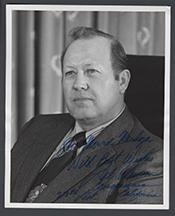
Delwin Clawson
Former U.S. Representative · California District 33 · 1963–1979 · Republican
Delwin Clawson represented California's District 33 in the United States House of Representatives (1963–1979) for the Republican party. The page below collects sourced biographical facts, term history, committee roles, and provenance for Clawson.
Bioguide ID: C000476
Key facts
- Full name
- Delwin Clawson
- State
- California
- District
- District 33
- Party
- Republican
- House service
- 1963–1979
- First House term
- 1963
- Status
- Left office
- Current term ends
- —
- Born
- 1914
- Bioguide ID
- C000476
- Committee assignments
- —
- Dataset version
- 1.20260605
Biographical narrative
821 words · sourced from the Wikipedia REST extract
Del Clawson was an American politician who served as a U.S. Representative for California's 33rd congressional district from 1963 until 1979. A member of the Republican Party, Clawson's political career spanned over three decades, during which he held various local offices, including that of mayor of Compton, California. His tenure in the U.S. House of Representatives was marked by his election to eight consecutive terms, reflecting a significant level of support from his constituents. Clawson's background in local governance and his subsequent congressional service positioned him as a notable figure in California politics during the mid-20th century.
Early life and career
Delwin Morgan Clawson was born on January 11, 1914, in Thatcher, Arizona. His early education included attendance at Gila College, where he studied during the years 1933 and 1934. Following his time in college, Clawson transitioned into a career in housing management, becoming the manager of the Mutual Housing Association of Compton in 1947. This role allowed him to gain valuable experience in community organization and local governance, which would later inform his political career.
Clawson's entry into politics began at the local level. He was elected to the City Council of Compton, serving from 1953 to 1957. His work on the council provided him with insights into the needs and concerns of his community, laying the groundwork for his subsequent election as mayor of Compton. Clawson held the mayoral office from 1957 until 1963, during which time he focused on local issues and community development. His leadership in Compton helped establish his reputation as a dedicated public servant, ultimately leading to his candidacy for the U.S. House of Representatives.
House tenure
Clawson's congressional career began following the death of Clyde Doyle, the previous representative for California's 33rd congressional district. Clawson was elected as a Republican to the 88th Congress through a special election, marking the start of his long tenure in the House. He was subsequently reelected to seven additional terms, serving a total of eight terms in Congress until his retirement on January 3, 1979. His sustained electoral success indicated a strong connection with his constituents and a solidified position within the Republican Party.
During his time in the House, Clawson participated in various legislative activities and contributed to discussions on a range of issues pertinent to his district and the nation. His experience in local governance likely influenced his approach to federal legislation, as he sought to address both local and national concerns through his work in Congress. Clawson's ability to navigate the political landscape of the 1960s and 1970s was indicative of his adaptability and commitment to public service.
Legislative focus and committees
Throughout his tenure in the U.S. House of Representatives, Clawson's legislative focus encompassed a variety of issues relevant to his constituents and the broader American public. While specific details regarding the bills he sponsored or supported are not provided, it is common for members of Congress to engage in matters related to local economic development, education, healthcare, and infrastructure during this period. Given his background in housing management and local governance, it is likely that Clawson prioritized issues that directly impacted the communities he represented.
In addition to his legislative work, Clawson's involvement in committees would have played a significant role in shaping his contributions to Congress. Members of the House typically serve on various committees that align with their interests and the needs of their constituents. These committees are crucial for reviewing legislation, conducting hearings, and overseeing government activities. Clawson's experience as a mayor and city council member would have provided him with valuable insights into the workings of government, which he could leverage in committee discussions and decision-making processes.
Clawson's political career was also shaped by the broader context of American politics during the 1960s and 1970s. This era was marked by significant social and political change, including the civil rights movement, the Vietnam War, and various economic challenges. As a Republican representative, Clawson would have navigated these complex issues while advocating for policies that aligned with his party's platform and the interests of his constituents.
In summary, Del Clawson's career as a U.S. Representative was characterized by a commitment to public service that began at the local level and extended to the national stage. His background in housing management and local governance informed his approach to legislation and constituent services. Clawson's eight terms in Congress reflect a significant level of support from voters in California's 33rd district, and his work during this period contributed to the political landscape of the time. After retiring from Congress, Clawson's legacy continued to be felt in the communities he served, and he remained a figure of interest in California's political history.
Clawson passed away on May 5, 1992, in Downey, California. His life and career remain a part of the historical narrative of American politics, particularly as it pertains to the evolution of local governance and representation in the U.S. Congress.
Notable legislation
Sponsored and co-sponsored legislation for Delwin Clawson is pending operator curation. The biographical narrative above carries the same provenance trail until per-bill rows are written.
Sources
- [1]https://en.wikipedia.org/wiki/Del_M._ClawsonWikipedia · retrieved 2026-06-05
Notable quotes
Sourced quotes for Delwin Clawson are pending operator curation. Narrative-scope provenance remains attached below.
Sources
- [1]https://en.wikipedia.org/wiki/Del_M._ClawsonWikipedia · retrieved 2026-06-05
Key positions
Curated policy positions for Delwin Clawson are pending operator review. The biographical narrative above carries the same provenance trail until per-topic positions are written.
Sources
- [1]https://en.wikipedia.org/wiki/Del_M._ClawsonWikipedia · retrieved 2026-06-05
Terms served
- 1963–1965U.S. House · Term 1 · Republican
- 1965–1967U.S. House · Term 2 · Republican
- 1967–1969U.S. House · Term 3 · Republican
- 1969–1971U.S. House · Term 4 · Republican
- 1971–1973U.S. House · Term 5 · Republican
- 1973–1975U.S. House · Term 6 · Republican
- 1975–1977U.S. House · Term 7 · Republican
- 1977–1979U.S. House · Term 8 · Republican
Sources & provenance
Every attributable claim above carries a per-section [N] marker that resolves to the corresponding URL below. Each entry records the upstream provider, the canonical URL, and the timestamp at which the source was retrieved by the ingest pipeline.
Key facts
- https://bioguide.congress.gov/search/bio/C000476bioguide · retrieved 2026-06-05
- https://www.govtrack.us/congress/members/402614govtrack · retrieved 2026-06-05
Biographical narrative
- https://en.wikipedia.org/wiki/Del_M._Clawsonwikipedia · retrieved 2026-06-05
Find your representative
Every U.S. state elects representatives by district. Browse California’s delegation, the full former-representative roster, or explore the role and term length.
Related on The Candidate
- Succeeded by Wayne GrishamLater holder of the California District 33 House seat · Republican.Open
- Barclay HenleyFormer U.S. Representative · California District 1 · DemocraticOpen
- Charles ClaytonFormer U.S. Representative · California District 1 · RepublicanOpen
- Clarence LeaFormer U.S. Representative · California District 1 · DemocraticOpen
- Clement MillerFormer U.S. Representative · California District 1 · DemocraticOpen
- Republican PartyFederal candidates and office holders on the Republican line.Open