
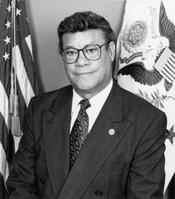
Historical · U.S. House · California · District 34
Esteban Torres
Former U.S. Representative · California District 34 · 1983–1999 · Democratic
Esteban Torres represented California's District 34 in the United States House of Representatives (1983–1999) for the Democratic party. The page below collects sourced biographical facts, term history, committee roles, and provenance for Torres.
Bioguide ID: T000316
Key facts
- Full name
- Esteban Torres
- State
- California
- District
- District 34
- Party
- Democratic
- House service
- 1983–1999
- First House term
- 1983
- Status
- Left office
- Current term ends
- —
- Born
- 1930
- Bioguide ID
- T000316
- Committee assignments
- —
- Dataset version
- 1.20260605
Biographical narrative
909 words · sourced from the Wikipedia REST extract
Esteban Edward Torres was an American politician who served as a member of the United States House of Representatives for California's 34th congressional district from 1983 until 1999. A member of the Democratic Party, Torres was known for his advocacy on issues affecting Hispanic communities and played a significant role in immigration reform during his tenure in Congress. His career spanned various roles, including labor leadership and diplomatic service, reflecting a commitment to public service and community engagement.
Early life and career
Esteban Edward Torres was born on January 27, 1930, in Miami, Arizona. He was raised in East Los Angeles, California, primarily by his mother, Rena Gómez, after his father, a miner, was deported to Mexico during the Mexican Repatriation of the 1930s. This early experience of hardship and displacement influenced Torres's later political and social advocacy, particularly regarding issues affecting the Hispanic community.
Torres pursued higher education, graduating from East Los Angeles College before attending California State University, Los Angeles. He furthered his education by taking graduate courses at the University of Maryland, College Park, and American University, which equipped him with the knowledge and skills that would later inform his political career.
In 1949, Torres enlisted in the United States Army, serving until 1953. His military service was a formative experience that contributed to his understanding of national and community issues. Following his time in the Army, he became involved in labor movements, particularly with the United Auto Workers (UAW). He rose through the ranks, ultimately serving as an international representative for the UAW from 1964 to 1968 in Washington, D.C. His work in labor advocacy laid the groundwork for his later political endeavors.
In addition to his labor activism, Torres held significant positions in the federal government. He was appointed as the United States Ambassador to the United Nations Educational, Scientific and Cultural Organization (UNESCO) in Paris, France, from 1977 to 1979. Following this role, he served as a special assistant to President Jimmy Carter from 1979 to 1981, where he further developed his understanding of policy-making and international relations.
Despite an unsuccessful bid for a congressional seat in 1974, Torres's political aspirations were realized when he was elected to the House of Representatives in 1982. His election marked the beginning of an impactful legislative career focused on the needs and rights of Hispanic Americans.
House tenure
Esteban Torres began his first term in the U.S. House of Representatives in 1983, representing California's 34th congressional district. Throughout his eight terms in office, which lasted until 1999, Torres was an active participant in legislative processes, advocating for policies that addressed the needs of his constituents and the broader Hispanic community.
During his tenure, Torres was particularly noted for his involvement in immigration reform. He played a key role in the development and passage of the Immigration Reform and Control Act in 1986, which aimed to address the status of undocumented immigrants in the United States. This legislation was significant in shaping immigration policy and reflected Torres's commitment to advocating for the rights of Hispanic individuals and families.
Torres's legislative focus extended beyond immigration issues. He worked on a variety of topics that were important to his constituents, including education, labor rights, and social justice. His background in labor activism informed his approach to economic issues, and he sought to promote policies that would benefit working families.
In 1998, Torres chose not to seek reelection, concluding his congressional career on January 3, 1999. He was succeeded by fellow Democrat Grace Napolitano. His decision to step down marked the end of a significant chapter in his life dedicated to public service and advocacy.
Legislative focus and committees
Throughout his time in the House, Esteban Torres served on various committees that aligned with his legislative priorities and expertise. His committee assignments allowed him to influence a range of issues, from labor and employment to education and social services. Torres's work on these committees was instrumental in shaping policies that affected not only his district but also had broader implications for the nation.
Torres's focus on immigration reform was a hallmark of his legislative agenda. He recognized the challenges faced by immigrant communities and worked to create pathways for legal status and integration into American society. His efforts in this area were part of a larger movement during the 1980s and 1990s aimed at addressing the complexities of immigration policy in the United States.
In addition to immigration, Torres was committed to issues related to education and economic opportunity. He advocated for increased funding for education and programs that supported the development of skills and job training for young people and adults alike. His background in labor also influenced his support for workers' rights and fair labor practices, reflecting his belief in the importance of economic justice.
After leaving Congress, Torres continued to engage in public service. He served on the California Transportation Commission from 1997 to 2007, where he contributed to discussions and decisions regarding transportation infrastructure in the state. His post-congressional career demonstrated his ongoing commitment to community service and public policy.
Esteban Edward Torres passed away on January 25, 2022, just two days before his 92nd birthday. His legacy includes his contributions to immigration reform, labor rights, and education, as well as his role as a prominent figure in the Hispanic community in the United States. His life and career reflect a dedication to public service and advocacy for those often marginalized in society.
Notable legislation
Sponsored and co-sponsored legislation for Esteban Torres is pending operator curation. The biographical narrative above carries the same provenance trail until per-bill rows are written.
Sources
- [1]https://en.wikipedia.org/wiki/Esteban_TorresWikipedia · retrieved 2026-06-05
Notable quotes
Sourced quotes for Esteban Torres are pending operator curation. Narrative-scope provenance remains attached below.
Sources
- [1]https://en.wikipedia.org/wiki/Esteban_TorresWikipedia · retrieved 2026-06-05
Key positions
Curated policy positions for Esteban Torres are pending operator review. The biographical narrative above carries the same provenance trail until per-topic positions are written.
Sources
- [1]https://en.wikipedia.org/wiki/Esteban_TorresWikipedia · retrieved 2026-06-05
Terms served
- 1983–1985U.S. House · Term 1 · Democratic
- 1985–1987U.S. House · Term 2 · Democratic
- 1987–1989U.S. House · Term 3 · Democratic
- 1989–1991U.S. House · Term 4 · Democratic
- 1991–1993U.S. House · Term 5 · Democratic
- 1993–1995U.S. House · Term 6 · Democratic
- 1995–1997U.S. House · Term 7 · Democratic
- 1997–1999U.S. House · Term 8 · Democratic
Sources & provenance
Every attributable claim above carries a per-section [N] marker that resolves to the corresponding URL below. Each entry records the upstream provider, the canonical URL, and the timestamp at which the source was retrieved by the ingest pipeline.
Key facts
- https://bioguide.congress.gov/search/bio/T000316bioguide · retrieved 2026-06-05
- https://www.govtrack.us/congress/members/410889govtrack · retrieved 2026-06-05
Biographical narrative
- https://en.wikipedia.org/wiki/Esteban_Torreswikipedia · retrieved 2026-06-05
Find your representative
Every U.S. state elects representatives by district. Browse California’s delegation, the full former-representative roster, or explore the role and term length.
Related on The Candidate
- Preceded by Mark HannafordEarlier holder of the California District 34 House seat · Democratic.Open
- Barclay HenleyFormer U.S. Representative · California District 1 · DemocraticOpen
- Charles ClaytonFormer U.S. Representative · California District 1 · RepublicanOpen
- Clarence LeaFormer U.S. Representative · California District 1 · DemocraticOpen
- Clement MillerFormer U.S. Representative · California District 1 · DemocraticOpen
- Democratic PartyFederal candidates and office holders on the Democratic line.Open