
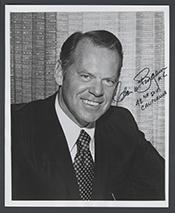
Historical · U.S. House · California · District 43
Clair Burgener
Former U.S. Representative · California District 43 · 1973–1983 · Republican
Clair Burgener represented California's District 43 in the United States House of Representatives (1973–1983) for the Republican party. The page below collects sourced biographical facts, term history, committee roles, and provenance for Burgener.
Bioguide ID: B001080
Key facts
- Full name
- Clair Burgener
- State
- California
- District
- District 43
- Party
- Republican
- House service
- 1973–1983
- First House term
- 1973
- Status
- Left office
- Current term ends
- —
- Born
- 1921
- Bioguide ID
- B001080
- Committee assignments
- —
- Dataset version
- 1.20260605
Biographical narrative
981 words · sourced from the Wikipedia REST extract
Clair W. Burgener was an American politician and World War II veteran who served as a Republican member of the U.S. House of Representatives for California's 43rd congressional district from 1973 until 1983. Known for his conservative voting record, Burgener was also recognized for his willingness to collaborate with members of the opposing party to advance local interests. His political career was marked by significant contributions to civic affairs, particularly in the realm of education for individuals with intellectual disabilities.
Early life and career
Clair Walter Burgener was born on December 5, 1921, in Vernal, Utah. He spent his formative years in both Vernal and Salt Lake City, where he was raised in a Latter-day Saint household. His early life was characterized by a strong sense of community and service, which would later influence his political career.
During World War II, Burgener served in the Army Air Corps as a navigator in the Pacific theater. He achieved the rank of second lieutenant and was awarded the Air Medal in 1945 for his service. Following the conclusion of World War II, he was recalled to serve in the Air Force during the Korean War, further solidifying his commitment to public service.
After his military service, Burgener pursued higher education and graduated from San Diego State College with a Bachelor of Arts degree in liberal arts. In the early 1950s, he worked as a realtor alongside his brother, which provided him with insights into the local economy and community needs. Additionally, Burgener had a brief stint in the performing arts, notably appearing on stage at the Old Globe Theatre in Balboa Park, where he played the character Elwood P. Dowd in the play "Harvey" for a 33-day run.
Burgener's entry into politics was somewhat serendipitous. At a social gathering, he received an unsolicited offer of financial support from an oilman, which prompted him to consider a political career. However, he returned the check, believing it would be inappropriate to accept such a large sum from a single out-of-state donor. This decision reflected his ethical stance and commitment to integrity in public service.
House tenure
Burgener's political career began in earnest when he was elected to the San Diego City Council in 1953, a position he held until 1957. During his time on the council, he advocated for the development of Mission Bay Park, although he later described this role as one of the least enjoyable experiences of his career. Following his tenure on the city council, Burgener was elected to the California State Assembly, where he served from 1963 to 1967. He then moved on to the California State Senate, serving from 1967 until 1973. Burgener regarded his years in the State Capitol as some of the most productive and fulfilling of his career, particularly highlighting his efforts in 1963 to pass legislation that mandated classroom training for intellectually disabled students.
In 1972, Burgener successfully ran for a seat in the U.S. House of Representatives, representing California's 43rd congressional district. He was re-elected four times, serving a total of five terms in Congress until his retirement in 1983. Throughout his congressional tenure, Burgener maintained a predominantly conservative voting record. However, he was known for his willingness to work across party lines, particularly with Democratic Congressman Lionel Van Deerlin, to address issues pertinent to the San Diego area.
One notable moment in Burgener's political career occurred during the 1980 election cycle when he faced a challenging opponent in the Democratic primary. The candidate, Tom Metzger, a leader of the Ku Klux Klan, garnered significant attention, leading to widespread disavowal from Democratic leaders, including then-Governor Jerry Brown. Burgener capitalized on this situation by highlighting Metzger's controversial statements and positions, ultimately winning re-election with a substantial majority of the vote, which set a record for the highest percentage received in a House race at that time.
In 1982, Burgener chose not to seek re-election, concluding his congressional career after a decade of service. His decision to retire marked the end of an era in which he had made significant contributions to both local and national politics.
Legislative focus and committees
During his time in the U.S. House of Representatives, Clair Burgener was involved in various legislative initiatives and served on several committees that aligned with his interests and the needs of his constituents. His legislative focus included issues related to education, particularly for individuals with disabilities, as well as local infrastructure and community development.
Burgener's commitment to education was evident in his advocacy for policies that supported the needs of intellectually disabled children. This focus was deeply personal for him, as his own son, Rod, was diagnosed with a developmental disability. Following his congressional career, Burgener became a prominent advocate for the rights and education of individuals with intellectual disabilities, leading various organizations and initiatives aimed at improving their quality of life.
In Congress, Burgener's work often intersected with local interests, as he sought to address the unique challenges faced by the San Diego community. His collaborative approach allowed him to build relationships with members of both parties, which facilitated the passage of legislation beneficial to his constituents.
Burgener's legacy extended beyond his time in office. After retiring from Congress, he remained active in civic and political affairs, serving as a Regent of the University of California from 1988 to 1997. His contributions to education and advocacy for the developmentally disabled were recognized through the establishment of the Clair Burgener Foundation for the Developmentally Disabled, which aimed to support families and individuals affected by similar challenges.
Clair W. Burgener passed away on September 9, 2006, in Encinitas, California. He left behind a legacy of public service characterized by his dedication to education, community development, and advocacy for those with disabilities. His contributions to both local and national politics continue to be remembered and honored through various institutions and initiatives established in his name.
Notable legislation
Sponsored and co-sponsored legislation for Clair Burgener is pending operator curation. The biographical narrative above carries the same provenance trail until per-bill rows are written.
Sources
- [1]https://en.wikipedia.org/wiki/Clair_BurgenerWikipedia · retrieved 2026-06-05
Notable quotes
Sourced quotes for Clair Burgener are pending operator curation. Narrative-scope provenance remains attached below.
Sources
- [1]https://en.wikipedia.org/wiki/Clair_BurgenerWikipedia · retrieved 2026-06-05
Key positions
Curated policy positions for Clair Burgener are pending operator review. The biographical narrative above carries the same provenance trail until per-topic positions are written.
Sources
- [1]https://en.wikipedia.org/wiki/Clair_BurgenerWikipedia · retrieved 2026-06-05
Terms served
- 1973–1975U.S. House · Term 1 · Republican
- 1975–1977U.S. House · Term 2 · Republican
- 1977–1979U.S. House · Term 3 · Republican
- 1979–1981U.S. House · Term 4 · Republican
- 1981–1983U.S. House · Term 5 · Republican
Sources & provenance
Every attributable claim above carries a per-section [N] marker that resolves to the corresponding URL below. Each entry records the upstream provider, the canonical URL, and the timestamp at which the source was retrieved by the ingest pipeline.
Key facts
- https://bioguide.congress.gov/search/bio/B001080bioguide · retrieved 2026-06-05
- https://www.govtrack.us/congress/members/402026govtrack · retrieved 2026-06-05
Biographical narrative
- https://en.wikipedia.org/wiki/Clair_Burgenerwikipedia · retrieved 2026-06-05
Find your representative
Every U.S. state elects representatives by district. Browse California’s delegation, the full former-representative roster, or explore the role and term length.
Related on The Candidate
- Succeeded by Joe BacaLater holder of the California District 43 House seat · Democratic.Open
- Barclay HenleyFormer U.S. Representative · California District 1 · DemocraticOpen
- Charles ClaytonFormer U.S. Representative · California District 1 · RepublicanOpen
- Clarence LeaFormer U.S. Representative · California District 1 · DemocraticOpen
- Clement MillerFormer U.S. Representative · California District 1 · DemocraticOpen
- Republican PartyFederal candidates and office holders on the Republican line.Open