
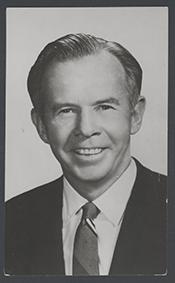
Historical · U.S. House · California · District 43
Victor Veysey
Former U.S. Representative · California District 43 · 1971–1975 · Republican
Victor Veysey represented California's District 43 in the United States House of Representatives (1971–1975) for the Republican party. The page below collects sourced biographical facts, term history, committee roles, and provenance for Veysey.
Bioguide ID: V000093
Key facts
- Full name
- Victor Veysey
- State
- California
- District
- District 43
- Party
- Republican
- House service
- 1971–1975
- First House term
- 1971
- Status
- Left office
- Current term ends
- —
- Born
- 1915
- Bioguide ID
- V000093
- Committee assignments
- —
- Dataset version
- 1.20260606
Biographical narrative
973 words · sourced from the Wikipedia REST extract
Victor Veysey was an American politician and member of the Republican Party who served as a U.S. Representative for California's 43rd congressional district from 1971 to 1975. His political career spanned various levels of government, including service in the California State Assembly and as Assistant Secretary of the Army under President Gerald Ford. Veysey's educational background in civil engineering and business administration, combined with his experience in academia and local governance, shaped his approach to public service and policy-making.
Early life and career
Victor Veysey was born on April 14, 1915, in Los Angeles, California. He spent his formative years in Brawley and Eagle Rock, California, where he completed his secondary education at Eagle Rock High School. Following high school, Veysey pursued higher education, earning a Bachelor of Science degree in civil engineering from the California Institute of Technology (Caltech) in 1936. He furthered his education by obtaining a Master of Business Administration (MBA) from Harvard University in 1938. In addition to these degrees, he engaged in graduate studies at Stanford University, which contributed to his comprehensive understanding of both engineering and business principles.
Veysey's professional career began in academia, where he served as a professor at Caltech from 1938 to 1940 and again from 1941 to 1946. During this time, he also held a teaching position at Stanford University for a brief period in 1940-1941. His academic roles allowed him to influence the next generation of engineers and business leaders, although he eventually transitioned from academia to a more hands-on approach to public service and community involvement.
In the late 1940s, Veysey relocated to the Imperial Valley, where he engaged in farming. This shift to agriculture not only connected him to the local economy but also provided him with firsthand experience of the challenges faced by farmers and agricultural workers in the region. His involvement in farming would later inform his political perspectives and priorities, particularly regarding agricultural policies and rural development.
Veysey's commitment to public service was evident early in his career. He became a member of the Brawley School Board in 1955, where he contributed to local educational governance. His dedication to education continued as he joined the Imperial Valley College Board in 1960. Additionally, he served on the U.S. Department of Agriculture Advisory Commission in 1959, further solidifying his engagement with agricultural issues and his understanding of federal policies affecting local communities.
House tenure
Victor Veysey's political career at the state level culminated in his election to the California State Assembly, where he represented the 75th district from 1963 until 1971. His tenure in the Assembly allowed him to gain valuable legislative experience and establish a network of political connections. During this period, he focused on various issues pertinent to his constituents, including education, agriculture, and infrastructure.
In 1970, Veysey successfully ran for a seat in the U.S. House of Representatives, representing California's 43rd congressional district. His election marked the beginning of his two terms in Congress, which lasted until 1975. During his time in the House, Veysey was involved in a range of legislative activities and served as a delegate to the 1972 Republican National Convention. His participation in the convention underscored his active role in the Republican Party and his commitment to its principles.
Veysey's congressional career coincided with a tumultuous period in American politics, particularly during the Watergate scandal. In 1974, he faced a challenging re-election campaign, ultimately losing to Democratic candidate James F. Lloyd, the Mayor of West Covina. The narrow defeat reflected the shifting political landscape of the time, as many incumbents faced difficulties in the wake of the scandal.
Following his congressional tenure, Veysey continued to serve in public office. From 1975 to 1977, he was appointed as Assistant Secretary for Civil Works in the U.S. Army under President Gerald Ford. In this role, he was responsible for overseeing various civil works projects and initiatives, further expanding his influence in federal governance.
Legislative focus and committees
During his time in the U.S. House of Representatives, Victor Veysey's legislative focus encompassed a variety of issues, particularly those relevant to his constituents in California. His background in civil engineering and business likely informed his approach to infrastructure and economic development. Veysey's experience in agriculture also positioned him to advocate for policies that supported farmers and rural communities, reflecting the needs of the Imperial Valley, where he had spent much of his life.
While specific details about the committees on which Veysey served are not provided, it can be inferred that his expertise in engineering and business would have made him a valuable member of committees related to transportation, infrastructure, and economic affairs. These areas are critical to the development and maintenance of public works and services, which are essential for the growth and sustainability of communities.
Veysey's involvement in education and local governance likely influenced his legislative priorities as well. His earlier roles on school boards and educational committees would have given him insight into the challenges faced by educational institutions, allowing him to advocate for policies that supported education funding and resources.
After leaving Congress, Veysey continued to contribute to public service in California. In 1983, he was appointed Secretary for Industrial Relations for the State of California, a position that allowed him to influence labor policies and workforce development initiatives. His extensive experience in both state and federal government provided him with a unique perspective on the intersection of labor, industry, and public policy.
Victor Veysey passed away on February 13, 2001, in Hemet, California. He is buried at Riverview Cemetery in Brawley, California, a community that played a significant role in his life and career. His legacy as a public servant and his contributions to California's political landscape continue to be recognized by those who remember his work in both the state assembly and the U.S. House of Representatives.
Notable legislation
Sponsored and co-sponsored legislation for Victor Veysey is pending operator curation. The biographical narrative above carries the same provenance trail until per-bill rows are written.
Sources
- [1]https://en.wikipedia.org/wiki/Victor_VeyseyWikipedia · retrieved 2026-06-06
Notable quotes
Sourced quotes for Victor Veysey are pending operator curation. Narrative-scope provenance remains attached below.
Sources
- [1]https://en.wikipedia.org/wiki/Victor_VeyseyWikipedia · retrieved 2026-06-06
Key positions
Curated policy positions for Victor Veysey are pending operator review. The biographical narrative above carries the same provenance trail until per-topic positions are written.
Sources
- [1]https://en.wikipedia.org/wiki/Victor_VeyseyWikipedia · retrieved 2026-06-06
Terms served
- 1971–1973U.S. House · Term 1 · Republican
- 1973–1975U.S. House · Term 2 · Republican
Sources & provenance
Every attributable claim above carries a per-section [N] marker that resolves to the corresponding URL below. Each entry records the upstream provider, the canonical URL, and the timestamp at which the source was retrieved by the ingest pipeline.
Key facts
- https://bioguide.congress.gov/search/bio/V000093bioguide · retrieved 2026-06-06
- https://www.govtrack.us/congress/members/411148govtrack · retrieved 2026-06-06
Biographical narrative
- https://en.wikipedia.org/wiki/Victor_Veyseywikipedia · retrieved 2026-06-06
Find your representative
Every U.S. state elects representatives by district. Browse California’s delegation, the full former-representative roster, or explore the role and term length.
Related on The Candidate
- Succeeded by Joe BacaLater holder of the California District 43 House seat · Democratic.Open
- Barclay HenleyFormer U.S. Representative · California District 1 · DemocraticOpen
- Charles ClaytonFormer U.S. Representative · California District 1 · RepublicanOpen
- Clarence LeaFormer U.S. Representative · California District 1 · DemocraticOpen
- Clement MillerFormer U.S. Representative · California District 1 · DemocraticOpen
- Republican PartyFederal candidates and office holders on the Republican line.Open