
Historical · U.S. House · California · District 48
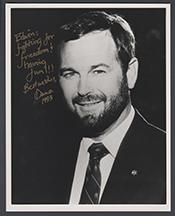
Dana Rohrabacher
Former U.S. Representative · California District 48 · 1989–2019 · Republican
Dana Rohrabacher represented California's District 48 in the United States House of Representatives (1989–2019) for the Republican party. The page below collects sourced biographical facts, term history, committee roles, and provenance for Rohrabacher.
Bioguide ID: R000409
Key facts
- Full name
- Dana Rohrabacher
- State
- California
- District
- District 48
- Party
- Republican
- House service
- 1989–2019
- First House term
- 1989
- Status
- Left office
- Current term ends
- —
- Born
- 1947
- Bioguide ID
- R000409
- Committee assignments
- —
- Dataset version
- 1.20260605
Biographical narrative
906 words · sourced from the Wikipedia REST extract
Dana Tyrone Rohrabacher is a former American politician who served as a U.S. Representative for California's 48th congressional district from 1989 until 2019. A member of the Republican Party, Rohrabacher's tenure in the House of Representatives spanned 15 terms, during which he became known for his distinctive political positions, particularly regarding foreign policy and his views on Russia. His political career concluded when he was defeated by Democrat Harley Rouda in the 2018 election.
Early life and career
Dana Rohrabacher was born on June 21, 1947, in Coronado, California. He was raised in a family that included his parents, Doris M. (née Haring) and Donald Tyler Rohrabacher, and an older brother, Kim, who lived from 1944 until 2007. Rohrabacher completed his secondary education at Palos Verdes High School in Palos Verdes Estates, California, before pursuing higher education. He attended Los Angeles Harbor College and later earned a bachelor's degree in history from California State University, Long Beach in 1969. Subsequently, he obtained a master's degree in American Studies from the University of Southern California.
In the early stages of his career, Rohrabacher engaged in various activities, including a brief stint as a folk singer during his time in graduate school. He also worked as a writer for the Orange County Register, where he began to develop his voice in media and public discourse. His political career took a significant turn when he served as assistant press secretary to Ronald Reagan during both the 1976 and 1980 presidential campaigns. Following these campaigns, he was appointed as a speechwriter and special assistant to President Reagan from 1981 to 1988. In this role, Rohrabacher played a pivotal part in shaping the Reagan Doctrine, which guided U.S. foreign policy during the latter part of the Cold War.
House tenure
Rohrabacher's political journey in the U.S. House of Representatives began when he left the Reagan administration in 1988 to run for the seat vacated by Dan Lungren. He campaigned on his close ties to President Reagan and garnered support from notable figures, including Lt. Col. Oliver North, associated with the Iran-Contra affair. In the Republican primary, he secured a plurality of votes, winning with 35%. He subsequently won the general election with a significant majority, receiving 64% of the vote.
Throughout his time in Congress, Rohrabacher faced varying levels of competition. In 1992, he won a three-candidate primary election with a plurality of 48%. His position was further solidified in 1998 when he won an open primary with 54% of the vote. Over the years, he continued to secure re-election, defeating Democratic opponents in several elections, including Debbie Cook in 2008 and Ken Arnold in 2010, with margins of 53-43% and 62-38%, respectively. Following redistricting in 2012, he announced his candidacy for the newly drawn 48th Congressional District, where he won with 61% of the vote. He continued to win re-election in 2014 and 2016, with 64% and 59% of the vote, respectively.
However, Rohrabacher's political career faced a significant challenge in 2018 when he was defeated by Democrat Harley Rouda. The election results indicated a shift in the political landscape, with Rouda receiving 53.6% of the vote. This defeat marked the end of Rohrabacher's 30-year tenure in the House of Representatives.
Legislative focus and committees
During his time in Congress, Rohrabacher was known for his distinctive legislative focus, which often centered on foreign policy, particularly regarding Russia. His views on Russia and its leadership, especially under President Vladimir Putin, garnered significant attention and controversy. Rohrabacher's strong pro-Russia stance led to him being characterized by some media outlets as "Putin's favorite congressman." His relationships and opinions raised questions about his connections to Russian officials and the implications of his foreign policy positions.
In addition to his foreign policy interests, Rohrabacher's tenure was marked by various legislative initiatives and committee assignments. He was involved in discussions surrounding national security, foreign relations, and issues related to the military. His approach to legislation often reflected his background in the Reagan administration, emphasizing a strong national defense and a critical stance toward perceived adversaries.
Throughout his congressional career, Rohrabacher faced scrutiny for several incidents, including a conviction related to campaign finance violations in the 1990s. He was found guilty of improper use of campaign contributions, which involved financing a decoy Democratic candidate to siphon votes from another Democratic contender. This conviction resulted in a fine of $50,000.
In 2011, during a visit to Iraq, Rohrabacher made headlines for his comments regarding the financial obligations of Iraq to the United States, suggesting that Iraq should repay the U.S. for expenditures related to the Iraq War. His delegation faced challenges during this visit, including being denied access to a site of interest by the Iraqi government.
In 2012, Rohrabacher received a warning from the FBI regarding potential attempts by Russian spies to recruit him as an "agent of influence." This warning followed a private meeting he had with a member of the Russian foreign ministry in Moscow, highlighting the complexities of his foreign policy engagements.
Throughout his lengthy career in the House of Representatives, Rohrabacher's legislative focus and committee work reflected his commitment to his constituents and his party's principles. His tenure was characterized by a blend of traditional Republican values and a unique approach to foreign policy, particularly in relation to Russia and national security issues. His departure from Congress in 2019 marked the conclusion of a significant chapter in California's political landscape.
Notable legislation
Sponsored and co-sponsored legislation for Dana Rohrabacher is pending operator curation. The biographical narrative above carries the same provenance trail until per-bill rows are written.
Sources
- [1]https://en.wikipedia.org/wiki/Dana_RohrabacherWikipedia · retrieved 2026-06-05
Notable quotes
Sourced quotes for Dana Rohrabacher are pending operator curation. Narrative-scope provenance remains attached below.
Sources
- [1]https://en.wikipedia.org/wiki/Dana_RohrabacherWikipedia · retrieved 2026-06-05
Key positions
Curated policy positions for Dana Rohrabacher are pending operator review. The biographical narrative above carries the same provenance trail until per-topic positions are written.
Sources
- [1]https://en.wikipedia.org/wiki/Dana_RohrabacherWikipedia · retrieved 2026-06-05
Terms served
- 1989–1991U.S. House · Term 1 · Republican
- 1991–1993U.S. House · Term 2 · Republican
- 1993–1995U.S. House · Term 3 · Republican
- 1995–1997U.S. House · Term 4 · Republican
- 1997–1999U.S. House · Term 5 · Republican
- 1999–2001U.S. House · Term 6 · Republican
- 2001–2003U.S. House · Term 7 · Republican
- 2003–2005U.S. House · Term 8 · Republican
- 2005–2007U.S. House · Term 9 · Republican
- 2007–2009U.S. House · Term 10 · Republican
- 2009–2011U.S. House · Term 11 · Republican
- 2011–2013U.S. House · Term 12 · Republican
- 2013–2015U.S. House · Term 13 · Republican
- 2015–2017U.S. House · Term 14 · Republican
- 2017–2019U.S. House · Term 15 · Republican
Sources & provenance
Every attributable claim above carries a per-section [N] marker that resolves to the corresponding URL below. Each entry records the upstream provider, the canonical URL, and the timestamp at which the source was retrieved by the ingest pipeline.
Key facts
- https://bioguide.congress.gov/search/bio/R000409bioguide · retrieved 2026-06-05
- https://rohrabacher.house.govhouse.gov · retrieved 2026-06-05
Biographical narrative
- https://en.wikipedia.org/wiki/Dana_Rohrabacherwikipedia · retrieved 2026-06-05
Find your representative
Every U.S. state elects representatives by district. Browse California’s delegation, the full former-representative roster, or explore the role and term length.
Related on The Candidate
- Succeeded by Harley RoudaLater holder of the California District 48 House seat · Democratic.Open
- Barclay HenleyFormer U.S. Representative · California District 1 · DemocraticOpen
- Charles ClaytonFormer U.S. Representative · California District 1 · RepublicanOpen
- Clarence LeaFormer U.S. Representative · California District 1 · DemocraticOpen
- Clement MillerFormer U.S. Representative · California District 1 · DemocraticOpen
- Republican PartyFederal candidates and office holders on the Republican line.Open