
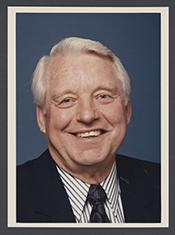
Historical · U.S. House · California · District 48
Ron Packard
Former U.S. Representative · California District 48 · 1983–2001 · Republican
Ron Packard represented California's District 48 in the United States House of Representatives (1983–2001) for the Republican party. The page below collects sourced biographical facts, term history, committee roles, and provenance for Packard.
Bioguide ID: P000005
Key facts
- Full name
- Ron Packard
- State
- California
- District
- District 48
- Party
- Republican
- House service
- 1983–2001
- First House term
- 1983
- Status
- Left office
- Current term ends
- —
- Born
- 1931
- Bioguide ID
- P000005
- Committee assignments
- —
- Dataset version
- 1.20260605
Biographical narrative
838 words · sourced from the Wikipedia REST extract
Ron Packard is a retired American politician who served as a Republican member of the U.S. House of Representatives for California's 48th congressional district from 1983 until 2001. Known for his unique entry into Congress as a write-in candidate, Packard's political career spanned nearly two decades, during which he was re-elected multiple times in a predominantly Republican district. His tenure in the House was marked by his involvement in various legislative committees and a focus on issues pertinent to his constituents.
Early life and career
Ron Packard was born on January 19, 1931, in Meridian, Idaho. He completed his early education at Meridian High School before pursuing higher education at several institutions, including Brigham Young University, Portland State University, and the University of Oregon Dental School, where he earned a Doctor of Dental Medicine (D.M.D.) degree in 1957. Following his graduation, Packard served in the Navy Dental Corps from 1957 to 1959, gaining valuable experience in the military before transitioning to civilian life as a practicing dentist.
Packard's initial foray into politics began at the local level. He served as a trustee for the Carlsbad Unified School District in California from 1962 to 1974, where he engaged in educational governance and policy-making. In 1976, he was elected to the Carlsbad City Council, and two years later, he became the Mayor of Carlsbad. During his time as mayor, Packard was actively involved in community and regional affairs, contributing to transportation policy as a member of the League of California Cities' transportation policy committee. He also served as a director of the North County Transit District and held the position of President of the Council of Mayors for San Diego County, further solidifying his role in local governance.
House tenure
Packard's congressional career began in a notable fashion. In 1982, he initially lost the Republican primary for the U.S. House of Representatives to Johnnie R. Crean by a narrow margin. However, following this defeat, he launched a write-in campaign that garnered significant support. Utilizing a unique campaign strategy that included the distribution of golf pencils and the use of a large pencil as a prop, Packard successfully mobilized voters, particularly within the Mormon community. His efforts culminated in his election to Congress, where he received approximately 37 percent of the vote, defeating both Crean and the Democratic candidate, Roy "Pat" Archer.
Packard's victory as a write-in candidate was significant, as he became only the third individual in U.S. history to achieve such a feat in a congressional election. After being sworn in, he joined the Republican caucus and quickly established himself as a prominent figure in the House. Over the course of his nine terms, he faced minimal opposition in elections, reflecting the strong Republican leanings of his district.
During his tenure, Packard served on the House Appropriations Committee, which plays a critical role in determining federal spending and budgetary allocations. His involvement in this committee allowed him to influence funding decisions that affected various sectors, including education, transportation, and healthcare, aligning with the interests of his constituents.
Packard's congressional career lasted until January 3, 2001, when he retired from the House. He was succeeded by fellow Republican Darrell Issa, who continued to represent the 48th congressional district.
Legislative focus and committees
Throughout his time in Congress, Ron Packard's legislative focus was shaped by the needs and interests of his constituents in California's 48th district. His service on the House Appropriations Committee was particularly influential, as it provided him with the opportunity to advocate for funding and resources that would benefit his district. Packard's work on this committee allowed him to engage in discussions regarding budgetary priorities and federal spending, which were critical to addressing local issues.
Packard's legislative agenda often reflected the priorities of his Republican affiliation, emphasizing fiscal conservatism and limited government intervention. He was involved in various initiatives aimed at promoting economic growth, enhancing public safety, and improving education. His background as a dentist also informed his interest in healthcare-related legislation, where he sought to ensure that healthcare services were accessible and affordable for his constituents.
In addition to his work on the Appropriations Committee, Packard participated in various other committees and subcommittees during his time in office. His involvement in these groups allowed him to engage with a wide range of policy issues, from transportation to education, reflecting the diverse needs of his district.
After retiring from Congress, Packard remained a notable figure in his community. In recognition of his service, a U.S. Post Office building in Oceanside, California, was named in his honor in 2002. Additionally, a section of California State Route 78 was designated as Ronald Packard Parkway, further commemorating his contributions to the region.
Ron Packard's political career is characterized by his unique entry into Congress as a write-in candidate, his long tenure representing a predominantly Republican district, and his active involvement in legislative matters that impacted his constituents. His legacy continues to be recognized through various honors and the ongoing influence of his work in the House of Representatives.
Notable legislation
Sponsored and co-sponsored legislation for Ron Packard is pending operator curation. The biographical narrative above carries the same provenance trail until per-bill rows are written.
Sources
- [1]https://en.wikipedia.org/wiki/Ron_PackardWikipedia · retrieved 2026-06-05
Notable quotes
Sourced quotes for Ron Packard are pending operator curation. Narrative-scope provenance remains attached below.
Sources
- [1]https://en.wikipedia.org/wiki/Ron_PackardWikipedia · retrieved 2026-06-05
Key positions
Curated policy positions for Ron Packard are pending operator review. The biographical narrative above carries the same provenance trail until per-topic positions are written.
Sources
- [1]https://en.wikipedia.org/wiki/Ron_PackardWikipedia · retrieved 2026-06-05
Terms served
- 1983–1985U.S. House · Term 1 · Republican
- 1985–1987U.S. House · Term 2 · Republican
- 1987–1989U.S. House · Term 3 · Republican
- 1989–1991U.S. House · Term 4 · Republican
- 1991–1993U.S. House · Term 5 · Republican
- 1993–1995U.S. House · Term 6 · Republican
- 1995–1997U.S. House · Term 7 · Republican
- 1997–1999U.S. House · Term 8 · Republican
- 1999–2001U.S. House · Term 9 · Republican
Sources & provenance
Every attributable claim above carries a per-section [N] marker that resolves to the corresponding URL below. Each entry records the upstream provider, the canonical URL, and the timestamp at which the source was retrieved by the ingest pipeline.
Key facts
- https://bioguide.congress.gov/search/bio/P000005bioguide · retrieved 2026-06-05
- https://www.govtrack.us/congress/members/400601govtrack · retrieved 2026-06-05
Biographical narrative
- https://en.wikipedia.org/wiki/Ron_Packardwikipedia · retrieved 2026-06-05
Find your representative
Every U.S. state elects representatives by district. Browse California’s delegation, the full former-representative roster, or explore the role and term length.
Related on The Candidate
- Succeeded by Harley RoudaLater holder of the California District 48 House seat · Democratic.Open
- Barclay HenleyFormer U.S. Representative · California District 1 · DemocraticOpen
- Charles ClaytonFormer U.S. Representative · California District 1 · RepublicanOpen
- Clarence LeaFormer U.S. Representative · California District 1 · DemocraticOpen
- Clement MillerFormer U.S. Representative · California District 1 · DemocraticOpen
- Republican PartyFederal candidates and office holders on the Republican line.Open