
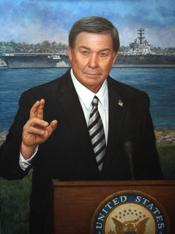
Historical · U.S. House · California · District 52
Duncan Hunter
Former U.S. Representative · California District 52 · 1981–2009 · Republican
Duncan Hunter represented California's District 52 in the United States House of Representatives (1981–2009) for the Republican party. The page below collects sourced biographical facts, term history, committee roles, and provenance for Hunter.
Bioguide ID: H000981
Key facts
- Full name
- Duncan Hunter
- State
- California
- District
- District 52
- Party
- Republican
- House service
- 1981–2009
- First House term
- 1981
- Status
- Left office
- Current term ends
- —
- Born
- 1948
- Bioguide ID
- H000981
- Committee assignments
- —
- Dataset version
- 1.20260605
Biographical narrative
860 words · sourced from the Wikipedia REST extract
Duncan Hunter is a retired American politician who served as a Republican member of the U.S. House of Representatives from California's 52nd, 45th, and 42nd congressional districts from 1981 until 2009. He is noted for his long tenure in Congress, during which he held significant positions, including chairman of the House Armed Services Committee. Hunter also sought the Republican nomination for President of the United States in 2008, although his campaign did not gain substantial traction. His political career concluded amid legal challenges that led to his guilty plea for misusing campaign funds.
Early life and career
Duncan Lee Hunter was born on May 31, 1948, in Riverside, California, to Lola Lee and Robert Olin Hunter. He completed his secondary education at Rubidoux High School in 1966. Following high school, he attended the University of Montana for a year before transferring briefly to the University of California, Santa Barbara. In 1969, he was commissioned into the United States Army, where he served in the Vietnam War as part of the Army Rangers' 75th Infantry Regiment, attached to the 173rd Airborne Brigade. His military service included participation in numerous helicopter assaults and reconnaissance patrols, and he achieved the rank of first lieutenant. For his service, he received several honors, including the Bronze Star and the Air Medal.
After returning from military service, Hunter utilized the G.I. Bill to further his education. He enrolled at the San Diego campus of the Western State University College of Law (now known as Thomas Jefferson School of Law) and earned both a Bachelor of Science in Law and a Juris Doctor by 1976. During his studies, he worked in farming and construction to support himself. He was admitted to the State Bar of California in December 1976 but has maintained inactive status since January 1983.
In 1973, Hunter married Lynne Layh. The couple had two sons: Duncan Duane Hunter, who served as a major in the United States Marine Corps Reserve, and Samuel Hunter. Duncan D. Hunter was elected to succeed his father in Congress in 2008. The family is affiliated with the First Baptist Church of Alpine, which is part of the San Diego Southern Baptist Association.
House tenure
Duncan Hunter's political career in the U.S. House of Representatives began in 1981 when he was elected to represent California's 42nd congressional district. He was initially considered an underdog against the long-serving Democratic incumbent Lionel Van Deerlin, who had held the seat for 18 years. Hunter's campaign focused on national defense issues, which resonated in a district with a significant military presence. His victory was part of a broader trend during the "Reagan revolution," where many Republicans gained seats in traditionally Democratic areas.
Following the 1980 census, Hunter's district underwent redistricting, which removed several Democratic-leaning areas, allowing him to secure re-election in subsequent terms with minimal opposition. Over his 14 terms in Congress, he faced only one significant electoral challenge, where he received just under 54 percent of the vote in 1992. His district was renumbered multiple times, becoming the 45th in 1983 and the 52nd in 1993.
In the 2006 general election, Hunter was re-elected with a substantial majority, receiving approximately 65 percent of the vote against his Democratic opponent and a Libertarian candidate. In March 2007, he announced that he would not seek a 15th term in 2008, as he was preparing to run for the Republican presidential nomination. His son, Duncan D. Hunter, subsequently announced his candidacy for the seat, and after being recalled to active duty, his wife campaigned on his behalf. Duncan D. Hunter won the Republican primary in June 2008 and later succeeded his father in Congress.
Legislative focus and committees
During his tenure in the House, Duncan Hunter was particularly focused on issues related to national defense and military affairs. He served as chairman of the House Armed Services Committee from 2002 to 2007, a position that allowed him to influence significant defense legislation. As chairman, he sponsored and oversaw the authorization of defense department activities for several fiscal years, including FY2004 through FY2007.
One notable aspect of his legislative work was his involvement in the FY2006 Defense Authorization Act, where he proposed an amendment that aimed to clarify policies regarding the participation of women in direct combat roles. This amendment sought to codify existing Army policies that restricted women from serving in combat units, although it was ultimately withdrawn to allow for further study on the matter.
In addition to his work on the Armed Services Committee, Hunter was involved in various legislative initiatives throughout his career. His focus on military and defense issues was reflective of the interests and demographics of his constituents, many of whom were connected to the military.
Hunter's congressional career came to an end amid legal troubles. In 2018, he and his wife were indicted for misusing campaign funds, which included expenditures on personal expenses. In December 2019, he pleaded guilty to one count of misusing campaign funds and was subsequently sentenced to 11 months in prison in March 2020. His departure from Congress marked the end of a lengthy and impactful political career that spanned nearly three decades.
Notable legislation
Sponsored and co-sponsored legislation for Duncan Hunter is pending operator curation. The biographical narrative above carries the same provenance trail until per-bill rows are written.
Sources
- [1]https://en.wikipedia.org/wiki/Duncan_L._HunterWikipedia · retrieved 2026-06-05
Notable quotes
Sourced quotes for Duncan Hunter are pending operator curation. Narrative-scope provenance remains attached below.
Sources
- [1]https://en.wikipedia.org/wiki/Duncan_L._HunterWikipedia · retrieved 2026-06-05
Key positions
Curated policy positions for Duncan Hunter are pending operator review. The biographical narrative above carries the same provenance trail until per-topic positions are written.
Sources
- [1]https://en.wikipedia.org/wiki/Duncan_L._HunterWikipedia · retrieved 2026-06-05
Terms served
- 1981–1983U.S. House · Term 1 · Republican
- 1983–1985U.S. House · Term 2 · Republican
- 1985–1987U.S. House · Term 3 · Republican
- 1987–1989U.S. House · Term 4 · Republican
- 1989–1991U.S. House · Term 5 · Republican
- 1991–1993U.S. House · Term 6 · Republican
- 1993–1995U.S. House · Term 7 · Republican
- 1995–1997U.S. House · Term 8 · Republican
- 1997–1999U.S. House · Term 9 · Republican
- 1999–2001U.S. House · Term 10 · Republican
- 2001–2003U.S. House · Term 11 · Republican
- 2003–2005U.S. House · Term 12 · Republican
- 2005–2007U.S. House · Term 13 · Republican
- 2007–2009U.S. House · Term 14 · Republican
Sources & provenance
Every attributable claim above carries a per-section [N] marker that resolves to the corresponding URL below. Each entry records the upstream provider, the canonical URL, and the timestamp at which the source was retrieved by the ingest pipeline.
Key facts
- https://bioguide.congress.gov/search/bio/H000981bioguide · retrieved 2026-06-05
- http://www.house.gov/hunterhouse.gov · retrieved 2026-06-05
Biographical narrative
- https://en.wikipedia.org/wiki/Duncan_L._Hunterwikipedia · retrieved 2026-06-05
Find your representative
Every U.S. state elects representatives by district. Browse California’s delegation, the full former-representative roster, or explore the role and term length.
Related on The Candidate
- Barclay HenleyFormer U.S. Representative · California District 1 · DemocraticOpen
- Charles ClaytonFormer U.S. Representative · California District 1 · RepublicanOpen
- Clarence LeaFormer U.S. Representative · California District 1 · DemocraticOpen
- Clement MillerFormer U.S. Representative · California District 1 · DemocraticOpen
- Republican PartyFederal candidates and office holders on the Republican line.Open
- Representatives from CaliforniaEvery former U.S. Representative who has represented California.Open