
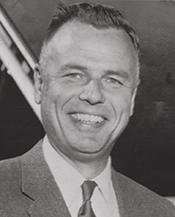
Historical · U.S. House · California · District 6
William Mailliard
Former U.S. Representative · California District 6 · 1953–1975 · Republican
William Mailliard represented California's District 6 in the United States House of Representatives (1953–1975) for the Republican party. The page below collects sourced biographical facts, term history, committee roles, and provenance for Mailliard.
Bioguide ID: M000070
Key facts
- Full name
- William Mailliard
- State
- California
- District
- District 6
- Party
- Republican
- House service
- 1953–1975
- First House term
- 1953
- Status
- Left office
- Current term ends
- —
- Born
- 1917
- Bioguide ID
- M000070
- Committee assignments
- —
- Dataset version
- 1.20260605
Biographical narrative
871 words · sourced from the Wikipedia REST extract
William S. Mailliard was an American politician and businessman who served as a U.S. Representative for California's 4th and 6th congressional districts from 1953 until 1974. A member of the Republican Party, Mailliard was known for his commitment to environmental conservation and played a significant role in the establishment of protected natural areas in California. His tenure in Congress was marked by a focus on preserving the state's natural resources, as well as a commitment to civil rights legislation.
Early life and career
William S. Mailliard was born on June 10, 1917, in Belvedere, California. He completed his early education at Tamalpais High School in San Rafael, California, and later attended the Taft School in Watertown, Connecticut. Mailliard graduated with a Bachelor of Arts degree from Yale University in 1939. Following his education, he began a career in banking, working with the American Trust Company in San Francisco during 1940 and 1941.
Mailliard's early career was also marked by military service. He served as an assistant naval attaché at the United States Embassy in London from 1939 to 1940. Subsequently, he worked with the Bureau of Naval Personnel in Washington, D.C., from 1941 to 1942. He attended the Naval War College in 1942 and was assigned to the staff of the Seventh Amphibious Force, where he served as flag lieutenant and aide to Vice Admiral D.E. Barbey during World War II. Mailliard was released to inactive duty in March 1946 with the rank of lieutenant commander and later achieved the rank of rear admiral in the U.S. Navy Reserve.
After his military service, Mailliard resumed his banking career and held various positions, including serving as assistant to the director of the California Youth Authority from 1947 to 1948. He was an unsuccessful candidate for the 81st Congress in 1948 and subsequently served as secretary to Governor Earl Warren from 1948 to 1951. Following this role, he was the executive assistant to the director of the California Academy of Sciences from 1951 to 1952.
House tenure
William S. Mailliard was elected as a Republican to the 83rd Congress, beginning his first term in the House of Representatives on January 3, 1953. He served a total of 11 consecutive terms in Congress, representing California's 4th and later the 6th congressional districts until his resignation on March 5, 1974. During his time in office, Mailliard was recognized for his efforts in environmental conservation, particularly in relation to California's natural resources. He was instrumental in the establishment of the Redwood National Park and played a key role in the creation of the Point Reyes National Seashore, advocating for the funding and development of these protected areas.
Mailliard's congressional career was characterized by his engagement in various legislative matters, including civil rights. He voted in favor of significant civil rights legislation, including the Civil Rights Acts of 1957, 1960, 1964, and 1968, as well as the Voting Rights Act of 1965 and the 24th Amendment to the U.S. Constitution. His support for these measures reflected a commitment to advancing civil rights during a transformative period in American history.
After resigning from Congress, Mailliard was appointed as a permanent representative of the United States to the Organization of American States, serving in this capacity from March 7, 1974, to February 1, 1977. He was nominated by President Gerald R. Ford and confirmed by the Senate to be a member of the Board of Directors of the Inter-American Foundation in December 1975.
Legislative focus and committees
Throughout his tenure in the House of Representatives, William S. Mailliard was known for his focus on environmental issues and resource conservation. His advocacy for the preservation of California's natural landscapes was a hallmark of his legislative work. Mailliard's efforts contributed to the establishment of significant national parks and protected areas, ensuring the conservation of vital ecosystems for future generations.
In addition to his environmental initiatives, Mailliard's legislative record included a strong commitment to civil rights. His votes in favor of landmark legislation during the civil rights movement underscored his support for equality and justice. Mailliard's engagement in these issues positioned him as a notable figure in the political landscape of his time.
Mailliard's involvement in various committees during his congressional career allowed him to influence a range of policies. His experience in banking and finance informed his contributions to economic discussions, while his military background provided insight into defense and national security matters. His multifaceted career and diverse experiences enabled him to address a wide array of issues affecting his constituents and the nation.
After leaving Congress, Mailliard continued to be active in public service and community affairs. He remained a resident of Belvedere, California, and later moved to San Francisco. Mailliard's legacy includes his contributions to environmental conservation, civil rights, and public service, reflecting a commitment to improving the lives of Californians and the broader American public.
William S. Mailliard passed away on June 10, 1992, coinciding with his 75th birthday. He is remembered for his long-standing service in the U.S. House of Representatives and his dedication to the preservation of California's natural resources and the advancement of civil rights. His career serves as a testament to the impact of public service on local and national levels.
Notable legislation
Sponsored and co-sponsored legislation for William Mailliard is pending operator curation. The biographical narrative above carries the same provenance trail until per-bill rows are written.
Sources
- [1]https://en.wikipedia.org/wiki/William_S._MailliardWikipedia · retrieved 2026-06-05
Notable quotes
Sourced quotes for William Mailliard are pending operator curation. Narrative-scope provenance remains attached below.
Sources
- [1]https://en.wikipedia.org/wiki/William_S._MailliardWikipedia · retrieved 2026-06-05
Key positions
Curated policy positions for William Mailliard are pending operator review. The biographical narrative above carries the same provenance trail until per-topic positions are written.
Sources
- [1]https://en.wikipedia.org/wiki/William_S._MailliardWikipedia · retrieved 2026-06-05
Terms served
- 1953–1955U.S. House · Term 1 · Republican
- 1955–1957U.S. House · Term 2 · Republican
- 1957–1959U.S. House · Term 3 · Republican
- 1959–1961U.S. House · Term 4 · Republican
- 1961–1963U.S. House · Term 5 · Republican
- 1963–1965U.S. House · Term 6 · Republican
- 1965–1967U.S. House · Term 7 · Republican
- 1967–1969U.S. House · Term 8 · Republican
- 1969–1971U.S. House · Term 9 · Republican
- 1971–1973U.S. House · Term 10 · Republican
- 1973–1975U.S. House · Term 11 · Republican
Sources & provenance
Every attributable claim above carries a per-section [N] marker that resolves to the corresponding URL below. Each entry records the upstream provider, the canonical URL, and the timestamp at which the source was retrieved by the ingest pipeline.
Key facts
- https://bioguide.congress.gov/search/bio/M000070bioguide · retrieved 2026-06-05
- https://www.govtrack.us/congress/members/407098govtrack · retrieved 2026-06-05
Biographical narrative
- https://en.wikipedia.org/wiki/William_S._Mailliardwikipedia · retrieved 2026-06-05
Find your representative
Every U.S. state elects representatives by district. Browse California’s delegation, the full former-representative roster, or explore the role and term length.
Related on The Candidate
- Preceded by Albert CarterEarlier holder of the California District 6 House seat · Republican.Open
- Succeeded by Lynn WoolseyLater holder of the California District 6 House seat · Democratic.Open
- Barclay HenleyFormer U.S. Representative · California District 1 · DemocraticOpen
- Charles ClaytonFormer U.S. Representative · California District 1 · RepublicanOpen
- Clarence LeaFormer U.S. Representative · California District 1 · DemocraticOpen
- Clement MillerFormer U.S. Representative · California District 1 · DemocraticOpen