
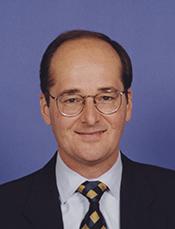
Historical · U.S. House · Florida · District 12
Charles Canady
Former U.S. Representative · Florida District 12 · 1993–2001 · Republican
Charles Canady represented Florida's District 12 in the United States House of Representatives (1993–2001) for the Republican party. The page below collects sourced biographical facts, term history, committee roles, and provenance for Canady.
Bioguide ID: C000107
Key facts
- Full name
- Charles Canady
- State
- Florida
- District
- District 12
- Party
- Republican
- House service
- 1993–2001
- First House term
- 1993
- Status
- Left office
- Current term ends
- —
- Born
- 1954
- Bioguide ID
- C000107
- Committee assignments
- —
- Dataset version
- 1.20260605
Biographical narrative
934 words · sourced from the Wikipedia REST extract
Charles T. Canady is a former U.S. Representative who served Florida's 12th congressional district from 1993 until 2001. A member of the Republican Party, Canady's legislative career was marked by his involvement in significant issues, including abortion rights and assisted suicide. After leaving Congress, he transitioned into the judicial branch, where he served as a judge on the Florida Second District Court of Appeal and later as a justice of the Florida Supreme Court.
Early life and career
Charles Terrance Canady was born on June 22, 1954, in Lakeland, Florida. He pursued higher education at Haverford College, where he earned a Bachelor of Arts degree in 1976. Following his undergraduate studies, Canady attended Yale Law School, graduating with a Juris Doctor in 1979. After being admitted to the bar in the same year, he began his legal career in Lakeland, Florida, where he practiced law.
In 1983, Canady took on the role of legal counsel for the Central Florida Regional Planning Commission, which allowed him to engage with legal and regulatory issues affecting the region. His political career began in earnest when he was elected to the Florida House of Representatives in 1984. Initially, he was elected as a member of the Democratic Party, but in June 1989, he switched his party affiliation to Republican. This change was controversial, particularly because it occurred shortly after he had accepted campaign contributions from Democratic sources for his re-election efforts. The switch led to tensions within the political community, as it was perceived as a betrayal by some of his former supporters.
Canady's tenure in the Florida House lasted until 1990, when he sought a seat in the Florida State Senate but was unsuccessful in that bid. His early political career laid the groundwork for his later entry into national politics.
House tenure
In 1992, Canady successfully ran for the U.S. House of Representatives, representing Florida's 12th congressional district. His election was closely contested, as he narrowly defeated his Democratic opponent, Tom Mims. Canady's tenure in Congress began in January 1993, and he was re-elected three times, serving a total of four terms until January 2001.
During his time in the House, Canady became known for his role in shaping legislation on contentious social issues. He is credited with coining the term "partial-birth abortion" while working on the Partial-Birth Abortion Ban Act of 1995. This legislation aimed to restrict certain abortion procedures, and the term itself was developed during discussions among Canady, a legal advisor, and a lobbyist for the National Right to Life Committee. The term was not found in medical literature, which led Canady and his team to create it for legislative purposes.
Canady's influence extended beyond abortion legislation; he also served as the Chairman of the Subcommittee on the Constitution of the House Judiciary Committee from January 1995 to January 2001. In this capacity, he led inquiries into various constitutional issues, including assisted suicide. His work culminated in a report that was referenced in the Supreme Court case Washington v. Glucksberg, where the Court ruled that the Constitution did not protect a right to assisted suicide.
In addition to his legislative efforts, Canady was appointed as one of the House managers during the impeachment trial of President Bill Clinton. This role placed him at the center of one of the most significant political events of the late 1990s, as the House managers were responsible for presenting the case against the President in the Senate.
Despite his accomplishments, Canady chose not to seek re-election for a fifth term in 2000, honoring a pledge he made during his initial campaign in 1992 to limit his time in office. His decision marked the end of his congressional career, but it paved the way for his subsequent judicial appointments.
Legislative focus and committees
Throughout his time in the U.S. House of Representatives, Canady's legislative focus was characterized by a commitment to conservative principles, particularly in the areas of social policy and constitutional law. His work on the Partial-Birth Abortion Ban Act exemplified his stance on abortion, which aligned with the broader Republican agenda during the 1990s. Canady's efforts in this area were part of a larger movement within the party to restrict abortion access and promote pro-life policies.
As Chairman of the Subcommittee on the Constitution, Canady was involved in significant discussions regarding the interpretation of constitutional rights. His inquiry into assisted suicide reflected a broader national debate about end-of-life issues and the rights of individuals in making personal medical decisions. The report produced under his leadership contributed to the legal framework surrounding these issues, influencing both public policy and judicial decisions.
Canady's role in the impeachment trial of President Clinton further highlighted his engagement with high-profile political matters. The impeachment proceedings were a defining moment in American politics, and Canady's involvement as a House manager placed him in a prominent position during a time of intense national scrutiny.
After leaving Congress, Canady transitioned to a judicial career, where he continued to influence legal and constitutional matters in Florida. His appointment as general counsel for Governor Jeb Bush allowed him to remain active in public service, and his subsequent judicial roles further solidified his legacy in the legal community.
In summary, Charles T. Canady's career spans significant roles in both legislative and judicial capacities. His time in the U.S. House of Representatives was marked by a focus on conservative social issues and constitutional law, and his later judicial service continued to shape legal interpretations in Florida. His contributions to American politics and law reflect a commitment to his principles and a dedication to public service.
Notable legislation
Sponsored and co-sponsored legislation for Charles Canady is pending operator curation. The biographical narrative above carries the same provenance trail until per-bill rows are written.
Sources
- [1]https://en.wikipedia.org/wiki/Charles_CanadyWikipedia · retrieved 2026-06-05
Notable quotes
Sourced quotes for Charles Canady are pending operator curation. Narrative-scope provenance remains attached below.
Sources
- [1]https://en.wikipedia.org/wiki/Charles_CanadyWikipedia · retrieved 2026-06-05
Key positions
Curated policy positions for Charles Canady are pending operator review. The biographical narrative above carries the same provenance trail until per-topic positions are written.
Sources
- [1]https://en.wikipedia.org/wiki/Charles_CanadyWikipedia · retrieved 2026-06-05
Terms served
- 1993–1995U.S. House · Term 1 · Republican
- 1995–1997U.S. House · Term 2 · Republican
- 1997–1999U.S. House · Term 3 · Republican
- 1999–2001U.S. House · Term 4 · Republican
Sources & provenance
Every attributable claim above carries a per-section [N] marker that resolves to the corresponding URL below. Each entry records the upstream provider, the canonical URL, and the timestamp at which the source was retrieved by the ingest pipeline.
Key facts
- https://bioguide.congress.gov/search/bio/C000107bioguide · retrieved 2026-06-05
- https://www.govtrack.us/congress/members/400574govtrack · retrieved 2026-06-05
Biographical narrative
- https://en.wikipedia.org/wiki/Charles_Canadywikipedia · retrieved 2026-06-05
Find your representative
Every U.S. state elects representatives by district. Browse Florida’s delegation, the full former-representative roster, or explore the role and term length.
Related on The Candidate
- Preceded by Edward StackEarlier holder of the Florida District 12 House seat · Democratic.Open
- Succeeded by Adam PutnamLater holder of the Florida District 12 House seat · Republican.Open
- Augustus MaxwellFormer U.S. Representative · Florida District 1 · DemocraticOpen
- Charles HamiltonFormer U.S. Representative · Florida District 1 · RepublicanOpen
- Chester McMullenFormer U.S. Representative · Florida District 1 · DemocraticOpen
- Courtney CampbellFormer U.S. Representative · Florida District 1 · DemocraticOpen