
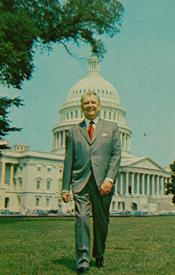
Historical · U.S. House · Florida · District 12
J. Burke
Former U.S. Representative · Florida District 12 · 1967–1979 · Republican
J. Burke represented Florida's District 12 in the United States House of Representatives (1967–1979) for the Republican party. The page below collects sourced biographical facts, term history, committee roles, and provenance for Burke.
Bioguide ID: B001091
Key facts
- Full name
- J. Burke
- State
- Florida
- District
- District 12
- Party
- Republican
- House service
- 1967–1979
- First House term
- 1967
- Status
- Left office
- Current term ends
- —
- Born
- 1913
- Bioguide ID
- B001091
- Committee assignments
- —
- Dataset version
- 1.20260605
Biographical narrative
844 words · sourced from the Wikipedia REST extract
J. Herbert Burke was a Republican politician who served as a U.S. Representative for Florida's 12th congressional district from 1967 until 1979. His political career spanned six terms in the House of Representatives, during which he participated in significant legislative developments. Burke's background included military service during World War II, a legal career, and local political involvement in Florida, culminating in his election to Congress.
Early life and career
J. Herbert Burke was born on January 14, 1913, in Chicago, Illinois. He received his early education in the public school system and later attended Central YMCA College, which is no longer in operation. He continued his education at Northwestern University, located in Evanston, Illinois, before graduating from Kent College of Law in Chicago. After being admitted to the bar in 1940, Burke began practicing law in Chicago, where he worked until 1949.
During World War II, Burke served in the United States Army, where he was deployed to France. His military service was distinguished; he was awarded the Purple Heart and the Bronze Star for his bravery and contributions during the conflict. Additionally, he received the European Theater Medal and the American Theater Ribbon. He was discharged from the Army with the rank of captain.
Following his military service, Burke relocated to Hollywood, Florida, where he continued his legal practice from 1949 until 1968. His entry into local politics began in 1952 when he was elected as a Republican commissioner in Broward County. He held this position until 1967, demonstrating his commitment to public service and local governance. Burke also served as a Republican State committeeman from 1954 to 1958, further solidifying his involvement in the Republican Party at the state level.
Burke's political aspirations included an unsuccessful bid for a congressional seat in a special election held in January 1955, where he lost to Democrat Paul Rogers. Despite this setback, he remained active in politics and was a delegate to the Republican National Conventions in 1968, 1972, and 1976. In 1968, he contributed to the party's platform as a member of the Republican Platform Committee. Additionally, in 1956, he was appointed by President Dwight D. Eisenhower to the Southeastern Advisory Board of Small Business, which highlighted his engagement with economic issues and small business advocacy.
House tenure
Burke's congressional career began when he was elected to the Ninetieth Congress, with his first term commencing on January 3, 1967. He was subsequently re-elected for five additional terms, serving in the House until January 3, 1979. Throughout his tenure, Burke was involved in various legislative activities and discussions that shaped policies affecting his constituents and the nation.
During his time in Congress, Burke was known to have voted in favor of the Civil Rights Act of 1968, a significant piece of legislation aimed at ending discrimination and promoting civil rights in the United States. His support for such legislation indicates his engagement with the pressing social issues of the time, reflecting the complex dynamics of American politics during the late 1960s and 1970s.
Burke's congressional career was marked by a blend of local and national concerns, as he worked to represent the interests of his constituents in Florida's 12th district. His experience in local government and law provided him with a unique perspective on the challenges faced by both individuals and communities, which he sought to address during his time in office.
Legislative focus and committees
Throughout his six terms in the House of Representatives, Burke served on various committees that aligned with his interests and expertise. While specific committee assignments during his tenure are not detailed in the available information, it can be inferred that his background in law and local governance likely influenced his legislative focus. Members of Congress typically engage with committees that address issues relevant to their constituents, such as education, transportation, and public safety.
Burke's legislative actions and decisions were shaped by the political landscape of the time, which included significant events such as the civil rights movement, the Vietnam War, and various domestic policy debates. His support for the Civil Rights Act of 1968 suggests that he was attuned to the social changes occurring in the United States and was willing to take a stand on important issues.
Despite his legislative contributions, Burke's career faced challenges, particularly towards the end of his time in Congress. In 1978, he was involved in a scandal that resulted in his arrest for disorderly intoxication and resisting arrest, as well as a charge of witness tampering. Although he pleaded guilty to some charges, the incident had repercussions for his political career. He ran for re-election later that year but lost to Democrat Edward J. Stack in a significant defeat.
After leaving Congress, Burke continued to reside in Florida and Virginia until his death in 1993. His life and career reflect the complexities of American political life during a transformative period, marked by both achievements and controversies. Burke's legacy is intertwined with the history of Florida's political landscape and the broader narrative of the Republican Party during the late 20th century.
Notable legislation
Sponsored and co-sponsored legislation for J. Burke is pending operator curation. The biographical narrative above carries the same provenance trail until per-bill rows are written.
Sources
- [1]https://en.wikipedia.org/wiki/J._Herbert_BurkeWikipedia · retrieved 2026-06-05
Notable quotes
Sourced quotes for J. Burke are pending operator curation. Narrative-scope provenance remains attached below.
Sources
- [1]https://en.wikipedia.org/wiki/J._Herbert_BurkeWikipedia · retrieved 2026-06-05
Key positions
Curated policy positions for J. Burke are pending operator review. The biographical narrative above carries the same provenance trail until per-topic positions are written.
Sources
- [1]https://en.wikipedia.org/wiki/J._Herbert_BurkeWikipedia · retrieved 2026-06-05
Terms served
- 1967–1969U.S. House · Term 1 · Republican
- 1969–1971U.S. House · Term 2 · Republican
- 1971–1973U.S. House · Term 3 · Republican
- 1973–1975U.S. House · Term 4 · Republican
- 1975–1977U.S. House · Term 5 · Republican
- 1977–1979U.S. House · Term 6 · Republican
Sources & provenance
Every attributable claim above carries a per-section [N] marker that resolves to the corresponding URL below. Each entry records the upstream provider, the canonical URL, and the timestamp at which the source was retrieved by the ingest pipeline.
Key facts
- https://bioguide.congress.gov/search/bio/B001091bioguide · retrieved 2026-06-05
- https://www.govtrack.us/congress/members/402037govtrack · retrieved 2026-06-05
Biographical narrative
- https://en.wikipedia.org/wiki/J._Herbert_Burkewikipedia · retrieved 2026-06-05
Find your representative
Every U.S. state elects representatives by district. Browse Florida’s delegation, the full former-representative roster, or explore the role and term length.
Related on The Candidate
- Succeeded by Edward StackLater holder of the Florida District 12 House seat · Democratic.Open
- Augustus MaxwellFormer U.S. Representative · Florida District 1 · DemocraticOpen
- Charles HamiltonFormer U.S. Representative · Florida District 1 · RepublicanOpen
- Chester McMullenFormer U.S. Representative · Florida District 1 · DemocraticOpen
- Courtney CampbellFormer U.S. Representative · Florida District 1 · DemocraticOpen
- Republican PartyFederal candidates and office holders on the Republican line.Open