
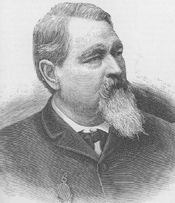
Historical · U.S. House · Florida · District 2
Robert Bullock
Former U.S. Representative · Florida District 2 · 1889–1893 · Democratic
Robert Bullock represented Florida's District 2 in the United States House of Representatives (1889–1893) for the Democratic party. The page below collects sourced biographical facts, term history, committee roles, and provenance for Bullock.
Bioguide ID: B001052
Key facts
- Full name
- Robert Bullock
- State
- Florida
- District
- District 2
- Party
- Democratic
- House service
- 1889–1893
- First House term
- 1889
- Status
- Left office
- Current term ends
- —
- Born
- 1828
- Bioguide ID
- B001052
- Committee assignments
- —
- Dataset version
- 1.20260606
Biographical narrative
891 words · sourced from the Wikipedia REST extract
Robert Bullock was an American lawyer, judge, and politician who served as a U.S. Representative for Florida's 2nd congressional district during the late 19th century. A member of the Democratic Party, Bullock's political career was preceded by significant military service as a brigadier general in the Confederate States Army during the American Civil War. His life spanned a period of considerable change in the United States, and his contributions to both military and civic life reflect the complexities of that era.
Early life and career
Robert Bullock was born on December 8, 1828, in Greenville, North Carolina. His early education took place in common schools, which provided him with a foundational understanding of various subjects. In 1844, Bullock relocated to Fort King, Florida, a military outpost at the time, situated near what is now Ocala. This move marked the beginning of his long-standing connection with Florida, where he would later contribute to the educational landscape by teaching in the first school established in Sumter County.
Bullock's involvement in military service began in 1856 when he was commissioned by the governor of Florida to raise a mounted company of volunteers aimed at suppressing the Seminole uprising. This initiative was part of the broader efforts to maintain order in the region, and Bullock's company was mustered into the service of the United States, serving for a period of 18 months until the cessation of hostilities.
With the onset of the American Civil War, Bullock joined the Confederate Army in 1861, initially serving as a captain in the 7th Florida Infantry. His military career progressed rapidly; he was promoted to lieutenant colonel in 1863 and later to brigadier general in 1865, with his promotion dated to November 29, 1864. Throughout the war, Bullock participated in several significant battles, including the Battle of Chickamauga and the Atlanta campaign, as well as the Franklin-Nashville Campaign, where he sustained severe injuries. His military service during this tumultuous period shaped his leadership skills and deepened his commitment to public service.
House tenure
Following the Civil War, Robert Bullock transitioned from military life to legal practice. He studied law and was admitted to the bar in 1866, establishing a legal career in Marion County, Florida. His legal expertise led him to serve as the judge of the probate court from 1866 to 1868, a role that allowed him to influence local governance and legal proceedings.
In 1879, Bullock expanded his political involvement by becoming a member of the Florida House of Representatives. This position enabled him to engage more directly with legislative processes and state governance. He later served as the clerk of the circuit court of Marion County from 1881 until 1889, further solidifying his reputation as a dedicated public servant.
Bullock's congressional career began when he was elected as a Democrat to the Fifty-first and Fifty-second Congresses, serving from March 4, 1889, until March 3, 1893. His election to Congress came at a time when Florida was still recovering from the effects of the Civil War and the Reconstruction era. Bullock's tenure in the House of Representatives was marked by the challenges of representing a state that was undergoing significant social and economic changes.
During his time in Congress, Bullock was involved in various legislative activities, although specific details regarding the bills he supported or opposed are not documented in the available records. His decision not to seek renomination in 1892 marked the end of his congressional career, and he was succeeded by Charles Merian Cooper. Bullock's departure from Congress did not signify a retreat from public life; instead, he continued to engage in various pursuits that reflected his commitment to his community and state.
Legislative focus and committees
While specific details regarding Robert Bullock's legislative focus and committee assignments during his time in Congress are not extensively documented, it can be inferred that his background as a lawyer and military officer likely influenced his approach to governance. His experiences in the military and judiciary would have provided him with a unique perspective on issues related to law, order, and civil rights, particularly in the context of a post-Civil War America.
Bullock's legislative priorities may have included matters pertinent to Florida's development, such as land use, agricultural policy, and veterans' affairs, given his background and the needs of his constituents. The late 19th century was a period of significant transformation in the United States, characterized by industrialization, urbanization, and shifts in social dynamics. As a representative from a southern state, Bullock would have had to navigate the complexities of a changing political landscape, balancing the interests of his constituents with the broader national discourse.
After leaving Congress, Bullock returned to Florida, where he engaged in agricultural pursuits, reflecting the state's economic reliance on agriculture during that period. In 1903, he was elected as the judge of Marion County, a position he held until his death on July 27, 1905, in Ocala, Florida. His contributions to the legal and political fabric of the region were recognized posthumously, as he was laid to rest in Evergreen Cemetery.
Robert Bullock's life and career encapsulate the multifaceted nature of American public service during a time of significant change. His military service, legal career, and political involvement illustrate a commitment to his community and state, leaving a legacy that reflects the complexities of the era in which he lived.
Notable legislation
Sponsored and co-sponsored legislation for Robert Bullock is pending operator curation. The biographical narrative above carries the same provenance trail until per-bill rows are written.
Sources
- [1]https://en.wikipedia.org/wiki/Robert_BullockWikipedia · retrieved 2026-06-06
Notable quotes
Sourced quotes for Robert Bullock are pending operator curation. Narrative-scope provenance remains attached below.
Sources
- [1]https://en.wikipedia.org/wiki/Robert_BullockWikipedia · retrieved 2026-06-06
Key positions
Curated policy positions for Robert Bullock are pending operator review. The biographical narrative above carries the same provenance trail until per-topic positions are written.
Sources
- [1]https://en.wikipedia.org/wiki/Robert_BullockWikipedia · retrieved 2026-06-06
Terms served
- 1889–1891U.S. House · Term 1 · Democratic
- 1891–1893U.S. House · Term 2 · Democratic
Sources & provenance
Every attributable claim above carries a per-section [N] marker that resolves to the corresponding URL below. Each entry records the upstream provider, the canonical URL, and the timestamp at which the source was retrieved by the ingest pipeline.
Key facts
- https://bioguide.congress.gov/search/bio/B001052bioguide · retrieved 2026-06-06
- https://www.govtrack.us/congress/members/402000govtrack · retrieved 2026-06-06
Biographical narrative
- https://en.wikipedia.org/wiki/Robert_Bullockwikipedia · retrieved 2026-06-06
Find your representative
Every U.S. state elects representatives by district. Browse Florida’s delegation, the full former-representative roster, or explore the role and term length.
Related on The Candidate
- Preceded by Charles DoughertyEarlier holder of the Florida District 2 House seat · Democratic.Open
- Succeeded by Charles CooperLater holder of the Florida District 2 House seat · Democratic.Open
- Augustus MaxwellFormer U.S. Representative · Florida District 1 · DemocraticOpen
- Charles HamiltonFormer U.S. Representative · Florida District 1 · RepublicanOpen
- Chester McMullenFormer U.S. Representative · Florida District 1 · DemocraticOpen
- Courtney CampbellFormer U.S. Representative · Florida District 1 · DemocraticOpen