
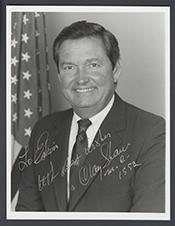
Historical · U.S. House · Florida · District 22
E. Shaw Jr.
Former U.S. Representative · Florida District 22 · 1981–2007 · Republican
E. Shaw Jr. represented Florida's District 22 in the United States House of Representatives (1981–2007) for the Republican party. The page below collects sourced biographical facts, term history, committee roles, and provenance for Jr..
Bioguide ID: S000303
Key facts
- Full name
- E. Shaw Jr.
- State
- Florida
- District
- District 22
- Party
- Republican
- House service
- 1981–2007
- First House term
- 1981
- Status
- Left office
- Current term ends
- —
- Born
- 1939
- Bioguide ID
- S000303
- Committee assignments
- —
- Dataset version
- 1.20260605
Biographical narrative
1,023 words · sourced from the Wikipedia REST extract
E. Clay Shaw Jr. was a prominent American politician and jurist who served as a Republican member of the United States House of Representatives, representing Florida's 22nd congressional district from 1981 until 2007. Prior to his congressional tenure, Shaw was the mayor of Fort Lauderdale and held various legal and political positions within the city. His career in public service spanned several decades, during which he was involved in significant legislative efforts and local governance.
Early life and career
Eugene Clay Shaw Jr. was born on April 19, 1939, in Miami, Florida. He completed his high school education at Miami Edison Senior High School, graduating in 1957. Shaw pursued higher education at Stetson University, where he earned a bachelor's degree in business in 1961. He continued his studies at the University of Alabama, obtaining a master's degree in accounting in 1963. Shaw returned to Stetson University for his legal education, graduating with a law degree in 1966.
Following his academic achievements, Shaw embarked on a career in law and accounting. He became a certified public accountant and practiced law, gaining experience in various legal capacities. In 1968, he took on the role of assistant city attorney in Fort Lauderdale, where he worked until 1969. He then served as the chief city prosecutor for a year before becoming an associate municipal judge from 1969 to 1971. These positions provided him with a solid foundation in both legal and municipal matters.
Shaw's political career began in local government, where he was elected as a city commissioner in Fort Lauderdale, serving from 1971 to 1973. He was then appointed vice mayor, a position he held from 1973 to 1975. His leadership qualities and popularity led to his election as mayor of Fort Lauderdale, a role he occupied from 1975 until 1981. During his mayoral tenure, Shaw was actively involved in various organizations, including the U.S. Conference of Mayors, where he served on the advisory board and executive committee. He also held the position of president of the National Conference of Republican Mayors. His contributions to local governance were recognized when he was appointed as a special U.S. ambassador to Papua New Guinea by President Gerald Ford.
House tenure
Shaw's entry into the U.S. House of Representatives came during the 1980 election cycle, a period marked by a Republican resurgence. The National Republican Campaign Committee sought a candidate to challenge the incumbent Democratic congressman Edward J. Stack in Florida's 15th congressional district. After considerable persuasion, Shaw agreed to run for the position, supported by his family. His campaign gained momentum when Stack was defeated in the Democratic primary, allowing Shaw to face a new opponent, Allen Becker, in the general election. Shaw won the election with a significant majority, securing 55 percent of the vote.
Following his initial victory, Shaw faced several re-election campaigns throughout his congressional career. In 1982, after redistricting, he successfully defended his seat against Stack again, winning with 57 percent of the vote. His subsequent elections in 1984, 1986, 1988, and 1990 saw him achieving substantial victories, often without significant opposition. In 1992, however, Shaw encountered a more challenging race against Democratic State Senate President Gwen Margolis. The newly configured 22nd District stretched along the coast, presenting a more competitive electoral landscape. Despite the tough campaign, Shaw emerged victorious, receiving 58 percent of the vote.
Shaw continued to secure re-election in subsequent years, including a notable victory in 1994, where he garnered 63 percent of the vote against Democratic nominee Hermine Weiner. His support for the Republican Contract with America, which aimed to implement significant policy changes, contributed to the Republican Party's control of Congress during this period. Shaw's electoral success continued through the late 1990s, with victories in 1996 and 1998, the latter being an unopposed re-election.
In 2000, Shaw faced a competitive challenge from state Representative Elaine Bloom, who capitalized on the Democratic momentum from the presidential election. Despite a close race, Shaw managed to secure his seat by a narrow margin, winning by just 599 votes. The changing political landscape in South Florida, which had shifted towards the Democratic Party, made this election particularly significant.
Shaw's final term in the House concluded in 2007 when he was defeated for re-election by Democratic candidate Ron Klein. His departure marked the end of a lengthy and impactful congressional career that spanned 13 terms.
Legislative focus and committees
Throughout his tenure in the U.S. House of Representatives, E. Clay Shaw Jr. was involved in various legislative initiatives and served on multiple committees. His legislative focus included issues pertinent to his constituents in South Florida, such as economic development, healthcare, and social security reform. Shaw was known for his advocacy on behalf of the interests of his district, which encompassed a diverse population with varying needs.
Shaw's committee assignments allowed him to influence key areas of policy. He served on committees that addressed important national issues, contributing to discussions and decisions that shaped legislation. His experience as a former mayor and city commissioner provided him with valuable insights into local governance, which he applied to his work in Congress.
In addition to his legislative responsibilities, Shaw was involved in various caucuses and coalitions, working alongside colleagues to promote shared interests and objectives. His long-standing commitment to public service and his understanding of the complexities of governance enabled him to navigate the political landscape effectively.
Shaw's career in the House of Representatives was characterized by a focus on bipartisanship and collaboration, as he sought to build relationships across party lines to achieve legislative goals. His extensive experience in local government and law provided him with a unique perspective on the challenges faced by constituents and the importance of responsive governance.
In summary, E. Clay Shaw Jr. was a significant figure in Florida politics, serving as a U.S. Representative for over two decades. His background in law and local governance, combined with his dedication to public service, shaped his approach to legislation and representation. Shaw's legacy includes his contributions to the political landscape of South Florida and his efforts to address the needs of his constituents during a transformative period in American politics.
Notable legislation
Sponsored and co-sponsored legislation for E. Shaw Jr. is pending operator curation. The biographical narrative above carries the same provenance trail until per-bill rows are written.
Sources
- [1]https://en.wikipedia.org/wiki/Clay_Shaw_(politician)Wikipedia · retrieved 2026-06-05
Notable quotes
Sourced quotes for E. Shaw Jr. are pending operator curation. Narrative-scope provenance remains attached below.
Sources
- [1]https://en.wikipedia.org/wiki/Clay_Shaw_(politician)Wikipedia · retrieved 2026-06-05
Key positions
Curated policy positions for E. Shaw Jr. are pending operator review. The biographical narrative above carries the same provenance trail until per-topic positions are written.
Sources
- [1]https://en.wikipedia.org/wiki/Clay_Shaw_(politician)Wikipedia · retrieved 2026-06-05
Terms served
- 1981–1983U.S. House · Term 1 · Republican
- 1983–1985U.S. House · Term 2 · Republican
- 1985–1987U.S. House · Term 3 · Republican
- 1987–1989U.S. House · Term 4 · Republican
- 1989–1991U.S. House · Term 5 · Republican
- 1991–1993U.S. House · Term 6 · Republican
- 1993–1995U.S. House · Term 7 · Republican
- 1995–1997U.S. House · Term 8 · Republican
- 1997–1999U.S. House · Term 9 · Republican
- 1999–2001U.S. House · Term 10 · Republican
- 2001–2003U.S. House · Term 11 · Republican
- 2003–2005U.S. House · Term 12 · Republican
- 2005–2007U.S. House · Term 13 · Republican
Sources & provenance
Every attributable claim above carries a per-section [N] marker that resolves to the corresponding URL below. Each entry records the upstream provider, the canonical URL, and the timestamp at which the source was retrieved by the ingest pipeline.
Key facts
- https://bioguide.congress.gov/search/bio/S000303bioguide · retrieved 2026-06-05
- http://www.house.gov/shawhouse.gov · retrieved 2026-06-05
Biographical narrative
- https://en.wikipedia.org/wiki/Clay_Shaw_(politician)wikipedia · retrieved 2026-06-05
Find your representative
Every U.S. state elects representatives by district. Browse Florida’s delegation, the full former-representative roster, or explore the role and term length.
Related on The Candidate
- Succeeded by Ron KleinLater holder of the Florida District 22 House seat · Democratic.Open
- Augustus MaxwellFormer U.S. Representative · Florida District 1 · DemocraticOpen
- Charles HamiltonFormer U.S. Representative · Florida District 1 · RepublicanOpen
- Chester McMullenFormer U.S. Representative · Florida District 1 · DemocraticOpen
- Courtney CampbellFormer U.S. Representative · Florida District 1 · DemocraticOpen
- Republican PartyFederal candidates and office holders on the Republican line.Open