
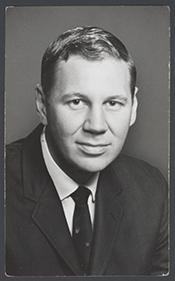
Historical · U.S. House · Florida · District 9
Louis Frey Jr.
Former U.S. Representative · Florida District 9 · 1969–1979 · Republican
Louis Frey Jr. represented Florida's District 9 in the United States House of Representatives (1969–1979) for the Republican party. The page below collects sourced biographical facts, term history, committee roles, and provenance for Jr..
Bioguide ID: F000381
Key facts
- Full name
- Louis Frey Jr.
- State
- Florida
- District
- District 9
- Party
- Republican
- House service
- 1969–1979
- First House term
- 1969
- Status
- Left office
- Current term ends
- —
- Born
- 1934
- Bioguide ID
- F000381
- Committee assignments
- —
- Dataset version
- 1.20260605
Biographical narrative
967 words · sourced from the Wikipedia REST extract
Louis Frey Jr. was an American lawyer and politician who served as a Republican member of the United States House of Representatives from 1969 until 1979. He represented Florida's 5th congressional district from 1969 to 1973 and subsequently the 9th district from 1973 until the end of his congressional career. After five terms in office, Frey sought the Republican nomination for governor in 1978 but was unsuccessful. His career in public service was marked by his commitment to fiscal responsibility and civic engagement.
Early life and career
Lou Frey Jr. was born on January 11, 1934, in Rutherford, New Jersey. He was the son of Mildred Engel and Louis Frey. Frey completed his secondary education at Rutherford High School, graduating in 1951. He then pursued higher education at Colgate University in Hamilton, New York, where he earned a Bachelor of Arts degree in 1955. Following his undergraduate studies, Frey served in the United States Navy, specifically in naval aviation, from 1955 to 1958. After his active duty, he continued his service in the Naval Reserve until 1978, retiring with the rank of captain.
In 1961, Frey obtained his Juris Doctor degree from the University of Michigan Law School in Ann Arbor. He was admitted to the Florida bar the same year, marking the beginning of his legal career. Frey initially worked in private practice and briefly served as an assistant county solicitor in Orange County, Florida. He became an associate and later a partner at the law firm Gurney, Skolfield & Frey in Winter Park, Florida, from 1963 to 1967. Additionally, he held the position of acting general counsel for the Florida State Turnpike Authority from 1966 to 1967. In 1967, he joined the law firm of Mateer, Frey, Young & Harbert in Orlando as a partner.
House tenure
Frey's political career began in earnest when he was elected to the U.S. House of Representatives in 1968, succeeding Edward Gurney, who had become Florida's first Republican U.S. Senator since Reconstruction. Frey was notable for being the fourth Florida Republican to be elected to the House in the 20th century. His first term commenced on January 3, 1969, and he was subsequently re-elected to four additional terms, serving until January 3, 1979.
During his time in Congress, Frey was an active member of several committees, including the Interstate and Foreign Commerce Committee, the Science and Technology Committee, and the Select Committee on Narcotics Abuse and Control. His legislative work was recognized with multiple awards, including the "Watch Dog of the Treasury Award," which he received for his efforts to limit government spending and combat inflation. He also earned the "Guardian of Small Business Award," reflecting his focus on issues affecting small businesses.
Frey's tenure was marked by a commitment to addressing various national concerns, including economic issues and public health. He was involved in discussions and initiatives related to narcotics abuse, reflecting a growing concern during that period. His participation in these committees allowed him to influence legislation that aimed to improve the welfare of his constituents and the broader American public.
In 1970, Frey played a role in addressing challenges within the Florida Republican Party during a tumultuous election cycle. He spoke at the Florida Republican State convention in Orlando, urging party members to unite despite internal divisions that threatened their electoral prospects. Although he sought to rally support for the party's candidates, both the gubernatorial and senatorial nominees ultimately faced defeat in the general election.
Frey chose not to seek re-election for the Ninety-sixth Congress in 1978. Instead, he launched a campaign for the Republican nomination for governor of Florida, aiming to succeed the term-limited Democrat Reubin Askew. However, he was unsuccessful in this bid, losing to Jack Eckerd in the primary.
Legislative focus and committees
Throughout his congressional career, Lou Frey Jr. was known for his focus on fiscal responsibility and public service. His legislative priorities included efforts to curb government spending and promote economic stability. As a member of the Interstate and Foreign Commerce Committee, Frey engaged with issues related to transportation, commerce, and trade, which were critical to Florida's economy and infrastructure.
Frey's involvement with the Science and Technology Committee allowed him to contribute to discussions on innovation and research, areas that were increasingly important in the rapidly changing landscape of the late 20th century. His work on the Select Committee on Narcotics Abuse and Control highlighted his commitment to addressing public health issues, particularly the growing concerns surrounding drug abuse and its societal impacts.
In addition to his legislative responsibilities, Frey was active in various civic organizations and political groups. He served as chairman of the Florida Federation of Young Republicans, demonstrating his commitment to engaging younger generations in the political process. His leadership in this capacity reflected his belief in the importance of civic education and participation.
After leaving Congress, Frey continued to be involved in public service and political commentary. He was a past president of The United States Association of Former Members of Congress and served on its executive committee. Frey also co-hosted a political commentary show on WMFE-FM and appeared on various talk shows, sharing his insights on political matters.
Frey's legacy includes the establishment of The Lou Frey Institute of Politics and Government at the University of Central Florida in Orlando. This nonpartisan foundation focuses on civic education, encouraging informed discussions on political issues, and promoting participation in the democratic process. The institute aims to engage students and the broader community in meaningful dialogues about governance and public policy.
Lou Frey Jr. passed away on October 14, 2019, leaving behind a legacy of public service and civic engagement that continues to influence future generations. His contributions to Florida's political landscape and his commitment to fostering civic education remain significant aspects of his enduring impact.
Notable legislation
Sponsored and co-sponsored legislation for Louis Frey Jr. is pending operator curation. The biographical narrative above carries the same provenance trail until per-bill rows are written.
Sources
- [1]https://en.wikipedia.org/wiki/Louis_Frey_Jr.Wikipedia · retrieved 2026-06-05
Notable quotes
Sourced quotes for Louis Frey Jr. are pending operator curation. Narrative-scope provenance remains attached below.
Sources
- [1]https://en.wikipedia.org/wiki/Louis_Frey_Jr.Wikipedia · retrieved 2026-06-05
Key positions
Curated policy positions for Louis Frey Jr. are pending operator review. The biographical narrative above carries the same provenance trail until per-topic positions are written.
Sources
- [1]https://en.wikipedia.org/wiki/Louis_Frey_Jr.Wikipedia · retrieved 2026-06-05
Terms served
- 1969–1971U.S. House · Term 1 · Republican
- 1971–1973U.S. House · Term 2 · Republican
- 1973–1975U.S. House · Term 3 · Republican
- 1975–1977U.S. House · Term 4 · Republican
- 1977–1979U.S. House · Term 5 · Republican
Sources & provenance
Every attributable claim above carries a per-section [N] marker that resolves to the corresponding URL below. Each entry records the upstream provider, the canonical URL, and the timestamp at which the source was retrieved by the ingest pipeline.
Key facts
- https://bioguide.congress.gov/search/bio/F000381bioguide · retrieved 2026-06-05
- https://www.govtrack.us/congress/members/404326govtrack · retrieved 2026-06-05
Biographical narrative
- https://en.wikipedia.org/wiki/Louis_Frey_Jr.wikipedia · retrieved 2026-06-05
Find your representative
Every U.S. state elects representatives by district. Browse Florida’s delegation, the full former-representative roster, or explore the role and term length.
Related on The Candidate
- Succeeded by Michael BilirakisLater holder of the Florida District 9 House seat · Republican.Open
- Augustus MaxwellFormer U.S. Representative · Florida District 1 · DemocraticOpen
- Charles HamiltonFormer U.S. Representative · Florida District 1 · RepublicanOpen
- Chester McMullenFormer U.S. Representative · Florida District 1 · DemocraticOpen
- Courtney CampbellFormer U.S. Representative · Florida District 1 · DemocraticOpen
- Republican PartyFederal candidates and office holders on the Republican line.Open