
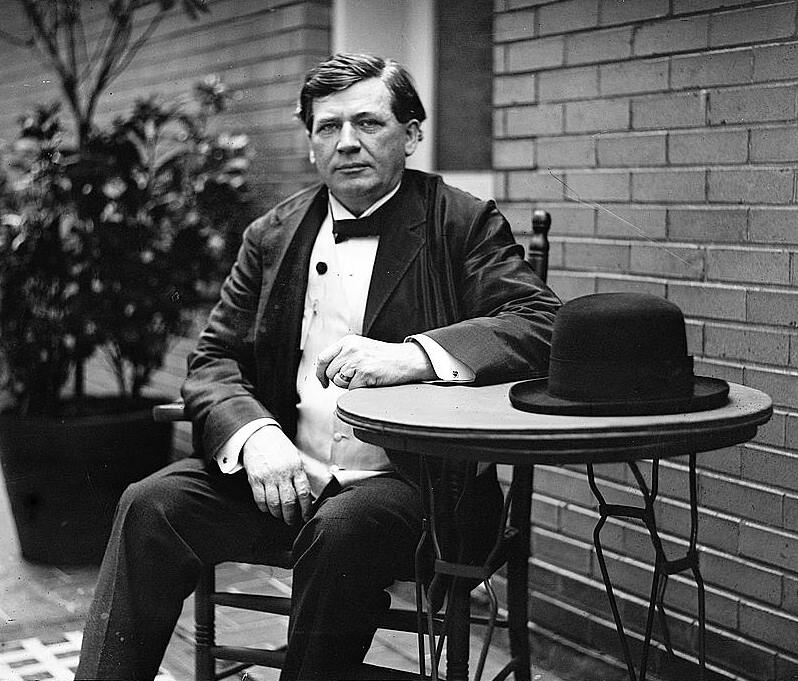
Historical · U.S. House · Iowa · District 2
Martin Wade
Former U.S. Representative · Iowa District 2 · 1903–1905 · Democratic
Martin Wade represented Iowa's District 2 in the United States House of Representatives (1903–1905) for the Democratic party. The page below collects sourced biographical facts, term history, committee roles, and provenance for Wade.
Bioguide ID: W000007
Key facts
- Full name
- Martin Wade
- State
- Iowa
- District
- District 2
- Party
- Democratic
- House service
- 1903–1905
- First House term
- 1903
- Status
- Left office
- Current term ends
- —
- Born
- 1861
- Bioguide ID
- W000007
- Committee assignments
- —
- Dataset version
- 1.20260606
Biographical narrative
1,018 words · sourced from the Wikipedia REST extract
Martin Wade was a prominent figure in early 20th-century American politics and law, serving as a United States Representative from Iowa's 2nd congressional district. A member of the Democratic Party, Wade's congressional tenure lasted from 1903 to 1905. Following his time in the House of Representatives, he transitioned to a significant judicial role, ultimately serving as a United States District Judge for the Southern District of Iowa. His career was marked by a commitment to public service and a dedication to the legal profession, reflecting the evolving landscape of American governance during his lifetime.
Early life and career
Martin Wade was born on October 20, 1861, in Burlington, Vermont, located in Chittenden County. His early years were spent in a rural environment, as his family moved to Iowa when he was still a child. They settled on a farm in Butler County, which at the time was characterized by expansive prairies and the challenges associated with pioneer life. This upbringing in a developing region likely influenced Wade's perspectives on agriculture and rural issues, which were significant in Iowa's political landscape.
Wade's education began in the common schools of Iowa, where he laid the foundation for his future academic pursuits. He furthered his education at St. Joseph's College in Dubuque, Iowa, which later became part of Columbia University. His academic journey culminated in 1886 when he earned a Bachelor of Laws degree from the University of Iowa College of Law. Following his admission to the bar, Wade began practicing law in Iowa City, where he remained active in private practice until 1893.
In addition to his legal practice, Wade contributed to the academic community as a faculty member at the University of Iowa. He served as a lecturer in law from 1890 to 1894 and later became a Professor of Medical Jurisprudence, a position he held until 1903. His involvement in legal education not only enhanced his own understanding of the law but also allowed him to influence the next generation of legal professionals in Iowa.
Wade's legal career included a significant judicial appointment when he was elected as a Judge of the Iowa District Court for the Eighth Judicial District, serving from 1893 to 1902. His leadership in this role was complemented by his tenure as President of the Iowa State Bar Association during the years 1897 and 1898. These experiences provided him with a solid foundation in both the practice and administration of law, preparing him for his future political career.
House tenure
Wade's entry into national politics came when he was elected as a Democrat to represent Iowa's 2nd congressional district in the United States House of Representatives. His term began on March 4, 1903, during the 58th Congress. Wade's election followed the decision of the incumbent congressman, John N. W. Rumple, not to seek re-election due to health concerns. Wade's campaign was notable for his choice to refrain from making public speeches, which he believed would be inappropriate for someone with his judicial background. Instead, he focused on his legal qualifications and community connections to secure his election.
During his time in Congress, Wade served for a little over two years, concluding his term on March 3, 1905. His tenure was marked by the political dynamics of the era, which included a Republican majority in the House. In the subsequent election of 1904, Wade sought re-election but was defeated by Republican candidate Albert F. Dawson amid a broader Republican landslide. This defeat ended Wade's congressional career, and he returned to private legal practice in Iowa City, where he remained until 1915.
Despite his brief time in Congress, Wade's political involvement continued. He participated as a delegate in the Democratic National Conventions of 1904 and 1912, engaging with the national party and contributing to the discourse surrounding Democratic policies and candidates. His congressional staffer, Irvin S. Pepper, later succeeded him in the House, indicating Wade's influence and the connections he fostered during his time in office.
Legislative focus and committees
While specific details regarding Wade's legislative focus during his congressional tenure are not extensively documented, his background as a lawyer and judge likely informed his perspectives on various legal and judicial issues. His experience in the Iowa District Court and as a law professor would have provided him with insights into the complexities of legal reform, civil rights, and governance, which were pertinent topics during the early 1900s.
Wade's service on committees, while not explicitly detailed in the available records, would have aligned with his legal expertise and interests. Members of Congress typically serve on committees that reflect their professional backgrounds and the needs of their constituents. Given Wade's legal background, it is reasonable to infer that he may have been involved in committees related to judiciary matters, public policy, or education.
After his congressional service, Wade transitioned to a significant judicial role when he was nominated by President Woodrow Wilson to the United States District Court for the Southern District of Iowa in 1915. His confirmation by the Senate and subsequent commission marked the beginning of a long judicial career that would last until his death in 1931. This transition from legislator to judge illustrates the fluidity of career paths in public service and the interconnected nature of law and politics.
Wade's judicial tenure included presiding over notable cases that reflected the contentious political climate of the time, particularly during World War I. His involvement in high-profile trials, such as those related to sedition, highlighted the challenges of balancing civil liberties with national security concerns during a period of heightened patriotism and political scrutiny.
In summary, Martin Wade's career spanned various roles in law and politics, from his early life in Iowa to his service in the U.S. House of Representatives and later as a federal judge. His contributions to the legal field and public service reflect the complexities of American governance in the early 20th century, showcasing the interplay between law, politics, and societal issues. Wade's legacy is marked by his commitment to justice and the rule of law, as evidenced by his extensive career in both legislative and judicial capacities.
Notable legislation
Sponsored and co-sponsored legislation for Martin Wade is pending operator curation. The biographical narrative above carries the same provenance trail until per-bill rows are written.
Sources
- [1]https://en.wikipedia.org/wiki/Martin_J._WadeWikipedia · retrieved 2026-06-06
Notable quotes
Sourced quotes for Martin Wade are pending operator curation. Narrative-scope provenance remains attached below.
Sources
- [1]https://en.wikipedia.org/wiki/Martin_J._WadeWikipedia · retrieved 2026-06-06
Key positions
Curated policy positions for Martin Wade are pending operator review. The biographical narrative above carries the same provenance trail until per-topic positions are written.
Sources
- [1]https://en.wikipedia.org/wiki/Martin_J._WadeWikipedia · retrieved 2026-06-06
Terms served
- 1903–1905U.S. House · Term 1 · Democratic
Sources & provenance
Every attributable claim above carries a per-section [N] marker that resolves to the corresponding URL below. Each entry records the upstream provider, the canonical URL, and the timestamp at which the source was retrieved by the ingest pipeline.
Key facts
- https://bioguide.congress.gov/search/bio/W000007bioguide · retrieved 2026-06-06
- https://www.govtrack.us/congress/members/411186govtrack · retrieved 2026-06-06
Biographical narrative
- https://en.wikipedia.org/wiki/Martin_J._Wadewikipedia · retrieved 2026-06-06
Find your representative
Every U.S. state elects representatives by district. Browse Iowa’s delegation, the full former-representative roster, or explore the role and term length.
Related on The Candidate
- Preceded by John RumpleEarlier holder of the Iowa District 2 House seat · Republican.Open
- Succeeded by Albert DawsonLater holder of the Iowa District 2 House seat · Republican.Open
- Abby FinkenauerFormer U.S. Representative · Iowa District 1 · DemocraticOpen
- Augustus HallFormer U.S. Representative · Iowa District 1 · DemocraticOpen
- Benton HallFormer U.S. Representative · Iowa District 1 · DemocraticOpen
- Bernhart HennFormer U.S. Representative · Iowa District 1 · DemocraticOpen