
Historical · U.S. House · Iowa · District 3
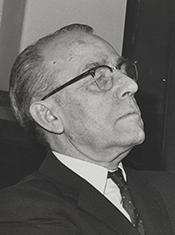
Harold Gross
Former U.S. Representative · Iowa District 3 · 1949–1975 · Republican
Harold Gross represented Iowa's District 3 in the United States House of Representatives (1949–1975) for the Republican party. The page below collects sourced biographical facts, term history, committee roles, and provenance for Gross.
Bioguide ID: G000495
Key facts
- Full name
- Harold Gross
- State
- Iowa
- District
- District 3
- Party
- Republican
- House service
- 1949–1975
- First House term
- 1949
- Status
- Left office
- Current term ends
- —
- Born
- 1899
- Bioguide ID
- G000495
- Committee assignments
- —
- Dataset version
- 1.20260605
Biographical narrative
907 words · sourced from the Wikipedia REST extract
H. R. Gross was a Republican politician who served as a United States Representative for Iowa's 3rd congressional district from 1949 until 1975. Known for his staunch fiscal conservatism and independent stance, Gross became a notable figure in Congress, often objecting to government spending measures he deemed excessive or wasteful. His approach to politics earned him the moniker "the useful pest" from Time magazine, reflecting his reputation for vigilance in fiscal matters and his willingness to challenge both party lines and prevailing political norms.
Early life and career
Harold Royce Gross was born on June 30, 1899, in Union County, Iowa, on a family farm that spanned 240 acres. Growing up in a rural environment, he received his education in local schools. In 1916, during his sophomore year of high school in Creston, Iowa, Gross enlisted in military service, concealing his age to do so. He initially served with the First Iowa Field Artillery during the Pancho Villa Expedition and later participated in World War I, where he served in France from 1917 to 1919.
After returning from military service, Gross pursued higher education, initially enrolling in an electrical engineering program at Iowa State College. He later transferred to the University of Missouri, where he studied journalism. His career in journalism began in 1921, and he worked as a reporter and editor for various newspapers until 1935. Notably, he edited the Iowa Union Farmer, a publication of the Iowa Farmer's Union, from 1929 to 1935. In 1935, he transitioned to radio, becoming a news commentator for WHO in Des Moines, Iowa. During this time, he worked alongside future President Ronald Reagan.
In 1929, Gross married Hazel Webster, whom he had met while covering the Iowa statehouse. The couple raised two children, Phillip and Alan. In 1940, Gross made an attempt to enter politics by running for Governor of Iowa. His campaign was characterized as a "sight-unseen" effort, relying solely on radio addresses and forgoing personal appearances. Despite a close primary race, he was ultimately defeated.
Following his gubernatorial campaign, Gross worked at a radio station in Ohio before moving to Indiana. After World War II, he returned to Iowa, where he resumed his career as a radio newscaster at KXEL in Waterloo.
House tenure
Gross's political career in the U.S. House of Representatives began in 1949 when he won a seat representing Iowa's 3rd congressional district. He entered Congress after defeating incumbent Republican John W. Gwynne in the primary election, a significant achievement given the lack of support from the party organization. Gross's first general election victory came in a challenging political climate, as the 1948 election saw Democratic President Harry S. Truman unexpectedly carry Iowa. Despite this, Gross secured his seat with a substantial margin.
Throughout his tenure, Gross was re-elected multiple times, serving a total of thirteen terms in the House. His political career was marked by a commitment to fiscal conservatism, and he became known for his critical stance on government spending. He was particularly vocal in his opposition to various appropriations and programs, including the Marshall Plan, foreign aid, and the U.S. Space Program. His independence was notable; he often voted against measures that he believed did not align with his principles, regardless of party pressure.
Gross's electoral success included surviving the 1964 Democratic landslide, where he was the only Republican from Iowa's congressional delegation to retain his seat. He chose to retire after his thirteenth term, opting not to run in the 1974 election. His time in Congress spanned from January 3, 1949, to January 3, 1975, during which he became a prominent figure known for his unwavering dedication to fiscal responsibility.
Legislative focus and committees
During his time in Congress, H. R. Gross developed a reputation as a vigilant watchdog of government spending. He rarely missed a roll call vote and was known for his attentive presence in the House chamber, where he scrutinized the details of pending legislation. His fiscal conservatism was characterized by a refusal to support what he considered unnecessary expenditures, including taxpayer-funded congressional trips, which he openly criticized. His colleagues recognized his commitment to these principles, with some noting that he lived frugally and often preferred solitary activities, such as watching professional wrestling on television, over social engagements typical of congressional life.
Gross's independent approach to politics was evident in his willingness to challenge the Eisenhower Administration and other party leaders. He famously remarked that he had taken his last marching orders during his military service, indicating his commitment to his own principles over party loyalty. His voting record attracted attention from various political commentators, including libertarian theorist Murray Rothbard, who praised Gross for his alignment with libertarian values.
Throughout his career, Gross expressed concerns about the implications of government spending and military pensions, advocating for fiscal restraint and accountability. He was particularly critical of the practice of allowing retired military personnel to receive both a pension and a federal paycheck. His independent stance often placed him at odds with prevailing political sentiments, but he remained steadfast in his beliefs, earning respect from both allies and opponents.
In summary, H. R. Gross's tenure in the U.S. House of Representatives was marked by a commitment to fiscal conservatism, independence from party pressures, and a vigilant approach to government spending. His legacy is characterized by his long service, his critical voice in Congress, and his dedication to the principles he believed in throughout his political career.
Notable legislation
Sponsored and co-sponsored legislation for Harold Gross is pending operator curation. The biographical narrative above carries the same provenance trail until per-bill rows are written.
Sources
- [1]https://en.wikipedia.org/wiki/H._R._GrossWikipedia · retrieved 2026-06-05
Notable quotes
Sourced quotes for Harold Gross are pending operator curation. Narrative-scope provenance remains attached below.
Sources
- [1]https://en.wikipedia.org/wiki/H._R._GrossWikipedia · retrieved 2026-06-05
Key positions
Curated policy positions for Harold Gross are pending operator review. The biographical narrative above carries the same provenance trail until per-topic positions are written.
Sources
- [1]https://en.wikipedia.org/wiki/H._R._GrossWikipedia · retrieved 2026-06-05
Terms served
- 1949–1951U.S. House · Term 1 · Republican
- 1951–1953U.S. House · Term 2 · Republican
- 1953–1955U.S. House · Term 3 · Republican
- 1955–1957U.S. House · Term 4 · Republican
- 1957–1959U.S. House · Term 5 · Republican
- 1959–1961U.S. House · Term 6 · Republican
- 1961–1963U.S. House · Term 7 · Republican
- 1963–1965U.S. House · Term 8 · Republican
- 1965–1967U.S. House · Term 9 · Republican
- 1967–1969U.S. House · Term 10 · Republican
- 1969–1971U.S. House · Term 11 · Republican
- 1971–1973U.S. House · Term 12 · Republican
- 1973–1975U.S. House · Term 13 · Republican
Sources & provenance
Every attributable claim above carries a per-section [N] marker that resolves to the corresponding URL below. Each entry records the upstream provider, the canonical URL, and the timestamp at which the source was retrieved by the ingest pipeline.
Key facts
- https://bioguide.congress.gov/search/bio/G000495bioguide · retrieved 2026-06-05
- https://www.govtrack.us/congress/members/404840govtrack · retrieved 2026-06-05
Biographical narrative
- https://en.wikipedia.org/wiki/H._R._Grosswikipedia · retrieved 2026-06-05
Find your representative
Every U.S. state elects representatives by district. Browse Iowa’s delegation, the full former-representative roster, or explore the role and term length.
Related on The Candidate
- Preceded by John GwynneEarlier holder of the Iowa District 3 House seat · Republican.Open
- Succeeded by Thomas EvansLater holder of the Iowa District 3 House seat · Republican.Open
- Abby FinkenauerFormer U.S. Representative · Iowa District 1 · DemocraticOpen
- Augustus HallFormer U.S. Representative · Iowa District 1 · DemocraticOpen
- Benton HallFormer U.S. Representative · Iowa District 1 · DemocraticOpen
- Bernhart HennFormer U.S. Representative · Iowa District 1 · DemocraticOpen