
Historical · U.S. House · Iowa · District 3
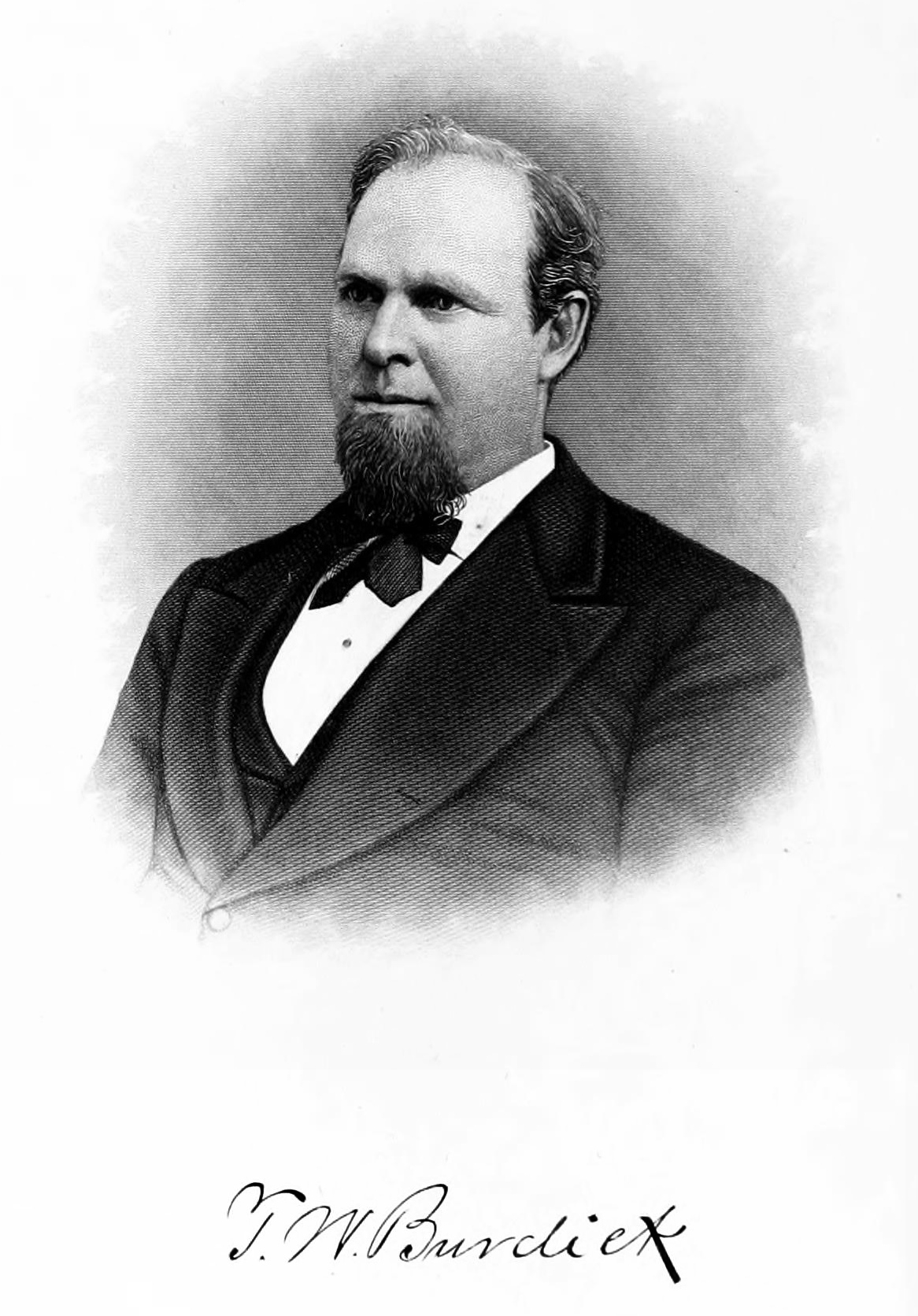
Theodore Burdick
Former U.S. Representative · Iowa District 3 · 1877–1879 · Republican
Theodore Burdick represented Iowa's District 3 in the United States House of Representatives (1877–1879) for the Republican party. The page below collects sourced biographical facts, term history, committee roles, and provenance for Burdick.
Bioguide ID: B001078
Key facts
- Full name
- Theodore Burdick
- State
- Iowa
- District
- District 3
- Party
- Republican
- House service
- 1877–1879
- First House term
- 1877
- Status
- Left office
- Current term ends
- —
- Born
- 1836
- Bioguide ID
- B001078
- Committee assignments
- —
- Dataset version
- 1.20260606
Biographical narrative
961 words · sourced from the Wikipedia REST extract
Theodore Weld Burdick was an American banker, Civil War veteran, and politician who served as a Republican U.S. Representative for Iowa's 3rd congressional district from 1877 to 1879. His career spanned various roles in public service and finance, reflecting the dynamic changes in American society during the late 19th century. Burdick's contributions to his community and his involvement in the political landscape of Iowa are notable aspects of his life.
Early life and career
Theodore Burdick was born on October 7, 1836, in Evansburg, Pennsylvania. He grew up in a period marked by significant social and economic changes in the United States. His early education took place in common schools, which were the primary educational institutions of the time, providing foundational knowledge to young Americans. In 1853, Burdick and his family relocated to Decorah, Iowa, a move that would shape his future career and community involvement.
At the age of seventeen, Burdick became the first schoolteacher in Decorah, an early indication of his commitment to education and community service. His role as an educator allowed him to contribute to the development of the local youth and establish a reputation as a responsible and engaged citizen. Following his tenure as a teacher, Burdick took on additional responsibilities in public service. From 1854 to 1857, he served as a deputy treasurer and recorder for Winneshiek County, where he gained valuable experience in financial management and local governance. His dedication to public service continued as he was elected treasurer and recorder of the county from 1858 to 1862.
In 1862, amid the growing conflict of the Civil War, Burdick resigned from his county position to enlist in the Union Army. He was commissioned as a captain and assigned to Company D of the 6th Regiment Iowa Volunteer Cavalry. His military service lasted three years, during which he was stationed in the Department of the Northwest. Burdick's unit was involved in various operations, particularly in response to uprisings by Native Americans against settlers in southern Minnesota and the Dakota Territory. This experience not only highlighted his commitment to the Union cause but also exposed him to the complexities of American frontier life during a tumultuous period in the nation's history. After the war, Burdick returned to Decorah, where he transitioned into a career in banking, becoming the cashier of the First National Bank.
House tenure
Theodore Burdick's political career took a significant step forward when he was elected to the U.S. House of Representatives as a Republican in 1876. He officially took office on March 4, 1877, as a member of the Forty-fifth Congress, representing Iowa's 3rd congressional district. His election came during a time of political realignment in the United States, as the nation was recovering from the Civil War and grappling with issues related to reconstruction, economic development, and westward expansion.
During his time in Congress, Burdick served on the House Committee on Expenditures, a role that involved oversight of government spending and accountability. This committee was crucial in ensuring that federal funds were used appropriately, reflecting the growing concern for fiscal responsibility in government. Burdick's tenure in the House lasted until March 3, 1879, when he completed his term. However, he chose not to seek renomination in 1878, marking the end of his congressional career after a single term. His decision not to pursue re-election may have been influenced by various factors, including personal considerations and the political climate of the time.
Legislative focus and committees
During his time in the House of Representatives, Theodore Burdick's legislative focus aligned with the priorities of the Republican Party, which was primarily concerned with issues such as economic development, infrastructure, and the integration of the western territories into the Union. The late 19th century was a period of significant transformation in the United States, characterized by rapid industrialization, the expansion of the railroad network, and the ongoing challenges of post-war reconstruction.
As a member of the House Committee on Expenditures, Burdick was involved in discussions regarding the allocation of federal funds, which were critical for supporting various initiatives, including infrastructure projects that would facilitate westward expansion and economic growth. His background in banking likely informed his perspective on financial matters, allowing him to contribute meaningfully to debates about fiscal policy and government spending.
Although specific legislative achievements during Burdick's term are not detailed in the available records, his participation in the committee suggests a focus on ensuring that government expenditures were managed effectively and transparently. This was particularly important during a time when the federal government was expanding its role in various aspects of American life, including economic development and public works.
After completing his term in Congress, Burdick returned to his banking career in Decorah and Sault Ste. Marie, Michigan, where he continued to influence local economies through his financial expertise. His involvement in banking also reflects the broader economic trends of the time, as financial institutions played a crucial role in supporting the growth of communities and facilitating commerce.
In addition to his banking career, Burdick remained active in public service. He served as a member of the Iowa Senate in 1886 and 1887, further demonstrating his commitment to civic engagement and governance. His legislative experience at both the state and federal levels provided him with a comprehensive understanding of the political landscape and the needs of his constituents.
Theodore Burdick passed away on July 16, 1898, in Decorah, Iowa. His contributions to his community, both as a banker and a public servant, left a lasting impact on the region. He was interred in Phelps Cemetery, where he rests alongside other notable figures from the area. Burdick's life reflects the complexities of American history during the 19th century, marked by significant social, political, and economic changes that shaped the nation.
Notable legislation
Sponsored and co-sponsored legislation for Theodore Burdick is pending operator curation. The biographical narrative above carries the same provenance trail until per-bill rows are written.
Sources
- [1]https://en.wikipedia.org/wiki/Theodore_Weld_BurdickWikipedia · retrieved 2026-06-06
Notable quotes
Sourced quotes for Theodore Burdick are pending operator curation. Narrative-scope provenance remains attached below.
Sources
- [1]https://en.wikipedia.org/wiki/Theodore_Weld_BurdickWikipedia · retrieved 2026-06-06
Key positions
Curated policy positions for Theodore Burdick are pending operator review. The biographical narrative above carries the same provenance trail until per-topic positions are written.
Sources
- [1]https://en.wikipedia.org/wiki/Theodore_Weld_BurdickWikipedia · retrieved 2026-06-06
Terms served
- 1877–1879U.S. House · Term 1 · Republican
Sources & provenance
Every attributable claim above carries a per-section [N] marker that resolves to the corresponding URL below. Each entry records the upstream provider, the canonical URL, and the timestamp at which the source was retrieved by the ingest pipeline.
Key facts
- https://bioguide.congress.gov/search/bio/B001078bioguide · retrieved 2026-06-06
- https://www.govtrack.us/congress/members/402024govtrack · retrieved 2026-06-06
Biographical narrative
- https://en.wikipedia.org/wiki/Theodore_Weld_Burdickwikipedia · retrieved 2026-06-06
Find your representative
Every U.S. state elects representatives by district. Browse Iowa’s delegation, the full former-representative roster, or explore the role and term length.
Related on The Candidate
- Preceded by Lucien AinsworthEarlier holder of the Iowa District 3 House seat · Democratic.Open
- Succeeded by David HendersonLater holder of the Iowa District 3 House seat · Republican.Open
- Abby FinkenauerFormer U.S. Representative · Iowa District 1 · DemocraticOpen
- Augustus HallFormer U.S. Representative · Iowa District 1 · DemocraticOpen
- Benton HallFormer U.S. Representative · Iowa District 1 · DemocraticOpen
- Bernhart HennFormer U.S. Representative · Iowa District 1 · DemocraticOpen