
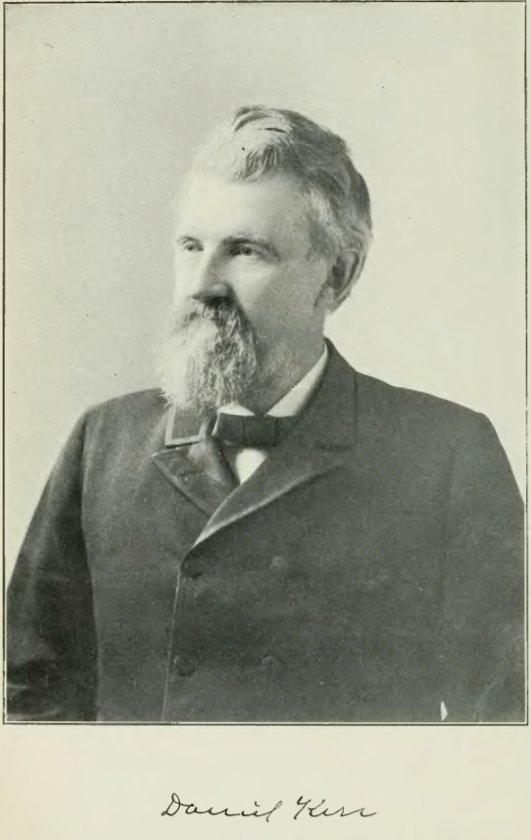
Historical · U.S. House · Iowa · District 5
Daniel Kerr
Former U.S. Representative · Iowa District 5 · 1887–1891 · Republican
Daniel Kerr represented Iowa's District 5 in the United States House of Representatives (1887–1891) for the Republican party. The page below collects sourced biographical facts, term history, committee roles, and provenance for Kerr.
Bioguide ID: K000134
Key facts
- Full name
- Daniel Kerr
- State
- Iowa
- District
- District 5
- Party
- Republican
- House service
- 1887–1891
- First House term
- 1887
- Status
- Left office
- Current term ends
- —
- Born
- 1836
- Bioguide ID
- K000134
- Committee assignments
- —
- Dataset version
- 1.20260606
Biographical narrative
993 words · sourced from the Wikipedia REST extract
Daniel Kerr was an American politician who served as a Republican U.S. Representative for Iowa's 5th congressional district during the late 19th century. His political career spanned two terms in the U.S. House of Representatives, where he was involved in various legislative matters and local governance. Born in Scotland and later emigrating to the United States, Kerr's early life and career were marked by his dedication to public service, law, and community leadership. After his tenure in Congress, he transitioned to the Democratic Party and continued to engage in political activities until his later years.
Early life and career
Daniel Kerr was born on June 18, 1836, near Dalry in Ayrshire, Scotland. In 1841, he emigrated to the United States with his parents, Hugh Kerr and Margaret Galt, settling in Madison County, Illinois. Kerr's early education took place in common schools, where he laid the foundation for his future pursuits. He furthered his education at McKendree College, from which he graduated in 1858. This academic background equipped him with the knowledge and skills that would later serve him in his legal and political endeavors.
Following his graduation, Kerr studied law and was admitted to the bar in 1862. He began his legal practice in Edwardsville, Illinois, where he established himself as a competent attorney. His commitment to public service was evident when he enlisted in the Union Army during the Civil War on August 12, 1862. Kerr's military service included a rise through the ranks, as he was promoted to second lieutenant in 1863 and then to first lieutenant in 1864, serving with the 117th Illinois Volunteer Infantry Regiment.
After the war, Kerr returned to Illinois and continued his legal career. His political aspirations took shape when he was elected to the Illinois House of Representatives in 1868, serving until 1870. This experience in state politics provided him with valuable insights into governance and legislative processes. In 1870, he relocated to Grundy Center, Iowa, where he continued to practice law and also became involved in agriculture. His commitment to education was demonstrated when he served as a school director in 1875, reflecting his interest in community development and youth education.
Kerr's political career in Iowa began to take off when he was elected mayor of Grundy Center in 1877. His leadership in local government further solidified his reputation as a dedicated public servant. In 1883, he was elected to the Iowa House of Representatives, where he continued to advocate for the interests of his constituents. His growing political influence and connections within the Republican Party set the stage for his future candidacy for Congress.
House tenure
In 1886, Kerr sought the Republican nomination for Iowa's 5th congressional district. His campaign was marked by a contentious primary process, which involved significant rivalry among party members. At the time of his nomination, Kerr was the owner of the Grundy Center Argus, a Republican newspaper, which likely played a role in his political visibility. Despite the challenges he faced during the nomination process, he successfully unseated the incumbent Democrat, Benjamin T. Frederick, and was elected to the 50th United States Congress. His first term began on March 4, 1887.
Kerr's tenure in Congress was characterized by his involvement in various legislative initiatives and his participation in the broader political landscape of the time. He was re-elected in 1888 to serve in the Fifty-first Congress, continuing his work on behalf of his constituents in Iowa. Throughout his time in office, he engaged with the pressing issues of the day, contributing to discussions and decisions that shaped national policy.
After completing his second term, which ended on March 3, 1891, Kerr chose not to seek a third term in 1890. His decision to step back from Congress allowed him to return to his legal practice, where he continued to apply his skills and experience in the field of law. His time in Congress was significant, as it marked a period of active engagement in national politics during a transformative era in American history.
Legislative focus and committees
During his time in the U.S. House of Representatives, Daniel Kerr was involved in various legislative matters that reflected the interests and concerns of his constituents in Iowa. While specific details about the bills he sponsored or the committees he served on are not provided, it is known that he was an active participant in the political discourse of his time. His background as a lawyer and his experience in local government likely informed his legislative priorities and approach to governance.
Kerr's political affiliations shifted over time, particularly after his congressional service. He was a delegate to the Republican National Convention in both 1888 and 1896, indicating his ongoing involvement in party politics. However, in 1896, he expressed support for the free coinage of silver, a position that aligned more closely with the Democratic presidential candidate William Jennings Bryan than with his own party's nominee, William McKinley. This divergence in political alignment led to Kerr's eventual switch to the Democratic Party.
Following his party switch, Kerr attempted to regain a seat in Congress as a Democratic candidate in 1900, but he was unsuccessful in his bid. His political career, however, did not end with this defeat. He remained engaged in civic affairs and continued to contribute to his community.
In his later years, Kerr moved to Pasadena, California, in 1909, where he lived until 1916. He eventually returned to Grundy Center, Iowa, where he passed away on October 8, 1916. His final resting place is in Rose Hill Cemetery, marking the end of a life dedicated to public service and community involvement.
Daniel Kerr's legacy is one of a committed public servant who navigated the complexities of political life in the late 19th century. His journey from Scotland to the halls of Congress illustrates the opportunities available in the United States during that era, as well as the challenges faced by politicians in a rapidly changing political landscape.
Notable legislation
Sponsored and co-sponsored legislation for Daniel Kerr is pending operator curation. The biographical narrative above carries the same provenance trail until per-bill rows are written.
Sources
- [1]https://en.wikipedia.org/wiki/Daniel_Kerr_(politician)Wikipedia · retrieved 2026-06-06
Notable quotes
Sourced quotes for Daniel Kerr are pending operator curation. Narrative-scope provenance remains attached below.
Sources
- [1]https://en.wikipedia.org/wiki/Daniel_Kerr_(politician)Wikipedia · retrieved 2026-06-06
Key positions
Curated policy positions for Daniel Kerr are pending operator review. The biographical narrative above carries the same provenance trail until per-topic positions are written.
Sources
- [1]https://en.wikipedia.org/wiki/Daniel_Kerr_(politician)Wikipedia · retrieved 2026-06-06
Terms served
- 1887–1889U.S. House · Term 1 · Republican
- 1889–1891U.S. House · Term 2 · Republican
Sources & provenance
Every attributable claim above carries a per-section [N] marker that resolves to the corresponding URL below. Each entry records the upstream provider, the canonical URL, and the timestamp at which the source was retrieved by the ingest pipeline.
Key facts
- https://bioguide.congress.gov/search/bio/K000134bioguide · retrieved 2026-06-06
- https://www.govtrack.us/congress/members/406300govtrack · retrieved 2026-06-06
Biographical narrative
- https://en.wikipedia.org/wiki/Daniel_Kerr_(politician)wikipedia · retrieved 2026-06-06
Find your representative
Every U.S. state elects representatives by district. Browse Iowa’s delegation, the full former-representative roster, or explore the role and term length.
Related on The Candidate
- Preceded by Benjamin FrederickEarlier holder of the Iowa District 5 House seat · Democratic.Open
- Succeeded by John HamiltonLater holder of the Iowa District 5 House seat · Democratic.Open
- Abby FinkenauerFormer U.S. Representative · Iowa District 1 · DemocraticOpen
- Augustus HallFormer U.S. Representative · Iowa District 1 · DemocraticOpen
- Benton HallFormer U.S. Representative · Iowa District 1 · DemocraticOpen
- Bernhart HennFormer U.S. Representative · Iowa District 1 · DemocraticOpen