
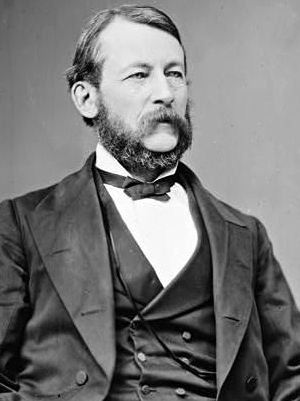
Historical · U.S. House · Iowa · District 7
John Kasson
Former U.S. Representative · Iowa District 7 · 1863–1885 · Republican
John Kasson represented Iowa's District 7 in the United States House of Representatives (1863–1885) for the Republican party. The page below collects sourced biographical facts, term history, committee roles, and provenance for Kasson.
Bioguide ID: K000018
Key facts
- Full name
- John Kasson
- State
- Iowa
- District
- District 7
- Party
- Republican
- House service
- 1863–1885
- First House term
- 1863
- Status
- Left office
- Current term ends
- —
- Born
- 1822
- Bioguide ID
- K000018
- Committee assignments
- —
- Dataset version
- 1.20260606
Biographical narrative
911 words · sourced from the Wikipedia REST extract
John Kasson was a prominent American lawyer, politician, and diplomat in the 19th century, who served as a U.S. Representative for Iowa's 7th congressional district. A member of the Republican Party, Kasson was elected to the House of Representatives six times, with his congressional service spanning from 1863 to 1885. His career was marked by significant contributions to both legislative processes and diplomatic missions, reflecting his influence in shaping policies during a transformative era in American history.
Early life and career
John Kasson was born on January 11, 1822, in Charlotte, Vermont, to John Steele Kasson and Nancy Blackman. He received his early education in local schools and went on to graduate from the University of Vermont in 1842. Following his graduation, Kasson pursued a career in law, gaining admission to the bar and beginning his legal practice in St. Louis, Missouri. In 1857, he relocated to Des Moines, Iowa, where he continued his law practice and became actively involved in local politics.
Kasson's political career began to take shape when he served as a delegate to the Republican National Convention in 1860. His role at the convention was significant; he was appointed to the platform committee and played a crucial part in drafting the party's platform, which included key antislavery provisions. This platform would later be referenced by southern states as they seceded following the election of Abraham Lincoln. In 1861, Kasson was appointed by President Lincoln as the First Assistant Postmaster General, a position he held until August 1862. His work in this role helped to shape postal policies during a critical period in American history.
House tenure
Kasson's congressional career began when he was elected as a Republican to represent Iowa's newly established 5th congressional district in 1862. His district encompassed 22 counties in southwestern Iowa, including the city of Des Moines. He took office in 1863 and served two terms until 1867. During his time in the House, Kasson was appointed as the chairman of the United States House Committee on Coinage, Weights, and Measures. In this capacity, he played a pivotal role in the passage of the Metric Act of 1866, which he had drafted, thereby influencing the standardization of measurements in the United States.
In addition to his legislative duties, Kasson was appointed as a commissioner to the International Postal Congress in Paris in 1863. However, his political journey faced challenges when he lost the Republican nomination in 1866 to General Grenville M. Dodge, a notable figure from the Civil War and Indian Campaigns. Following this setback, Kasson continued to engage in diplomatic efforts, serving as a commissioner to negotiate postal conventions with several European nations in 1867.
Kasson returned to state politics in 1868 when he was elected to the Iowa House of Representatives, serving until 1872. In 1872, he was elected to represent Iowa's newly created 7th congressional district, which included ten counties in south-central Iowa. He served in this capacity from 1873 to 1877. Despite speculation about his potential candidacy for Speaker of the House in 1876, he chose not to seek renomination that year.
In 1877, Kasson's career took a diplomatic turn when President Rutherford B. Hayes appointed him as the Envoy Extraordinary and Minister Plenipotentiary to Austria-Hungary. He held this position until early 1881, during which time he suggested the minting of the four dollar Stella pattern coins in 1879 and 1880. Kasson returned to Congress in 1880, winning both the Republican nomination and the general election for Iowa's 7th congressional district. He was re-elected and served until 1884, when he was appointed as Envoy and Head of the U.S. Legation in Berlin, Germany, by President Chester A. Arthur. His diplomatic service continued with his appointment as a special envoy to the Congo Conference in Berlin in 1885.
Legislative focus and committees
Throughout his congressional tenure, Kasson was involved in various legislative initiatives, particularly in the areas of coinage and postal services. As chairman of the House Committee on Coinage, Weights, and Measures, he was instrumental in the passage of the Metric Act of 1866, which aimed to standardize measurements in the United States. This legislation was significant as it laid the groundwork for future discussions on measurement systems and their adoption in the country.
Kasson's involvement in postal matters extended beyond his congressional duties. His participation as a commissioner at the International Postal Congress highlighted his commitment to improving international postal services. His efforts in negotiating postal conventions with multiple European nations further underscored his expertise in this area, contributing to the establishment of more efficient communication channels between the United States and other countries.
In addition to his legislative work, Kasson's diplomatic roles allowed him to engage in international affairs, where he represented U.S. interests in various capacities. His appointment as a special commissioner plenipotentiary to negotiate reciprocity treaties in 1897 and his participation in the United States and British Joint High Commission in 1898 demonstrated his ongoing influence in shaping U.S. foreign policy.
Kasson's career reflects a blend of legislative and diplomatic achievements, showcasing his versatility as a public servant. His contributions to both the House of Representatives and the diplomatic service illustrate the interconnected nature of domestic and international policy during a pivotal time in American history. John Kasson passed away on May 18, 1910, in Washington, D.C., and was interred in Woodland Cemetery in Des Moines, leaving behind a legacy of public service that spanned several decades and encompassed significant historical events.
Notable legislation
Sponsored and co-sponsored legislation for John Kasson is pending operator curation. The biographical narrative above carries the same provenance trail until per-bill rows are written.
Sources
- [1]https://en.wikipedia.org/wiki/John_A._KassonWikipedia · retrieved 2026-06-06
Notable quotes
Sourced quotes for John Kasson are pending operator curation. Narrative-scope provenance remains attached below.
Sources
- [1]https://en.wikipedia.org/wiki/John_A._KassonWikipedia · retrieved 2026-06-06
Key positions
Curated policy positions for John Kasson are pending operator review. The biographical narrative above carries the same provenance trail until per-topic positions are written.
Sources
- [1]https://en.wikipedia.org/wiki/John_A._KassonWikipedia · retrieved 2026-06-06
Terms served
- 1863–1865U.S. House · Term 1 · Republican
- 1865–1867U.S. House · Term 2 · Republican
- 1873–1875U.S. House · Term 3 · Republican
- 1875–1877U.S. House · Term 4 · Republican
- 1881–1883U.S. House · Term 5 · Republican
- 1883–1885U.S. House · Term 6 · Republican
Sources & provenance
Every attributable claim above carries a per-section [N] marker that resolves to the corresponding URL below. Each entry records the upstream provider, the canonical URL, and the timestamp at which the source was retrieved by the ingest pipeline.
Key facts
- https://bioguide.congress.gov/search/bio/K000018bioguide · retrieved 2026-06-06
- https://www.govtrack.us/congress/members/406189govtrack · retrieved 2026-06-06
Biographical narrative
- https://en.wikipedia.org/wiki/John_A._Kassonwikipedia · retrieved 2026-06-06
Find your representative
Every U.S. state elects representatives by district. Browse Iowa’s delegation, the full former-representative roster, or explore the role and term length.
Related on The Candidate
- Succeeded by Edwin CongerLater holder of the Iowa District 7 House seat · Republican.Open
- Abby FinkenauerFormer U.S. Representative · Iowa District 1 · DemocraticOpen
- Augustus HallFormer U.S. Representative · Iowa District 1 · DemocraticOpen
- Benton HallFormer U.S. Representative · Iowa District 1 · DemocraticOpen
- Bernhart HennFormer U.S. Representative · Iowa District 1 · DemocraticOpen
- Republican PartyFederal candidates and office holders on the Republican line.Open