
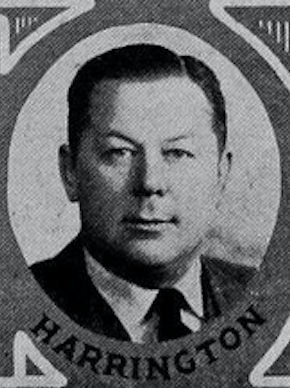
Historical · U.S. House · Iowa · District 9
Vincent Harrington
Former U.S. Representative · Iowa District 9 · 1937–1943 · Democratic
Vincent Harrington represented Iowa's District 9 in the United States House of Representatives (1937–1943) for the Democratic party. The page below collects sourced biographical facts, term history, committee roles, and provenance for Harrington.
Bioguide ID: H000231
Key facts
- Full name
- Vincent Harrington
- State
- Iowa
- District
- District 9
- Party
- Democratic
- House service
- 1937–1943
- First House term
- 1937
- Status
- Left office
- Current term ends
- —
- Born
- 1903
- Bioguide ID
- H000231
- Committee assignments
- —
- Dataset version
- 1.20260605
Biographical narrative
931 words · sourced from the Wikipedia REST extract
Vincent Harrington was a Democratic politician who served as a U.S. Representative for Iowa's 9th congressional district from 1937 until his resignation in 1942. Born in Sioux City, Iowa, in 1903, Harrington had a diverse background that included education, athletics, and business before entering politics. His congressional career was marked by significant events, including his service during World War II, which ultimately led to his untimely death while on active duty. Harrington's legacy includes a Liberty Ship named in his honor, reflecting his contributions to both his state and the nation.
Early life and career
Vincent Francis Harrington was born on May 16, 1903, in Sioux City, Iowa, to Thomas F. and Maria Harrington. He received his early education at Cathedral Grammar School in Sioux City before attending Trinity College Academy, a local institution established by the Order of St. Francis on land acquired from his family. Harrington furthered his education at the University of Notre Dame in South Bend, Indiana, where he was a member of the football team coached by the renowned Knute Rockne. He played as a second-string player on the celebrated "Four Horsemen" team during the 1924 season, which is remembered for its dominance in college football.
After graduating from Notre Dame in 1925, Harrington took on the role of instructor and athletic director at Columbia University, now known as the University of Portland, in Oregon. He taught economics and history from 1926 to 1927. Following this brief academic career, he returned to Sioux City to work alongside his father at Continental Mortgage Company. Harrington held various positions within the company, eventually becoming vice president and general manager.
On June 7, 1927, Harrington married Catherine O'Connor from Homer, Nebraska. The couple had two daughters, Catherine Tim and Patricia Ann Harrington. His family life and professional experiences in business and education laid a foundation for his later political career.
House tenure
Harrington's political career began in earnest when he was elected to the Iowa Senate, where he served from 1933 to 1937. His tenure in the state legislature provided him with valuable experience in governance and public service. In 1936, Harrington sought the Democratic nomination for Lieutenant Governor of Iowa. However, a significant shift in the political landscape occurred when Democratic U.S. Senator Richard Louis Murphy died in a car accident. This event prompted Harrington to withdraw from the lieutenant governor race and accept the Democratic nomination for the U.S. House of Representatives, aiming to fill the vacancy left by Congressman Guy M. Gillette, who was running for the Senate.
Harrington successfully won the general election, defeating Republican candidate Fred B. Wolf by a margin of over 10,000 votes. He began his first term in the House of Representatives in 1937 and was re-elected in 1938 and 1940. However, his subsequent re-elections were considerably narrower. In 1938, he won by just 269 votes after a contentious election that involved challenges to the validity of some ballots. His 1940 victory was similarly close, with a margin of only 2,140 votes.
The 1941 reapportionment, which followed the 1940 census, resulted in Iowa losing one of its congressional seats. This change reconfigured the congressional districts, impacting Harrington's electoral prospects. The old 9th district, which he represented, was transformed into the new 8th district, with certain areas, including Monona County, removed from his constituency. This alteration was seen as detrimental to his chances for re-election in 1942.
As the United States approached its entry into World War II, Harrington's political stance shifted. Initially, he had aligned with a policy of strict neutrality, opposing additional funding for the Lend-Lease program and other measures that would escalate U.S. involvement in the conflict. However, following the attack on Pearl Harbor, he voted for a declaration of war, which led him to fulfill a promise he had made during his campaign: if he ever voted for war, he would enlist.
Legislative focus and committees
During his time in the House, Harrington's legislative focus reflected the concerns and interests of his constituents in Iowa. His initial opposition to expanding U.S. involvement in international conflicts mirrored the sentiments of many Iowans at the time. However, as the war progressed, he recognized the need for military engagement and took steps to serve his country.
In May 1942, Harrington was commissioned as a captain in the United States Army Air Forces and took a leave of absence from Congress. His decision to resign from his congressional seat was influenced by President Franklin D. Roosevelt's order that required members of Congress who were serving in the military to resign from one position or the other. Harrington resigned on September 5, 1942, to honor his commitment to serve in the military.
His resignation created a unique situation for voters in his district, who had to cast two separate votes in the 1942 general election: one to fill the remainder of Harrington's term and another for the new congressional seat in the reconfigured district. Ultimately, two Republican candidates were elected to fill these positions, marking a shift in representation for the district.
Harrington's military service continued until his death on November 29, 1943, while he was stationed in England as a security control officer. He passed away from a heart attack and was interred at the Cambridge American Cemetery in Cambridge, England. In recognition of his service and contributions, a Liberty Ship was named the SS Vincent Harrington, which was christened by his widow in July 1944. Harrington's life and career reflect a commitment to public service, both in civilian and military capacities, during a pivotal time in American history.
Notable legislation
Sponsored and co-sponsored legislation for Vincent Harrington is pending operator curation. The biographical narrative above carries the same provenance trail until per-bill rows are written.
Sources
- [1]https://en.wikipedia.org/wiki/Vincent_F._HarringtonWikipedia · retrieved 2026-06-05
Notable quotes
Sourced quotes for Vincent Harrington are pending operator curation. Narrative-scope provenance remains attached below.
Sources
- [1]https://en.wikipedia.org/wiki/Vincent_F._HarringtonWikipedia · retrieved 2026-06-05
Key positions
Curated policy positions for Vincent Harrington are pending operator review. The biographical narrative above carries the same provenance trail until per-topic positions are written.
Sources
- [1]https://en.wikipedia.org/wiki/Vincent_F._HarringtonWikipedia · retrieved 2026-06-05
Terms served
- 1937–1939U.S. House · Term 1 · Democratic
- 1939–1941U.S. House · Term 2 · Democratic
- 1941–1943U.S. House · Term 3 · Democratic
Sources & provenance
Every attributable claim above carries a per-section [N] marker that resolves to the corresponding URL below. Each entry records the upstream provider, the canonical URL, and the timestamp at which the source was retrieved by the ingest pipeline.
Key facts
- https://bioguide.congress.gov/search/bio/H000231bioguide · retrieved 2026-06-05
- https://www.govtrack.us/congress/members/405109govtrack · retrieved 2026-06-05
Biographical narrative
- https://en.wikipedia.org/wiki/Vincent_F._Harringtonwikipedia · retrieved 2026-06-05
Find your representative
Every U.S. state elects representatives by district. Browse Iowa’s delegation, the full former-representative roster, or explore the role and term length.
Related on The Candidate
- Preceded by Charles SwansonEarlier holder of the Iowa District 9 House seat · Republican.Open
- Abby FinkenauerFormer U.S. Representative · Iowa District 1 · DemocraticOpen
- Augustus HallFormer U.S. Representative · Iowa District 1 · DemocraticOpen
- Benton HallFormer U.S. Representative · Iowa District 1 · DemocraticOpen
- Bernhart HennFormer U.S. Representative · Iowa District 1 · DemocraticOpen
- Democratic PartyFederal candidates and office holders on the Democratic line.Open