
Historical · U.S. House · Kansas · District 4
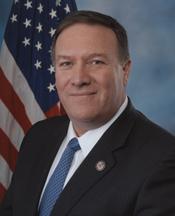
Mike Pompeo
Former U.S. Representative · Kansas District 4 · 2011–2017 · Republican
Mike Pompeo represented Kansas's District 4 in the United States House of Representatives (2011–2017) for the Republican party. The page below collects sourced biographical facts, term history, committee roles, and provenance for Pompeo.
Bioguide ID: P000602
Key facts
- Full name
- Mike Pompeo
- State
- Kansas
- District
- District 4
- Party
- Republican
- House service
- 2011–2017
- First House term
- 2011
- Status
- Left office
- Current term ends
- —
- Born
- 1963
- Bioguide ID
- P000602
- Committee assignments
- —
- Dataset version
- 1.20260605
Biographical narrative
881 words · sourced from the Wikipedia REST extract
Michael Richard Pompeo is a former U.S. Representative who served Kansas's 4th congressional district from 2011 until 2017. A member of the Republican Party, Pompeo transitioned to significant roles in the federal government, including serving as the Director of the Central Intelligence Agency and later as the Secretary of State during the Trump administration. His political career is marked by a focus on national security, foreign policy, and a strong stance against the Chinese Communist Party.
Early life and career
Mike Pompeo was born on December 30, 1963, in Orange, California. He is the son of Dorothy and Wayne Pompeo. His family has Italian roots, with his paternal great-grandparents emigrating from Italy to the United States in the late 19th century. Pompeo completed his high school education at Los Amigos High School in Fountain Valley, California, where he was active in sports, particularly basketball.
In 1982, he graduated from high school and went on to attend the United States Military Academy at West Point, where he excelled academically. He graduated in 1986 at the top of his class, majoring in engineering management. During his time at West Point, he formed lasting relationships with fellow graduates, including Brian Bulatao and Ulrich Brechbuhl, who would later become influential figures in his career.
Following his graduation, Pompeo served in the U.S. Army from 1986 to 1991. He was stationed in West Germany with the 2nd Squadron, 7th Cavalry of the 4th Infantry Division, where he held various leadership positions, including tank platoon leader and squadron maintenance officer, ultimately leaving the Army with the rank of captain.
After his military service, Pompeo pursued a legal education at Harvard Law School, earning his Juris Doctor degree in 1994. While at Harvard, he was actively involved in academic publications, serving as an editor for both the Harvard Law Review and the Harvard Journal of Law & Public Policy. Following law school, he began his professional career as an attorney at the prestigious law firm Williams & Connolly in Washington, D.C.
In 1996, Pompeo relocated to Wichita, Kansas, where he co-founded Thayer Aerospace, a company focused on manufacturing aircraft parts. This venture was backed by significant investments from Koch Industries and other private equity firms. Over the years, he played a crucial role in growing the company, which eventually became known as Nex-Tech Aerospace. In 2006, he sold his stake in the company and subsequently became president of Sentry International, an oilfield equipment manufacturer.
House tenure
Pompeo entered politics and was elected to the United States House of Representatives in 2010, representing Kansas's 4th congressional district. His first term began in 2011, and he served a total of four terms in the House until his departure in January 2017. During his time in Congress, Pompeo was known for his active engagement in various legislative matters and his alignment with Republican Party priorities.
Throughout his tenure, Pompeo was involved in numerous issues, particularly those related to national security and foreign policy. He was a member of the House Intelligence Committee, where he contributed to discussions and decisions regarding intelligence operations and oversight. His background as a former Army officer and attorney informed his approach to these complex issues.
In the 2016 presidential election cycle, Pompeo initially expressed criticism of Donald Trump, labeling him as "authoritarian" and "not a conservative believer." However, as Trump secured the Republican nomination, Pompeo shifted his stance and endorsed him. This endorsement marked a significant turning point in his political alignment and set the stage for his subsequent appointments in the Trump administration.
Legislative focus and committees
During his time in the House, Pompeo focused on a range of issues, with a particular emphasis on national security, intelligence, and foreign relations. His experience as a military officer and attorney provided him with a unique perspective on these topics, allowing him to contribute meaningfully to legislative discussions.
Pompeo was a vocal advocate for a strong U.S. military presence and robust national defense policies. He often highlighted the need for the United States to take a firm stance against adversarial nations, particularly in relation to China and Iran. His criticisms of the Chinese Communist Party were prominent during his tenure, where he called attention to issues such as human rights abuses and aggressive territorial claims in the South China Sea.
In addition to his focus on foreign policy, Pompeo was involved in various committees that shaped domestic legislation. He participated in discussions surrounding economic policies, healthcare, and energy, reflecting the diverse interests of his constituents in Kansas. His legislative efforts were often aligned with the broader goals of the Republican Party, advocating for limited government intervention and free-market principles.
Pompeo's time in the House concluded in January 2017 when he was appointed as the Director of the Central Intelligence Agency by President Trump. His transition from Congress to a high-level executive role marked a significant shift in his career, allowing him to influence U.S. intelligence and national security policy on a broader scale.
Overall, Mike Pompeo's tenure in the U.S. House of Representatives was characterized by a strong commitment to national security and a focus on foreign policy issues. His legislative work laid the foundation for his subsequent roles in the Trump administration, where he continued to shape U.S. policy on the global stage.
Notable legislation
Sponsored and co-sponsored legislation for Mike Pompeo is pending operator curation. The biographical narrative above carries the same provenance trail until per-bill rows are written.
Sources
- [1]https://en.wikipedia.org/wiki/Mike_PompeoWikipedia · retrieved 2026-06-05
Notable quotes
Sourced quotes for Mike Pompeo are pending operator curation. Narrative-scope provenance remains attached below.
Sources
- [1]https://en.wikipedia.org/wiki/Mike_PompeoWikipedia · retrieved 2026-06-05
Key positions
Curated policy positions for Mike Pompeo are pending operator review. The biographical narrative above carries the same provenance trail until per-topic positions are written.
Sources
- [1]https://en.wikipedia.org/wiki/Mike_PompeoWikipedia · retrieved 2026-06-05
Terms served
- 2011–2013U.S. House · Term 1 · Republican
- 2013–2015U.S. House · Term 2 · Republican
- 2015–2017U.S. House · Term 3 · Republican
- 2017–2017U.S. House · Term 4 · Republican
Sources & provenance
Every attributable claim above carries a per-section [N] marker that resolves to the corresponding URL below. Each entry records the upstream provider, the canonical URL, and the timestamp at which the source was retrieved by the ingest pipeline.
Key facts
- https://bioguide.congress.gov/search/bio/P000602bioguide · retrieved 2026-06-05
- http://pompeo.house.govhouse.gov · retrieved 2026-06-05
Biographical narrative
- https://en.wikipedia.org/wiki/Mike_Pompeowikipedia · retrieved 2026-06-05
Find your representative
Every U.S. state elects representatives by district. Browse Kansas’s delegation, the full former-representative roster, or explore the role and term length.
Related on The Candidate
- Preceded by Todd TiahrtEarlier holder of the Kansas District 4 House seat · Republican.Open
- Abel WilderFormer U.S. Representative · Kansas District 1 · RepublicanOpen
- Albert ColeFormer U.S. Representative · Kansas District 1 · RepublicanOpen
- Case BroderickFormer U.S. Representative · Kansas District 1 · RepublicanOpen
- Daniel Anthony Jr.Former U.S. Representative · Kansas District 1 · RepublicanOpen
- Republican PartyFederal candidates and office holders on the Republican line.Open