
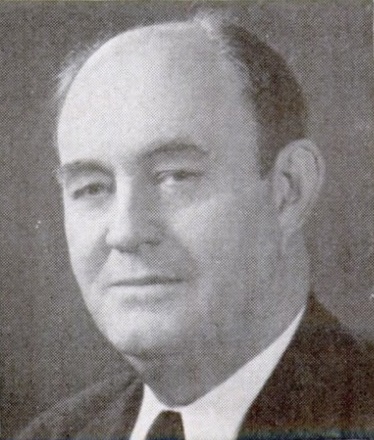
Historical · U.S. House · Kansas · District 6
Wint Smith
Former U.S. Representative · Kansas District 6 · 1947–1961 · Republican
Wint Smith represented Kansas's District 6 in the United States House of Representatives (1947–1961) for the Republican party. The page below collects sourced biographical facts, term history, committee roles, and provenance for Smith.
Bioguide ID: S000640
Key facts
- Full name
- Wint Smith
- State
- Kansas
- District
- District 6
- Party
- Republican
- House service
- 1947–1961
- First House term
- 1947
- Status
- Left office
- Current term ends
- —
- Born
- 1892
- Bioguide ID
- S000640
- Committee assignments
- —
- Dataset version
- 1.20260605
Biographical narrative
967 words · sourced from the Wikipedia REST extract
Wint Smith was an American lawyer and politician who served as a U.S. Representative for Kansas's 6th congressional district from 1947 to 1961. A member of the Republican Party, Smith completed seven terms in the House of Representatives, contributing to legislative discussions during a period marked by significant social and political changes in the United States. His career was characterized by a blend of legal expertise and military service, which informed his approach to governance and public policy.
Early life and career
Wint Smith was born on October 7, 1892, in Mankato, Kansas. He grew up in a small-town environment, attending public schools and graduating from Mankato High School. His early education laid the foundation for his later academic pursuits. In 1920, he enrolled at the University of Kansas, where he began to develop his legal acumen. Following his undergraduate studies, Smith attended Yale Law School, graduating in 1922. He was admitted to the bar in 1923, marking the beginning of his legal career in Kansas City, Kansas.
Smith's legal career quickly expanded as he gained admission to practice in all federal courts, including the United States Supreme Court in 1934. His legal expertise was further demonstrated through his role as assistant attorney general for the state of Kansas from 1931 to 1940. During this time, he also served as the attorney for the Kansas Highway Commission from 1932 to 1940. In these capacities, Smith was involved in significant legal and administrative matters, including the establishment of motor vehicle inspectors tasked with patrolling state highways. This initiative, authorized by the Kansas Legislature in 1933, aimed to enhance highway safety and curb criminal activities, reflecting Smith's commitment to public service and law enforcement.
In 1937, the Kansas Highway Patrol was formed, and Smith played a pivotal role in this transition as he served as the director of the motor vehicle inspectors. His work in this area highlighted his dedication to improving state infrastructure and public safety, which would later influence his legislative priorities in Congress.
House tenure
Wint Smith's political career took a significant turn when he was elected as a Republican to the 80th United States Congress, beginning his first term on January 3, 1947. He was subsequently re-elected to six additional terms, serving in the House until January 3, 1961. His tenure in Congress coincided with a transformative period in American history, characterized by post-World War II recovery, the civil rights movement, and the early stages of the Cold War.
During his time in the House, Smith was involved in various legislative initiatives and discussions that shaped national policy. Notably, he voted against the Civil Rights Acts of 1957 and 1960, reflecting his position on civil rights issues during a time when the nation was grappling with questions of racial equality and justice. His voting record on these significant pieces of legislation has been a point of historical interest, illustrating the complex dynamics of political ideology and party alignment during the mid-20th century.
In addition to his legislative work, Smith's role as a member of Congress was marked by his involvement in various committees. His leadership experience and legal background likely informed his contributions to discussions on legal and regulatory matters. Smith's position as a congressman allowed him to advocate for the interests of his constituents in Kansas, addressing local concerns while also engaging in broader national debates.
Legislative focus and committees
Throughout his congressional career, Wint Smith's legislative focus was shaped by his legal background and his experiences in public service. His work on the Kansas Highway Commission and as assistant attorney general provided him with insights into infrastructure, law enforcement, and regulatory issues, which likely influenced his priorities in Congress. While specific details about the committees he served on are not provided, it can be inferred that his legal expertise would have made him a valuable member of committees related to legal affairs, transportation, and public safety.
Smith's voting record, particularly his opposition to the Civil Rights Acts, indicates a conservative stance on social issues during a time of significant change in American society. His decisions in Congress were reflective of the political climate of the era, as well as the prevailing attitudes within his party. The Republican Party during the late 1940s and 1950s was navigating its own internal divisions regarding civil rights, and Smith's positions were indicative of the complexities faced by lawmakers during this transformative period.
In addition to his legislative work, Smith's military service also played a role in shaping his public persona and approach to governance. He enlisted in the Kansas National Guard in 1915 and served in various capacities during World War I, earning recognition for his service. His military background may have influenced his perspectives on national defense and veterans' affairs, although specific legislative actions in these areas are not detailed in the available information.
After serving seven terms in the House, Smith chose not to seek renomination in 1960. He was succeeded by fellow Republican Robert J. Dole, who would go on to have a prominent political career of his own. Following his departure from Congress, Smith returned to Mankato, where he engaged in farming and ranching, reflecting a return to his roots and a continuation of his connection to the land and community.
Wint Smith passed away on April 27, 1976, in Wichita, Kansas. His contributions to public service, both as a lawyer and a politician, left a lasting impact on his community and the state of Kansas. He was interred at Mount Hope Cemetery in Mankato, where he is remembered for his service and dedication to the people he represented. Smith's life and career exemplify the intersection of law, politics, and public service in mid-20th century America, providing insights into the complexities of governance during a pivotal era in U.S. history.
Notable legislation
Sponsored and co-sponsored legislation for Wint Smith is pending operator curation. The biographical narrative above carries the same provenance trail until per-bill rows are written.
Sources
- [1]https://en.wikipedia.org/wiki/Wint_SmithWikipedia · retrieved 2026-06-05
Notable quotes
Sourced quotes for Wint Smith are pending operator curation. Narrative-scope provenance remains attached below.
Sources
- [1]https://en.wikipedia.org/wiki/Wint_SmithWikipedia · retrieved 2026-06-05
Key positions
Curated policy positions for Wint Smith are pending operator review. The biographical narrative above carries the same provenance trail until per-topic positions are written.
Sources
- [1]https://en.wikipedia.org/wiki/Wint_SmithWikipedia · retrieved 2026-06-05
Terms served
- 1947–1949U.S. House · Term 1 · Republican
- 1949–1951U.S. House · Term 2 · Republican
- 1951–1953U.S. House · Term 3 · Republican
- 1953–1955U.S. House · Term 4 · Republican
- 1955–1957U.S. House · Term 5 · Republican
- 1957–1959U.S. House · Term 6 · Republican
- 1959–1961U.S. House · Term 7 · Republican
Sources & provenance
Every attributable claim above carries a per-section [N] marker that resolves to the corresponding URL below. Each entry records the upstream provider, the canonical URL, and the timestamp at which the source was retrieved by the ingest pipeline.
Key facts
- https://bioguide.congress.gov/search/bio/S000640bioguide · retrieved 2026-06-05
- https://www.govtrack.us/congress/members/410114govtrack · retrieved 2026-06-05
Biographical narrative
- https://en.wikipedia.org/wiki/Wint_Smithwikipedia · retrieved 2026-06-05
Find your representative
Every U.S. state elects representatives by district. Browse Kansas’s delegation, the full former-representative roster, or explore the role and term length.
Related on The Candidate
- Preceded by Kathryn O’Loughlin McCarthyEarlier holder of the Kansas District 6 House seat · Democratic.Open
- Abel WilderFormer U.S. Representative · Kansas District 1 · RepublicanOpen
- Albert ColeFormer U.S. Representative · Kansas District 1 · RepublicanOpen
- Case BroderickFormer U.S. Representative · Kansas District 1 · RepublicanOpen
- Daniel Anthony Jr.Former U.S. Representative · Kansas District 1 · RepublicanOpen
- Republican PartyFederal candidates and office holders on the Republican line.Open