
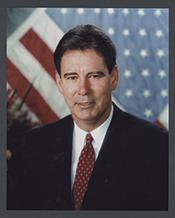
Historical · U.S. House · Kentucky · District 2
Ron Lewis
Former U.S. Representative · Kentucky District 2 · 1993–2009 · Republican
Ron Lewis represented Kentucky's District 2 in the United States House of Representatives (1993–2009) for the Republican party. The page below collects sourced biographical facts, term history, committee roles, and provenance for Lewis.
Bioguide ID: L000293
Key facts
- Full name
- Ron Lewis
- State
- Kentucky
- District
- District 2
- Party
- Republican
- House service
- 1993–2009
- First House term
- 1993
- Status
- Left office
- Current term ends
- —
- Born
- 1946
- Bioguide ID
- L000293
- Committee assignments
- —
- Dataset version
- 1.20260605
Biographical narrative
965 words · sourced from the Wikipedia REST extract
Ron Lewis is a former U.S. Representative who served the 2nd congressional district of Kentucky from 1994 until 2009. A member of the Republican Party, Lewis was initially elected in a special election to fill the vacancy left by the passing of long-time Democratic incumbent William H. Natcher. Over his eight terms in office, Lewis focused on various legislative issues and served on several key committees, contributing to the Republican agenda during a time of significant political change in the United States.
Early life and career
Ron Lewis was born on September 14, 1946, in McKell, a small community located near South Shore in Greenup County, Kentucky. He completed his secondary education at McKell High School, graduating in 1964. Following high school, Lewis attended Morehead State University from 1964 to 1967 before transferring to the University of Kentucky in Lexington, where he earned a Bachelor of Arts degree in history and political science in 1969. In 1981, he returned to Morehead State University to obtain a master's degree in professional education.
Lewis's early career was marked by his involvement in politics. At the age of 21, he participated in the gubernatorial campaign of Louie B. Nunn in 1967. Nunn's victory provided Lewis with a state job, which encouraged him to pursue a political career. In 1971, he ran for a seat in the Kentucky House of Representatives representing Greenup County but was unsuccessful in a challenging political environment dominated by Democrats. Despite this setback, Lewis maintained his interest in Republican politics.
In 1972, Lewis briefly served in the U.S. Navy, attending the Navy Officer Candidate School in Pensacola, Florida. However, he was medically discharged due to a kidney ailment. Following his military service, Lewis worked in sales for various companies, including Ashland Oil. In 1980, he transitioned into education, teaching at Watterson College in Louisville for five years until the institution closed in the 1990s.
In addition to his professional endeavors, Lewis was ordained as a Southern Baptist minister in 1980. He served as the pastor of the historic White Mills Baptist Church and was involved in other local churches, including Friendship Baptist Church outside Hodgenville. In 1985, he opened a religious bookstore named Alpha and Omega Bookstore in Elizabethtown, Kentucky. Lewis has been married to Kayi Gambill Lewis since 1966, and the couple resides in Cecilia, near Elizabethtown, where they have two children.
House tenure
Lewis's congressional career began in 1994 when he ran for the U.S. House of Representatives in a special election to replace the late William H. Natcher. At the time, the 2nd congressional district was predominantly Democratic, and Natcher had held the seat since 1953. Lewis was initially viewed as a "sacrificial lamb" candidate, despite receiving endorsements from state GOP leadership and prominent figures like Senator Mitch McConnell.
The dynamics of the race shifted dramatically when Natcher passed away in March 1994, leading to a special election in May. Lewis faced Joe Prather, a state senator, and benefited from support from national Republican organizations and social conservative groups. He effectively campaigned by linking Prather to unpopular policies associated with President Bill Clinton, particularly a proposed tax increase on tobacco, a significant crop in the region. Lewis's campaign resonated with the socially conservative electorate, and he won the special election with a notable upset, securing 55 percent of the vote against Prather.
Following his special election victory, Lewis was elected to a full term in November 1994, defeating Democrat David Adkisson with a significant majority. Throughout his tenure, Lewis emphasized term limits, having initially pledged to serve no more than four full terms in Congress. However, in 1998, he announced a change of heart regarding his commitment to term limits, expressing a desire to continue serving beyond the originally promised timeframe.
Lewis faced various electoral challenges during his congressional career. He won re-election in 1996 with 58 percent of the vote against former Kentucky Senate floor leader Joe Wright. In 2004, he achieved a significant victory over Democrat Adam Smith, garnering 68 percent of the vote. However, in 2006, Lewis encountered his first serious challenge in a decade from retired U.S. Army Colonel Mike Weaver, managing to secure only 55 percent of the vote.
Legislative focus and committees
During his time in Congress, Lewis was known for his conservative positions on various issues. He consistently voted against tax increases and the expansion of social programs, aligning with the Republican Party's fiscal policies. In 2004, he co-sponsored legislation that aimed to allow Congress to override certain Supreme Court decisions with a two-thirds majority vote, drawing a parallel to the existing authority to override presidential vetoes.
Lewis served on several important committees during his tenure, including the Ways and Means Committee, which is responsible for taxation and revenue generation. Within this committee, he was a member of the Subcommittee on Social Security and the Subcommittee on Trade. Additionally, he was part of the Republican Policy Committee, which played a role in shaping the party's legislative agenda.
After serving eight terms in the House, Lewis announced on January 29, 2008, that he would not seek re-election in 2008, coinciding with the filing deadline for candidates. His decision was met with surprise and disappointment from many in the Kentucky Republican Party. Lewis cited a desire to reduce the time spent commuting between Washington, D.C., and Kentucky and expressed that his experience in Congress had become less encouraging following the Democratic Party's gain of the majority in 2007.
In summary, Ron Lewis's congressional career was marked by significant electoral victories, a focus on conservative legislative priorities, and a commitment to public service that spanned over a decade. His tenure reflects the evolving political landscape of Kentucky and the broader national context during a period of Republican resurgence in the 1990s and early 2000s.
Notable legislation
Sponsored and co-sponsored legislation for Ron Lewis is pending operator curation. The biographical narrative above carries the same provenance trail until per-bill rows are written.
Sources
- [1]https://en.wikipedia.org/wiki/Ron_LewisWikipedia · retrieved 2026-06-05
Notable quotes
Sourced quotes for Ron Lewis are pending operator curation. Narrative-scope provenance remains attached below.
Sources
- [1]https://en.wikipedia.org/wiki/Ron_LewisWikipedia · retrieved 2026-06-05
Key positions
Curated policy positions for Ron Lewis are pending operator review. The biographical narrative above carries the same provenance trail until per-topic positions are written.
Sources
- [1]https://en.wikipedia.org/wiki/Ron_LewisWikipedia · retrieved 2026-06-05
Terms served
- 1993–1995U.S. House · Term 1 · Republican
- 1995–1997U.S. House · Term 2 · Republican
- 1997–1999U.S. House · Term 3 · Republican
- 1999–2001U.S. House · Term 4 · Republican
- 2001–2003U.S. House · Term 5 · Republican
- 2003–2005U.S. House · Term 6 · Republican
- 2005–2007U.S. House · Term 7 · Republican
- 2007–2009U.S. House · Term 8 · Republican
Sources & provenance
Every attributable claim above carries a per-section [N] marker that resolves to the corresponding URL below. Each entry records the upstream provider, the canonical URL, and the timestamp at which the source was retrieved by the ingest pipeline.
Key facts
- https://bioguide.congress.gov/search/bio/L000293bioguide · retrieved 2026-06-05
- http://www.house.gov/ronlewishouse.gov · retrieved 2026-06-05
Biographical narrative
- https://en.wikipedia.org/wiki/Ron_Lewiswikipedia · retrieved 2026-06-05
Find your representative
Every U.S. state elects representatives by district. Browse Kentucky’s delegation, the full former-representative roster, or explore the role and term length.
Related on The Candidate
- Preceded by John WhitakerEarlier holder of the Kentucky District 2 House seat · Democratic.Open
- Andrew BooneFormer U.S. Representative · Kentucky District 1 · DemocraticOpen
- Carroll Hubbard Jr.Former U.S. Representative · Kentucky District 1 · DemocraticOpen
- Charles WheelerFormer U.S. Representative · Kentucky District 1 · DemocraticOpen
- Chittenden LyonFormer U.S. Representative · Kentucky District 1 · JacksonOpen
- Republican PartyFederal candidates and office holders on the Republican line.Open