
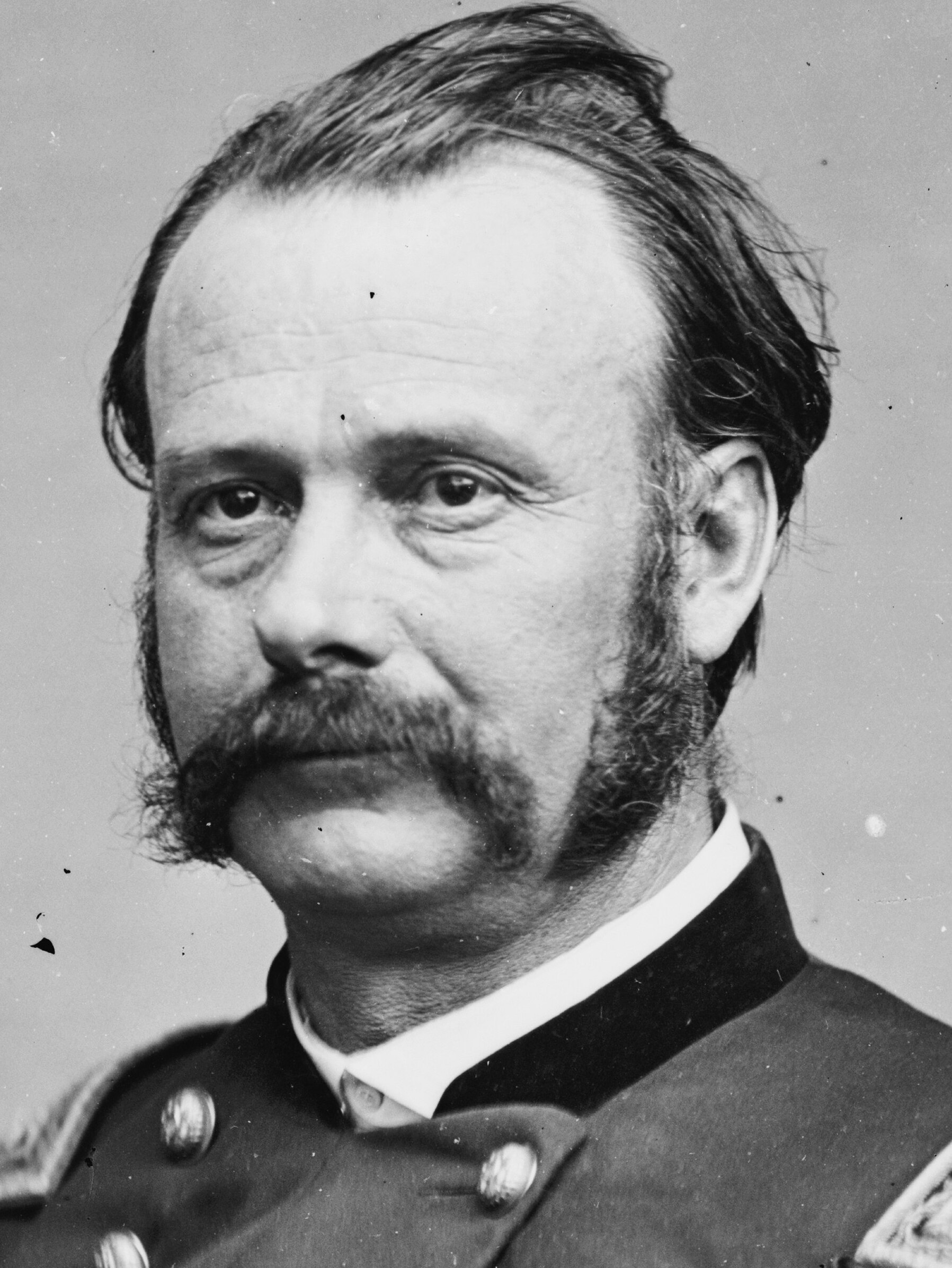
Historical · U.S. House · Kentucky · District 5
Lovell Rousseau
Former U.S. Representative · Kentucky District 5 · 1865–1867 · Unconditional Unionist
Lovell Rousseau represented Kentucky's District 5 in the United States House of Representatives (1865–1867) for the Unconditional Unionist party. The page below collects sourced biographical facts, term history, committee roles, and provenance for Rousseau.
Bioguide ID: R000468
Key facts
- Full name
- Lovell Rousseau
- State
- Kentucky
- District
- District 5
- Party
- Unconditional Unionist
- House service
- 1865–1867
- First House term
- 1865
- Status
- Left office
- Current term ends
- —
- Born
- 1818
- Bioguide ID
- R000468
- Committee assignments
- —
- Dataset version
- 1.20260606
Biographical narrative
851 words · sourced from the Wikipedia REST extract
Lovell Rousseau was a U.S. Representative from Kentucky's 5th congressional district, serving as a member of the Unconditional Unionist Party. His political career was preceded by a distinguished military service during the American Civil War, where he rose through the ranks to become a major general in the Union Army. Rousseau's tenure in the House of Representatives was marked by a notable incident of censure due to an altercation with a fellow congressman. He was born on August 4, 1818, and his life spanned significant periods of American history, including the Civil War and the Reconstruction era, until his death on January 7, 1869.
Early life and career
Lovell Rousseau was born near Stanford, Kentucky, in 1818. He grew up in a family that faced numerous challenges, particularly after the death of his father, David Rousseau, who succumbed to cholera while attempting to relocate the family in 1833. Following this tragedy, Lovell became the primary provider for his family at the young age of fifteen. This responsibility forced him to make difficult decisions, including the sale of family slaves to alleviate debts.
In pursuit of a better future, Rousseau worked on a road-building crew, which allowed him to travel throughout the Midwest. He was determined to improve his education and took it upon himself to study subjects such as grammar, mathematics, and French. Eventually, he returned to Kentucky, where he began studying law in Louisville. By 1841, he successfully passed the bar examination in Indiana and started practicing law in Bloomfield, Indiana, alongside his brother Richard Hillaire Rousseau.
Rousseau's political career began in earnest when he was elected to the Indiana House of Representatives as a member of the Whig Party in 1844. His military service commenced during the Mexican-American War, where he was commissioned as a captain and led a company of volunteers at the Battle of Buena Vista. Following the war, he continued his political engagement by serving in the Indiana State Senate from 1847 to 1849. In 1860, he moved to Kentucky, where he was elected to the Kentucky State Senate, serving until 1861.
House tenure
Rousseau's political career took a significant turn during the Civil War. He was a staunch advocate for maintaining Kentucky's allegiance to the Union and played a crucial role in preventing the state from seceding. In June 1861, he resigned from the Kentucky Senate to enlist in the Union Army, where he successfully raised two regiments of volunteers known as the Louisville Legion. His leadership was instrumental in thwarting Confederate attempts to capture Louisville.
Rousseau's military career advanced rapidly; he was appointed colonel of the 5th Kentucky Infantry Regiment and later promoted to brigadier general. He served in several key battles, including Shiloh and Stones River, and commanded forces in Nashville until his resignation in November 1865. Following his military service, Rousseau was elected to the U.S. House of Representatives as an Unconditional Unionist in 1864. He served from 1865 until 1867, during which time he was involved in various legislative matters, particularly those related to military affairs.
Rousseau's time in Congress was marred by a notable incident in June 1866, when tensions escalated between him and Representative Josiah B. Grinnell over a proposed bill that aimed to enhance the powers of the Freedman's Bureau. Their debates became increasingly contentious, culminating in an altercation on June 14, 1866. Rousseau confronted Grinnell about perceived insults and subsequently assaulted him with a cane, resulting in bruises but no serious injuries. The incident led to an investigation by the House, which ultimately resulted in Rousseau being censured on July 17, 1866. He resigned shortly thereafter but was re-elected to fill the vacancy created by his resignation, allowing him to serve until March 3, 1867.
Legislative focus and committees
During his time in the House of Representatives, Rousseau was a member of the Committee on Military Affairs, reflecting his background and expertise as a former military officer. His legislative focus was likely influenced by his experiences during the Civil War, particularly concerning issues related to military personnel and veterans. Rousseau's opposition to the Freedman's Bureau bill, which aimed to provide assistance to formerly enslaved individuals, indicated his complex views on post-war reconstruction and civil rights, shaped by his military experiences and the political climate of the time.
Despite his relatively short tenure in Congress, Rousseau's actions and the controversies surrounding him highlighted the intense political divisions of the Reconstruction era. His censure for the assault on Grinnell exemplified the challenges faced by legislators during a time of significant social and political upheaval. After leaving Congress, Rousseau continued to serve in the military, receiving a promotion to brigadier general in 1867 and later taking on assignments in Alaska and Louisiana.
Lovell Rousseau's life and career were marked by significant transitions, from a challenging childhood to military leadership and political service. His contributions during the Civil War and his subsequent role in Congress reflect the complexities of American governance during a pivotal period in the nation's history. He passed away on January 7, 1869, leaving behind a legacy intertwined with the tumultuous events of his time.
Notable legislation
Sponsored and co-sponsored legislation for Lovell Rousseau is pending operator curation. The biographical narrative above carries the same provenance trail until per-bill rows are written.
Sources
- [1]https://en.wikipedia.org/wiki/Lovell_RousseauWikipedia · retrieved 2026-06-06
Notable quotes
Sourced quotes for Lovell Rousseau are pending operator curation. Narrative-scope provenance remains attached below.
Sources
- [1]https://en.wikipedia.org/wiki/Lovell_RousseauWikipedia · retrieved 2026-06-06
Key positions
Curated policy positions for Lovell Rousseau are pending operator review. The biographical narrative above carries the same provenance trail until per-topic positions are written.
Sources
- [1]https://en.wikipedia.org/wiki/Lovell_RousseauWikipedia · retrieved 2026-06-06
Terms served
- 1865–1867U.S. House · Term 1 · Unconditional Unionist
Sources & provenance
Every attributable claim above carries a per-section [N] marker that resolves to the corresponding URL below. Each entry records the upstream provider, the canonical URL, and the timestamp at which the source was retrieved by the ingest pipeline.
Key facts
- https://bioguide.congress.gov/search/bio/R000468bioguide · retrieved 2026-06-06
- https://www.govtrack.us/congress/members/409429govtrack · retrieved 2026-06-06
Biographical narrative
- https://en.wikipedia.org/wiki/Lovell_Rousseauwikipedia · retrieved 2026-06-06
Find your representative
Every U.S. state elects representatives by district. Browse Kentucky’s delegation, the full former-representative roster, or explore the role and term length.
Related on The Candidate
- Preceded by Robert MalloryEarlier holder of the Kentucky District 5 House seat · Unionist.Open
- Succeeded by Asa GroverLater holder of the Kentucky District 5 House seat · Democratic.Open
- Andrew BooneFormer U.S. Representative · Kentucky District 1 · DemocraticOpen
- Carroll Hubbard Jr.Former U.S. Representative · Kentucky District 1 · DemocraticOpen
- Charles WheelerFormer U.S. Representative · Kentucky District 1 · DemocraticOpen
- Chittenden LyonFormer U.S. Representative · Kentucky District 1 · JacksonOpen