
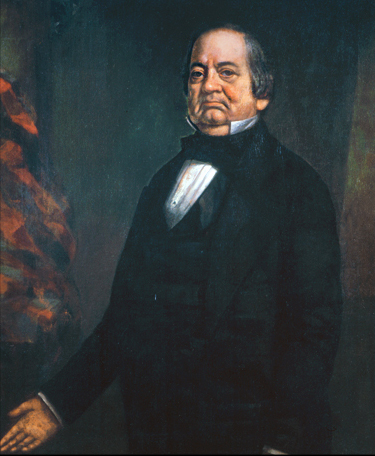
Historical · U.S. House · Kentucky · District 5
Robert Letcher
Former U.S. Representative · Kentucky District 5 · 1823–1835
Robert Letcher represented Kentucky's District 5 in the United States House of Representatives (1823–1835). The page below collects sourced biographical facts, term history, committee roles, and provenance for Letcher.
Bioguide ID: L000257
Key facts
- Full name
- Robert Letcher
- State
- Kentucky
- District
- District 5
- Party
- —
- House service
- 1823–1835
- First House term
- 1823
- Status
- Left office
- Current term ends
- —
- Born
- 1788
- Bioguide ID
- L000257
- Committee assignments
- —
- Dataset version
- 1.20260606
Biographical narrative
948 words · sourced from the Wikipedia REST extract
Robert Letcher was an American politician and lawyer who served as a U.S. Representative for Kentucky's 5th congressional district from 1823 to 1833 and again from 1834 to 1835. He was a prominent member of the Whig Party and later became the 15th governor of Kentucky, serving from 1840 to 1844. Letcher's political career was marked by his involvement in various legislative initiatives and his relationships with key political figures of his time, including Henry Clay and John J. Crittenden. He was also appointed as Minister to Mexico after his governorship. Letcher was born on February 10, 1788, and passed away on January 24, 1861.
Early life and career
Robert Perkins Letcher was born in Goochland County, Virginia, into a large family as the seventh of twelve children to Stephen Giles and Betsy (Perkins) Letcher. Around 1800, the Letcher family relocated to Kentucky, initially settling in Harrodsburg before establishing their home in Garrard County. Letcher’s early education was marked by challenges; he attended local common schools but was dismissed due to behavioral issues. Subsequently, he studied masonry at his father's brickyard, although he did not show much enthusiasm for the trade.
Seeking a better educational experience, Letcher enrolled in Joshua Fry's private academy near Danville, Kentucky, where he thrived academically. After completing his studies at the academy, he returned to his father's brickyard, where he is traditionally believed to have contributed to the construction of the first governor's mansion in Kentucky alongside future governor Thomas Metcalfe. Letcher later pursued a legal career by reading law in the office of Humphrey Marshall and was eventually admitted to the bar, beginning his practice in Lancaster, Kentucky.
In addition to his legal career, Letcher briefly served as a judge advocate in Colonel John Allen's volunteer militia during the War of 1812. His political career commenced in 1813 when he was elected to represent Garrard County in the Kentucky House of Representatives, a position he held until 1815. After a brief hiatus, he was re-elected in 1817. In 1819, President James Monroe offered him a judgeship in the Superior Court of the Arkansas Territory, but Letcher declined the appointment.
Letcher’s personal life included two marriages. His first wife, Susan Oden Epps, passed away in 1816 without having children. He later married Charlotte Robertson, the sister of George Robertson, who would become a congressman and chief justice of the Kentucky Court of Appeals. Although Letcher and Charlotte did not have children together, they raised one of their nieces. Charlotte outlived Letcher, passing away in 1879.
House tenure
Letcher was elected as a Democratic-Republican to the U.S. House of Representatives in 1823, representing Kentucky's fourth district. His tenure in the House was marked by significant political events and shifts. He served in this capacity until 1833, when a redistricting process altered the congressional boundaries, placing Garrard County in the newly defined fifth district. Letcher continued to represent this district until 1835.
During his time in the House, Letcher developed a close relationship with prominent political figures, particularly Henry Clay. He played a notable role in the contentious 1824 presidential election, where no candidate secured a majority of the electoral votes. The election was ultimately decided by the House of Representatives, and Letcher acted as an intermediary between Clay and John Quincy Adams. This political maneuvering led to accusations of a "corrupt bargain" from Andrew Jackson, who was Clay's opponent in the election.
After supporting Adams' administration, Letcher shifted his stance following Jackson's victory in 1828. He became an advocate for internal improvements, aligning himself with Clay's vision for infrastructure development, including support for the Maysville Road bill, which Jackson vetoed. Letcher's legislative activities included introducing Clay's compromise in the House during the Nullification Crisis in 1833, showcasing his involvement in significant national issues.
In the 1833 election, Letcher faced a challenge from Thomas P. Moore for the fifth district seat. The election results were so close that the House refused to seat either candidate, leading to a new election, which Letcher ultimately won by a narrow margin. During this term, he served on the Committee on Foreign Affairs. However, he chose not to seek re-election at the end of this term in 1835.
Legislative focus and committees
Throughout his congressional career, Letcher was known for his support of internal improvements and fiscal responsibility. His alignment with the Whig Party and his close association with Henry Clay influenced his legislative priorities. Letcher was a proponent of policies aimed at enhancing infrastructure and promoting economic growth, reflecting the Whig Party's broader platform during that era.
His committee assignments included the Committee on Foreign Affairs, where he engaged in discussions and decisions related to international relations and trade. Letcher's legislative focus was characterized by a commitment to advancing Kentucky's interests and addressing national issues through collaboration with his political allies.
After his time in the House, Letcher continued to be active in politics, eventually becoming the governor of Kentucky in 1840. His governorship was marked by efforts to stabilize the state's finances following the Panic of 1837, and he implemented fiscally conservative policies that led to budget surpluses by the end of his term. Following his governorship, he was appointed Minister to Mexico, further extending his political career.
Letcher's political journey reflects the complexities of early 19th-century American politics, including the shifting allegiances and the rise and fall of political parties. Although he faced electoral challenges later in his career, including a defeat in a bid to return to the House, Letcher's contributions to Kentucky and national politics during his time in office were significant. He passed away on January 24, 1861, leaving behind a legacy intertwined with the political developments of his era.
Notable legislation
Sponsored and co-sponsored legislation for Robert Letcher is pending operator curation. The biographical narrative above carries the same provenance trail until per-bill rows are written.
Sources
- [1]https://en.wikipedia.org/wiki/Robert_P._LetcherWikipedia · retrieved 2026-06-06
Notable quotes
Sourced quotes for Robert Letcher are pending operator curation. Narrative-scope provenance remains attached below.
Sources
- [1]https://en.wikipedia.org/wiki/Robert_P._LetcherWikipedia · retrieved 2026-06-06
Key positions
Curated policy positions for Robert Letcher are pending operator review. The biographical narrative above carries the same provenance trail until per-topic positions are written.
Sources
- [1]https://en.wikipedia.org/wiki/Robert_P._LetcherWikipedia · retrieved 2026-06-06
Terms served
- 1823–1825U.S. House · Term 1
- 1825–1827U.S. House · Term 2 · Adams
- 1827–1829U.S. House · Term 3 · Adams
- 1829–1831U.S. House · Term 4
- 1831–1833U.S. House · Term 5
- 1833–1835U.S. House · Term 6
Sources & provenance
Every attributable claim above carries a per-section [N] marker that resolves to the corresponding URL below. Each entry records the upstream provider, the canonical URL, and the timestamp at which the source was retrieved by the ingest pipeline.
Key facts
- https://bioguide.congress.gov/search/bio/L000257bioguide · retrieved 2026-06-06
- https://www.govtrack.us/congress/members/406760govtrack · retrieved 2026-06-06
Biographical narrative
- https://en.wikipedia.org/wiki/Robert_P._Letcherwikipedia · retrieved 2026-06-06
Find your representative
Every U.S. state elects representatives by district. Browse Kentucky’s delegation, the full former-representative roster, or explore the role and term length.
Related on The Candidate
- Preceded by Anthony NewEarlier holder of the Kentucky District 5 House seat · Republican.Open
- Succeeded by James HarlanLater holder of the Kentucky District 5 House seat · Whig.Open
- Andrew BooneFormer U.S. Representative · Kentucky District 1 · DemocraticOpen
- Carroll Hubbard Jr.Former U.S. Representative · Kentucky District 1 · DemocraticOpen
- Charles WheelerFormer U.S. Representative · Kentucky District 1 · DemocraticOpen
- Chittenden LyonFormer U.S. Representative · Kentucky District 1 · JacksonOpen