
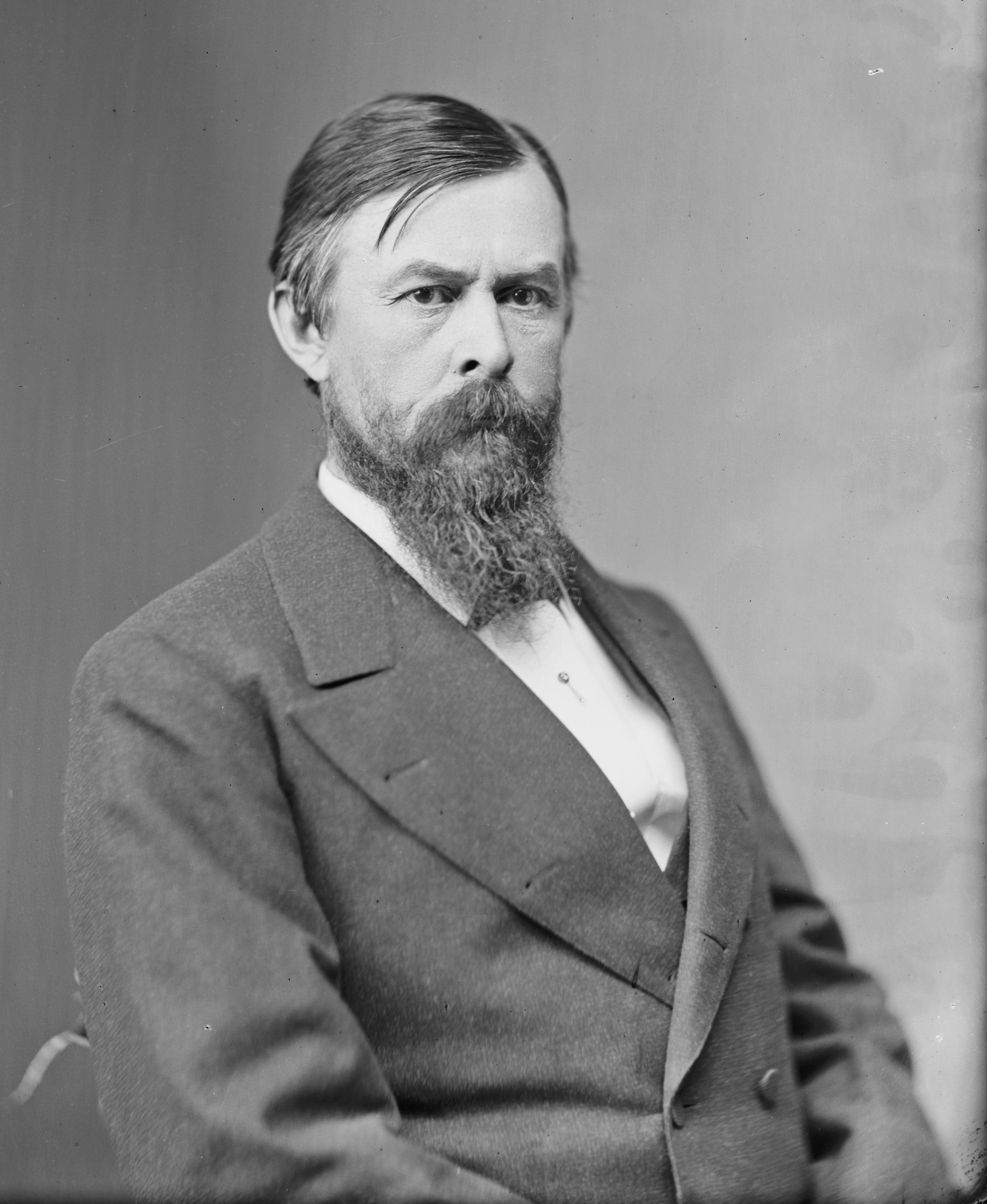
Historical · U.S. House · Kentucky · District 6
Green Smith
Former U.S. Representative · Kentucky District 6 · 1863–1867 · Unconditional Unionist
Green Smith represented Kentucky's District 6 in the United States House of Representatives (1863–1867) for the Unconditional Unionist party. The page below collects sourced biographical facts, term history, committee roles, and provenance for Smith.
Bioguide ID: S000544
Key facts
- Full name
- Green Smith
- State
- Kentucky
- District
- District 6
- Party
- Unconditional Unionist
- House service
- 1863–1867
- First House term
- 1863
- Status
- Left office
- Current term ends
- —
- Born
- 1826
- Bioguide ID
- S000544
- Committee assignments
- —
- Dataset version
- 1.20260606
Biographical narrative
937 words · sourced from the Wikipedia REST extract
Green Clay Smith was a notable American soldier and politician who served as a U.S. Representative for Kentucky's 6th congressional district during the tumultuous period of the American Civil War. A member of the Unconditional Union Party, Smith's political career was marked by his commitment to Unionist principles and his active involvement in military service. His tenure in Congress spanned from 1863 to 1867, after which he served as the Territorial Governor of Montana. In addition to his political and military roles, Smith was also a Baptist minister and a proponent of the temperance movement.
Early life and career
Green Clay Smith was born on July 4, 1826, in Richmond, Kentucky, to John Speed Smith and Elizabeth Lewis (Clay) Smith. He was the third of seven children in a family with a strong political background. His maternal grandfather, Green Clay, was a wealthy planter and a prominent figure in Kentucky politics, which influenced Smith's upbringing and career aspirations. His siblings included individuals named after family members, reflecting the family's traditions and connections. Smith's father had a notable political career, having served in both the Kentucky legislature and the U.S. House of Representatives. Additionally, his uncles, Brutus J. Clay and Cassius M. Clay, were also involved in politics, with Cassius being recognized as an abolitionist prior to the Civil War.
Smith's education began with academic studies in his youth, and he enlisted in the Army during the U.S.-Mexican War, where he was commissioned as a second lieutenant in the First Regiment of the Kentucky Volunteer Infantry on June 9, 1846. Following his military service, he returned to Kentucky and graduated from Transylvania University in 1849. He later pursued a legal career, studying law and gaining admission to the bar in 1852, after which he began practicing in Covington. In addition to his legal work, Smith served as a school commissioner from 1853 to 1857, further establishing his public service credentials.
House tenure
Smith's political career took a significant turn when he was elected to the Kentucky House of Representatives, serving from 1861 to 1863. His military background continued to develop during this time, as he was commissioned as colonel of the Fourth Regiment of the Kentucky Volunteer Cavalry on April 4, 1862. His leadership abilities were recognized when he was appointed brigadier general of volunteers on June 12, 1862. Aligning himself with the Unconditional Union Party, Smith was elected to the 38th Congress in 1862, where he represented Kentucky as an Unconditional Unionist. He resigned from his military post on December 1, 1863, to focus on his congressional duties.
During his time in the House, Smith was actively involved in legislative matters, serving as chairman of the Committee on Militia from 1865 to 1866. His military experience informed his contributions to discussions on military affairs and the needs of the Union during the Civil War. He was brevetted to the rank of major general of volunteers on March 13, 1865, reflecting his significant contributions to the Union war effort.
Smith's congressional tenure ended in March 1867, after which he transitioned to a new role in public service. His resignation from Congress in July 1866 came as he accepted an appointment from President Andrew Johnson to serve as the Territorial Governor of Montana. This position marked a new chapter in his career, allowing him to engage with the challenges of governance in a developing territory.
Legislative focus and committees
During his time in the U.S. House of Representatives, Green Clay Smith's legislative focus was largely influenced by his military background and his commitment to Unionist principles. As chairman of the Committee on Militia, he played a crucial role in shaping policies related to military affairs, particularly during a time when the nation was embroiled in civil conflict. His experiences as a soldier provided him with insights into the needs of the military and the importance of maintaining a strong defense for the Union.
Smith's alignment with the Unconditional Union Party underscored his dedication to preserving the Union and supporting efforts that aligned with that goal. His military service and subsequent political career were deeply intertwined, as he sought to advocate for measures that would bolster the Union's position during the Civil War. His contributions to the Committee on Militia were significant, as he worked to address the pressing issues of troop organization, supply, and overall military readiness.
After leaving Congress, Smith's appointment as Territorial Governor of Montana allowed him to apply his leadership skills in a different context. In this role, he focused on moderating tensions between European American settlers and Native American tribes, including those of the Blackfoot Confederacy. His efforts in governance reflected a commitment to finding peaceful resolutions and fostering cooperation in a region marked by conflict and change.
Following his time as governor, Smith returned to Washington, D.C., where he transitioned into a religious vocation. He was ordained as a Baptist minister and became actively involved in various congregations, promoting the temperance movement and advocating for social reforms. His later years were characterized by a dedication to both his faith and community service, culminating in his role as pastor of the Metropolitan Baptist Church in Washington, D.C., until his passing in 1895.
Green Clay Smith's life and career were marked by a blend of military service, political engagement, and religious commitment. His contributions to the Union during the Civil War, coupled with his later efforts in governance and ministry, illustrate the multifaceted nature of his public service. Smith's legacy is reflected in his roles as a soldier, legislator, and pastor, demonstrating a lifelong dedication to the principles he championed throughout his life.
Notable legislation
Sponsored and co-sponsored legislation for Green Smith is pending operator curation. The biographical narrative above carries the same provenance trail until per-bill rows are written.
Sources
- [1]https://en.wikipedia.org/wiki/Green_C._SmithWikipedia · retrieved 2026-06-06
Notable quotes
Sourced quotes for Green Smith are pending operator curation. Narrative-scope provenance remains attached below.
Sources
- [1]https://en.wikipedia.org/wiki/Green_C._SmithWikipedia · retrieved 2026-06-06
Key positions
Curated policy positions for Green Smith are pending operator review. The biographical narrative above carries the same provenance trail until per-topic positions are written.
Sources
- [1]https://en.wikipedia.org/wiki/Green_C._SmithWikipedia · retrieved 2026-06-06
Terms served
- 1863–1865U.S. House · Term 1 · Unconditional Unionist
- 1865–1867U.S. House · Term 2 · Unconditional Unionist
Sources & provenance
Every attributable claim above carries a per-section [N] marker that resolves to the corresponding URL below. Each entry records the upstream provider, the canonical URL, and the timestamp at which the source was retrieved by the ingest pipeline.
Key facts
- https://bioguide.congress.gov/search/bio/S000544bioguide · retrieved 2026-06-06
- https://www.govtrack.us/congress/members/410026govtrack · retrieved 2026-06-06
Biographical narrative
- https://en.wikipedia.org/wiki/Green_C._Smithwikipedia · retrieved 2026-06-06
Find your representative
Every U.S. state elects representatives by district. Browse Kentucky’s delegation, the full former-representative roster, or explore the role and term length.
Related on The Candidate
- Preceded by George DunlapEarlier holder of the Kentucky District 6 House seat · Unionist.Open
- Succeeded by Thomas JonesLater holder of the Kentucky District 6 House seat · Democratic.Open
- Andrew BooneFormer U.S. Representative · Kentucky District 1 · DemocraticOpen
- Carroll Hubbard Jr.Former U.S. Representative · Kentucky District 1 · DemocraticOpen
- Charles WheelerFormer U.S. Representative · Kentucky District 1 · DemocraticOpen
- Chittenden LyonFormer U.S. Representative · Kentucky District 1 · JacksonOpen