
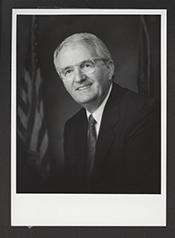
Historical · U.S. House · Kentucky · District 6
Larry Hopkins
Former U.S. Representative · Kentucky District 6 · 1979–1993 · Republican
Larry Hopkins represented Kentucky's District 6 in the United States House of Representatives (1979–1993) for the Republican party. The page below collects sourced biographical facts, term history, committee roles, and provenance for Hopkins.
Bioguide ID: H000776
Key facts
- Full name
- Larry Hopkins
- State
- Kentucky
- District
- District 6
- Party
- Republican
- House service
- 1979–1993
- First House term
- 1979
- Status
- Left office
- Current term ends
- —
- Born
- 1933
- Bioguide ID
- H000776
- Committee assignments
- —
- Dataset version
- 1.20260605
Biographical narrative
861 words · sourced from the Wikipedia REST extract
Larry J. Hopkins was an American businessman and politician who served as a U.S. Representative for Kentucky's 6th congressional district from 1979 until 1993. A member of the Republican Party, he was involved in various political roles throughout his career, including a bid for governor of Kentucky in 1991. His tenure in Congress was marked by his participation in significant legislative efforts, particularly in the area of national defense. Following his congressional career, he held positions in the federal government and worked as a lobbyist. He was also the father of actor Josh Hopkins.
Early life and career
Larry J. Hopkins was born on October 25, 1933, in Detroit, Michigan. He spent much of his childhood in Kentucky, where he was raised by his parents, Louise Jones and James Glenn Hopkins. His early education took place in public schools located in the village of Wingo, Kentucky. Following his primary education, he pursued higher education at Murray State University, where he began to lay the groundwork for his future career.
In the mid-1950s, Hopkins served in the United States Marine Corps from 1954 to 1956. This experience in the military likely influenced his later legislative focus on defense and national security issues. After completing his service, he transitioned into the business world, working as a stockbroker with Hilliard Lyons, a financial services firm. His background in finance and business provided him with insights that would later inform his political career.
Before entering the U.S. Congress, Hopkins held several political positions in Kentucky. He served as the Fayette County clerk, a role that allowed him to gain experience in local governance. His political career continued to advance when he was elected to the Kentucky House of Representatives, where he served from 1972 to 1978. Following his tenure in the House, he moved to the Kentucky Senate in 1978, further solidifying his political credentials and connections within the state.
House tenure
Hopkins's congressional career began on January 3, 1979, when he was elected to represent Kentucky's 6th congressional district in the U.S. House of Representatives. Over the course of his seven terms in office, which lasted until January 3, 1993, he became known for his active involvement in various legislative initiatives. His time in Congress coincided with significant political and social changes in the United States, including the end of the Cold War and shifts in domestic policy.
During his tenure, Hopkins was a member of the United States House Committee on Armed Services. His role on this committee allowed him to engage deeply with issues related to national defense, military funding, and veterans' affairs. Notably, he was a principal House cosponsor of the Goldwater–Nichols Act, a significant piece of legislation aimed at reorganizing the U.S. military command structure to improve the effectiveness of military operations.
In 1991, Hopkins sought to expand his political influence by running for governor of Kentucky. He successfully navigated the Republican primary, defeating his opponent Larry Forgy. However, in the general election, he was defeated by Democrat Brereton C. Jones, who garnered a substantial majority of the votes. Following this electoral setback, Hopkins chose not to seek re-election to the House in 1992. His decision was influenced by his recent loss in the gubernatorial race and his involvement in the House banking scandal, although he was later exonerated of any wrongdoing related to that incident.
Legislative focus and committees
Throughout his congressional career, Larry J. Hopkins focused on a range of issues, with a particular emphasis on national defense and military affairs. His position on the House Committee on Armed Services allowed him to advocate for policies that aimed to strengthen the U.S. military and ensure the nation's security. The Goldwater–Nichols Act, which he co-sponsored, was a landmark reform that aimed to improve the coordination and effectiveness of the military services, reflecting his commitment to enhancing the operational capabilities of the armed forces.
In addition to his work on defense-related issues, Hopkins was involved in various other legislative matters. His experience as a businessman and stockbroker informed his perspective on economic policies, and he likely contributed to discussions around fiscal responsibility and economic development during his time in Congress. While specific details of his legislative initiatives beyond defense are not extensively documented, his overall approach was shaped by his background in finance and public service.
After leaving Congress, Hopkins continued to engage in public service. He served as the director of the Tobacco Division of the Agricultural Marketing Service during the administration of President George H.W. Bush. In this role, he was involved in overseeing policies related to tobacco production and marketing, reflecting his ongoing interest in agricultural issues. Additionally, he worked as a lobbyist, representing various interests and advocating for policy changes at the federal level.
Hopkins's political career was marked by a blend of public service, business acumen, and a commitment to his constituents in Kentucky. His legacy includes his contributions to national defense policy and his involvement in state and local governance. He passed away on November 15, 2021, at the age of 88, leaving behind a family that includes his son, Josh Hopkins, who is known for his work as an actor.
Notable legislation
Sponsored and co-sponsored legislation for Larry Hopkins is pending operator curation. The biographical narrative above carries the same provenance trail until per-bill rows are written.
Sources
- [1]https://en.wikipedia.org/wiki/Larry_J._HopkinsWikipedia · retrieved 2026-06-05
Notable quotes
Sourced quotes for Larry Hopkins are pending operator curation. Narrative-scope provenance remains attached below.
Sources
- [1]https://en.wikipedia.org/wiki/Larry_J._HopkinsWikipedia · retrieved 2026-06-05
Key positions
Curated policy positions for Larry Hopkins are pending operator review. The biographical narrative above carries the same provenance trail until per-topic positions are written.
Sources
- [1]https://en.wikipedia.org/wiki/Larry_J._HopkinsWikipedia · retrieved 2026-06-05
Terms served
- 1979–1981U.S. House · Term 1 · Republican
- 1981–1983U.S. House · Term 2 · Republican
- 1983–1985U.S. House · Term 3 · Republican
- 1985–1987U.S. House · Term 4 · Republican
- 1987–1989U.S. House · Term 5 · Republican
- 1989–1991U.S. House · Term 6 · Republican
- 1991–1993U.S. House · Term 7 · Republican
Sources & provenance
Every attributable claim above carries a per-section [N] marker that resolves to the corresponding URL below. Each entry records the upstream provider, the canonical URL, and the timestamp at which the source was retrieved by the ingest pipeline.
Key facts
- https://bioguide.congress.gov/search/bio/H000776bioguide · retrieved 2026-06-05
- https://www.govtrack.us/congress/members/405626govtrack · retrieved 2026-06-05
Biographical narrative
- https://en.wikipedia.org/wiki/Larry_J._Hopkinswikipedia · retrieved 2026-06-05
Find your representative
Every U.S. state elects representatives by district. Browse Kentucky’s delegation, the full former-representative roster, or explore the role and term length.
Related on The Candidate
- Preceded by John BreckinridgeEarlier holder of the Kentucky District 6 House seat · Democratic.Open
- Succeeded by Scotty BaeslerLater holder of the Kentucky District 6 House seat · Democratic.Open
- Andrew BooneFormer U.S. Representative · Kentucky District 1 · DemocraticOpen
- Carroll Hubbard Jr.Former U.S. Representative · Kentucky District 1 · DemocraticOpen
- Charles WheelerFormer U.S. Representative · Kentucky District 1 · DemocraticOpen
- Chittenden LyonFormer U.S. Representative · Kentucky District 1 · JacksonOpen