
Historical · U.S. House · Maryland · District 1
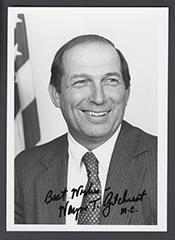
Wayne Gilchrest
Former U.S. Representative · Maryland District 1 · 1991–2009 · Republican
Wayne Gilchrest represented Maryland's District 1 in the United States House of Representatives (1991–2009) for the Republican party. The page below collects sourced biographical facts, term history, committee roles, and provenance for Gilchrest.
Bioguide ID: G000180
Key facts
- Full name
- Wayne Gilchrest
- State
- Maryland
- District
- District 1
- Party
- Republican
- House service
- 1991–2009
- First House term
- 1991
- Status
- Left office
- Current term ends
- —
- Born
- 1946
- Bioguide ID
- G000180
- Committee assignments
- —
- Dataset version
- 1.20260605
Biographical narrative
963 words · sourced from the Wikipedia REST extract
Wayne T. Gilchrest is a former American politician who served as a Republican member of the United States House of Representatives, representing Maryland's 1st congressional district from 1991 until 2009. Known for his moderate positions and willingness to break with party lines, Gilchrest's tenure in Congress was marked by a focus on environmental issues, social justice, and military policy. After losing his seat in a primary election, he shifted his political affiliation and has since engaged in environmental education and advocacy.
Early life and career
Wayne Thomas Gilchrest was born on April 15, 1946, in Rahway, New Jersey, as the fourth of six sons in the family of Elizabeth and Arthur Gilchrest. His early life was characterized by a commitment to service, which led him to join the United States Marine Corps shortly after graduating high school in 1964. During his military service, he participated in significant historical events, including the invasion of the Dominican Republic and the Vietnam War. As a platoon leader in Vietnam, Gilchrest was wounded and earned several commendations for his service, including the Purple Heart, the Bronze Star, and the Navy Commendation Medal. His military experience has been a defining aspect of his identity and political career.
After completing his military service, Gilchrest pursued higher education. He earned an associate's degree from Wesley College in Dover, Delaware, in 1969. Following this, he spent time studying rural poverty in Appalachia, which likely influenced his later political perspectives. He then obtained a bachelor's degree in history from Delaware State College in 1973. Gilchrest also took steps toward a master's degree at Loyola College in Baltimore, although he did not complete this program.
Before entering politics, Gilchrest worked as a teacher at Kent County High School on Maryland's Eastern Shore. His experience in education and community engagement laid the groundwork for his subsequent political aspirations. In 1988, he made his first attempt to enter Congress by challenging the incumbent Democratic representative, Roy Dyson, in the 1st District. Despite facing a well-established opponent and being significantly outspent, Gilchrest narrowly lost the election. However, he continued to build his political profile and successfully defeated Dyson in a rematch in 1990, marking the beginning of his long tenure in the House of Representatives.
House tenure
Gilchrest's congressional career began with his election to the House in 1991, where he served for nine consecutive terms until his departure in 2009. His initial victory over Dyson was notable, as he won by a margin of 14%. Throughout his time in office, Gilchrest faced various electoral challenges but established himself as a prominent figure within the Republican Party, particularly among moderate Republicans.
In the 1992 election, Gilchrest faced a close contest against Tom McMillen, a former representative from Maryland's 4th District. He managed to secure his seat with a narrow victory, winning by just 3%. Following this early challenge, he enjoyed a period of relative electoral stability, facing little serious opposition for over a decade. His district, while leaning Republican, had a complex political landscape, with a Cook Partisan Voting Index rating of R+13, indicating a strong Republican presence.
Gilchrest's voting record and political positions often set him apart from his party colleagues. In 2007, he was noted for breaking ranks with the Republican Party more frequently than any other House member, reflecting his moderate and sometimes liberal stances on various issues. His willingness to diverge from party orthodoxy became a defining characteristic of his political identity.
Legislative focus and committees
During his time in Congress, Gilchrest was involved in a range of legislative issues, with a particular focus on environmental protection, social justice, and military policy. He was a member of several moderate Republican groups, including the Republican Main Street Partnership and Republicans for Environmental Protection. His commitment to environmental issues was further demonstrated through his co-chairmanship of the Congressional Climate Change Caucus, which he led alongside Democrat John Olver.
Gilchrest's legislative actions included support for significant social issues, such as same-sex marriage and military policy reform. He was a co-sponsor of the "Military Readiness Enhancement Act," which aimed to repeal the "Don't ask, don't tell" policy regarding LGBTQ+ individuals in the military. His advocacy for social justice extended to his support for same-sex marriage, which he framed as a matter of civil rights and democracy.
In addition to his progressive social positions, Gilchrest's views on military engagement evolved over time. Initially supportive of the Iraq War, he became increasingly critical as the conflict escalated. He expressed support for the Iraq Study Group Report and advocated for establishing a timetable for troop withdrawal. His voting record reflected this shift, as he joined a significant number of both Republicans and Democrats in opposing the troop surge in 2007.
Despite his long-standing affiliation with the Republican Party, Gilchrest faced challenges from more conservative candidates within the party, culminating in a primary defeat in 2008. His moderate voting record and willingness to collaborate across party lines led to accusations of being a "Republican in Name Only." After losing the primary to State Senator Andy Harris, Gilchrest endorsed the Democratic nominee in the general election, marking a significant departure from his party loyalty.
Following his congressional career, Gilchrest has remained active in public life, particularly in the realm of environmental education. He has also been associated with the ReFormers Caucus of Issue One, reflecting his ongoing commitment to civic engagement and political reform. In 2019, he registered as a Democrat, further illustrating his evolving political identity.
Wayne T. Gilchrest's career in the U.S. House of Representatives exemplifies the complexities of American political life, particularly for moderate voices within a polarized environment. His legislative focus, characterized by a blend of environmental advocacy and social justice, has left a lasting impact on the political landscape of Maryland and beyond.
Notable legislation
Sponsored and co-sponsored legislation for Wayne Gilchrest is pending operator curation. The biographical narrative above carries the same provenance trail until per-bill rows are written.
Sources
- [1]https://en.wikipedia.org/wiki/Wayne_GilchrestWikipedia · retrieved 2026-06-05
Notable quotes
Sourced quotes for Wayne Gilchrest are pending operator curation. Narrative-scope provenance remains attached below.
Sources
- [1]https://en.wikipedia.org/wiki/Wayne_GilchrestWikipedia · retrieved 2026-06-05
Key positions
Curated policy positions for Wayne Gilchrest are pending operator review. The biographical narrative above carries the same provenance trail until per-topic positions are written.
Sources
- [1]https://en.wikipedia.org/wiki/Wayne_GilchrestWikipedia · retrieved 2026-06-05
Terms served
- 1991–1993U.S. House · Term 1 · Republican
- 1993–1995U.S. House · Term 2 · Republican
- 1995–1997U.S. House · Term 3 · Republican
- 1997–1999U.S. House · Term 4 · Republican
- 1999–2001U.S. House · Term 5 · Republican
- 2001–2003U.S. House · Term 6 · Republican
- 2003–2005U.S. House · Term 7 · Republican
- 2005–2007U.S. House · Term 8 · Republican
- 2007–2009U.S. House · Term 9 · Republican
Sources & provenance
Every attributable claim above carries a per-section [N] marker that resolves to the corresponding URL below. Each entry records the upstream provider, the canonical URL, and the timestamp at which the source was retrieved by the ingest pipeline.
Key facts
- https://bioguide.congress.gov/search/bio/G000180bioguide · retrieved 2026-06-05
- http://www.house.gov/gilchresthouse.gov · retrieved 2026-06-05
Biographical narrative
- https://en.wikipedia.org/wiki/Wayne_Gilchrestwikipedia · retrieved 2026-06-05
Find your representative
Every U.S. state elects representatives by district. Browse Maryland’s delegation, the full former-representative roster, or explore the role and term length.
Related on The Candidate
- Preceded by Royden DysonEarlier holder of the Maryland District 1 House seat · Democratic.Open
- Succeeded by Frank Kratovil Jr.Later holder of the Maryland District 1 House seat · Democratic.Open
- Clement DorseyFormer U.S. Representative · Maryland District 1Open
- Daniel HenryFormer U.S. Representative · Maryland District 1 · DemocraticOpen
- David WardFormer U.S. Representative · Maryland District 1 · DemocraticOpen
- Dudley RoeFormer U.S. Representative · Maryland District 1 · DemocraticOpen