
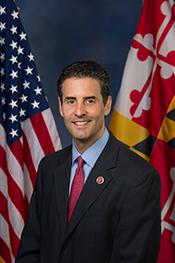
Historical · U.S. House · Maryland · District 3
John Sarbanes
Former U.S. Representative · Maryland District 3 · 2007–2025 · Democratic
John Sarbanes represented Maryland's District 3 in the United States House of Representatives (2007–2025) for the Democratic party. The page below collects sourced biographical facts, term history, committee roles, and provenance for Sarbanes.
Bioguide ID: S001168
Key facts
- Full name
- John Sarbanes
- State
- Maryland
- District
- District 3
- Party
- Democratic
- House service
- 2007–2025
- First House term
- 2007
- Status
- Left office
- Current term ends
- —
- Born
- 1962
- Bioguide ID
- S001168
- Committee assignments
- —
- Dataset version
- 1.20260603
Biographical narrative
981 words · sourced from the Wikipedia REST extract
John P. Sarbanes is a former U.S. Representative who served Maryland's 3rd congressional district from 2007 until 2025. A member of the Democratic Party, Sarbanes is known for his focus on government reform, environmental education, and public service. He is the son of former U.S. Senator Paul Sarbanes and has a background in law and education, which informed his legislative priorities during his time in Congress.
Early life and career
John P. Sarbanes was born on May 22, 1962, in Baltimore, Maryland. He is the eldest son of Paul Sarbanes, who had a long career in public service as both a U.S. Representative and a U.S. Senator, and Christine Dunbar Sarbanes, a teacher. Sarbanes has Greek heritage from his father's side and English ancestry from his mother's side. He completed his secondary education at the Gilman School in Baltimore, graduating in 1980.
Sarbanes pursued higher education at Princeton University, where he earned a Bachelor of Arts degree, graduating cum laude from the School of Public and International Affairs in 1984. His senior thesis, which was notably extensive, focused on the American intelligence community, specifically examining a case study related to Greece in 1967. Following his undergraduate studies, Sarbanes attended Harvard Law School, where he received his Juris Doctor degree in 1988. During his time at Harvard, he was actively involved in student government, serving as co-chair of the Law School Democrats.
After completing his legal education, Sarbanes began his career in public service and law. He worked for seven years with the Maryland State Department of Education, where he contributed to the development of the state's public school system. Following this role, he clerked for Judge J. Frederick Motz on the U.S. District Court for the District of Maryland. Sarbanes then joined the law firm Venable LLP in Baltimore, where he worked from 1989 to 2006. During his tenure at Venable, he chaired the healthcare practice from 2000 to 2006 and was involved in the firm's hiring committee from 1992 to 1996.
House tenure
Sarbanes entered the political arena by seeking the Democratic nomination for Maryland's 3rd congressional district in 2006, following the decision of ten-term incumbent Ben Cardin to run for the U.S. Senate seat previously held by his father. Sarbanes faced several challengers in the primary, including state senator Paula Hollinger and former Baltimore City health commissioner Peter Beilenson. He secured the nomination with approximately 31.9% of the vote. In the general election, Sarbanes faced Republican candidate John White, a marketing executive from Annapolis. Given the heavily Democratic nature of the district, which had been under Democratic control since 1927, Sarbanes was expected to win. He was elected on November 7, 2006, receiving 64% of the vote, while White garnered 34% and Libertarian candidate Charles Curtis McPeek received 2%.
Throughout his nine terms in office, Sarbanes represented a district that initially included portions of Anne Arundel, Baltimore, Howard, and Montgomery counties, as well as much of downtown Baltimore City. However, following the 2020 Census, redistricting altered the boundaries of his district, making it more compact. As a result, he lost parts of Baltimore City and Baltimore County but gained a significant portion of Carroll County, all of Howard County, and additional areas in Anne Arundel County. This change also meant that Sarbanes's home in Towson was no longer within the district he represented, although members of Congress are only required to reside in the state they represent.
Sarbanes was re-elected eight times without facing substantial opposition, reflecting the strong Democratic leanings of his district. On October 26, 2023, he announced that he would not seek re-election in 2024, concluding his tenure in Congress.
Legislative focus and committees
During his time in the House of Representatives, Sarbanes served on several key committees, including the Committee on Energy and Commerce and the Committee on Oversight and Reform. Within these committees, he participated in various subcommittees, such as the Subcommittee on Energy, the Subcommittee on Health, the Subcommittee on Oversight and Investigations, and the Subcommittee on Government Operations. His committee assignments allowed him to engage with a wide range of legislative issues, particularly those related to health care and energy policy.
Sarbanes was also a member of several caucuses, reflecting his legislative interests and priorities. He was involved in the Armenian Caucus, the Congressional Public Service Caucus (which he co-chaired), the House Congressional Hellenic Caucus, the United States Congressional International Conservation Caucus, the Joint Congressional Human Rights Caucus, the Pakistan Caucus, the Congressional Arts Caucus, and the Congressional NextGen 9-1-1 Caucus.
One of Sarbanes's notable legislative initiatives was the introduction of the No Child Left Inside Act (H.R. 2054), which aimed to enhance environmental education in public schools. This legislation sought to create a new grant program for environmental education, provide teacher training, and ensure that states develop plans for high school graduates to be environmentally literate. The bill garnered support from a coalition of over 1,200 organizations advocating for a renewed commitment to environmental education.
Sarbanes was also instrumental in authoring the For the People Act, a comprehensive piece of legislation aimed at reforming various aspects of the electoral process. This bill included provisions for small-dollar public funding of congressional elections, automatic national voter registration, and measures to reduce gerrymandering through the establishment of independent commissions. Although the bill passed the House in 2019, it did not advance in the Republican-controlled Senate. It was reintroduced in the 117th Congress and again passed the House.
In summary, John P. Sarbanes's career in the U.S. House of Representatives was marked by a focus on government reform, environmental education, and public service. His legislative efforts and committee work reflected his commitment to addressing key issues affecting his constituents and the broader American public. After concluding his congressional service in January 2025, he transitioned to a role as a distinguished practitioner in residence at Johns Hopkins University's Stavros Niarchos Foundation Agora Institute.
Notable legislation
Sponsored and co-sponsored legislation for John Sarbanes is pending operator curation. The biographical narrative above carries the same provenance trail until per-bill rows are written.
Sources
- [1]https://en.wikipedia.org/wiki/John_SarbanesWikipedia · retrieved 2026-06-03
Notable quotes
Sourced quotes for John Sarbanes are pending operator curation. Narrative-scope provenance remains attached below.
Sources
- [1]https://en.wikipedia.org/wiki/John_SarbanesWikipedia · retrieved 2026-06-03
Key positions
Curated policy positions for John Sarbanes are pending operator review. The biographical narrative above carries the same provenance trail until per-topic positions are written.
Sources
- [1]https://en.wikipedia.org/wiki/John_SarbanesWikipedia · retrieved 2026-06-03
Terms served
- 2007–2009U.S. House · Term 1 · Democratic
- 2009–2011U.S. House · Term 2 · Democratic
- 2011–2013U.S. House · Term 3 · Democratic
- 2013–2015U.S. House · Term 4 · Democratic
- 2015–2017U.S. House · Term 5 · Democratic
- 2017–2019U.S. House · Term 6 · Democratic
- 2019–2021U.S. House · Term 7 · Democratic
- 2021–2023U.S. House · Term 8 · Democratic
- 2023–2025U.S. House · Term 9 · Democratic
Sources & provenance
Every attributable claim above carries a per-section [N] marker that resolves to the corresponding URL below. Each entry records the upstream provider, the canonical URL, and the timestamp at which the source was retrieved by the ingest pipeline.
Key facts
- https://bioguide.congress.gov/search/bio/S001168bioguide · retrieved 2026-06-03
- https://sarbanes.house.govhouse.gov · retrieved 2026-06-03
Biographical narrative
- https://en.wikipedia.org/wiki/John_Sarbaneswikipedia · retrieved 2026-06-03
Find your representative
Every U.S. state elects representatives by district. Browse Maryland’s delegation, the full former-representative roster, or explore the role and term length.
Related on The Candidate
- Preceded by Edward GarmatzEarlier holder of the Maryland District 3 House seat · Democratic.Open
- Clement DorseyFormer U.S. Representative · Maryland District 1Open
- Daniel HenryFormer U.S. Representative · Maryland District 1 · DemocraticOpen
- David WardFormer U.S. Representative · Maryland District 1 · DemocraticOpen
- Dudley RoeFormer U.S. Representative · Maryland District 1 · DemocraticOpen
- Democratic PartyFederal candidates and office holders on the Democratic line.Open