
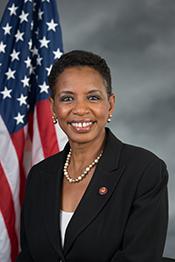
Historical · U.S. House · Maryland · District 4
Donna Edwards
Former U.S. Representative · Maryland District 4 · 2008–2017 · Democratic
Donna Edwards represented Maryland's District 4 in the United States House of Representatives (2008–2017) for the Democratic party. The page below collects sourced biographical facts, term history, committee roles, and provenance for Edwards.
Bioguide ID: E000290
Key facts
- Full name
- Donna Edwards
- State
- Maryland
- District
- District 4
- Party
- Democratic
- House service
- 2008–2017
- First House term
- 2008
- Status
- Left office
- Current term ends
- —
- Born
- 1958
- Bioguide ID
- E000290
- Committee assignments
- —
- Dataset version
- 1.20260605
Biographical narrative
907 words · sourced from the Wikipedia REST extract
Donna F. Edwards is a former U.S. Representative who served Maryland's 4th congressional district from 2008 until 2017. A member of the Democratic Party, she made history as the first African-American woman to represent Maryland in the United States Congress. Edwards is recognized for her legal background and extensive community activism, particularly in areas concerning domestic violence and education reform.
Early life and career
Donna Fern Edwards was born on June 28, 1958, in Yanceyville, North Carolina. She pursued her higher education at Wake Forest University, where she earned Bachelor of Arts degrees in both English and Spanish. During her time at Wake Forest, she was one of only six Black women in her graduating class of 1980. Following her undergraduate studies, Edwards began her professional career at Lockheed Corporation, working at the Goddard Space Flight Center as part of the Spacelab program. This experience marked the beginning of her engagement in fields that combined science and public service.
Edwards later attended the Franklin Pierce Law Center, now known as the University of New Hampshire School of Law, where she earned her Juris Doctor degree in 1989. Her early career included a position as a clerk for Albert Wynn, who at the time served in the Maryland House of Delegates. This role provided her with insights into the legislative process and laid the groundwork for her future political aspirations.
In addition to her legal career, Edwards has been a prominent community activist. She co-founded the National Network to End Domestic Violence, where she served as the first executive director. This organization focuses on advocacy and legal support for victims of domestic violence. Edwards played a significant role in the passage of the Violence Against Women Act in 1994, which aimed to improve legal protections for women facing domestic abuse.
Her professional journey continued as she worked with Public Citizen and later became the executive director of the Center for a New Democracy. In 2000, she took on the role of executive director of the Arca Foundation, although she took a leave of absence during her initial political campaign. Edwards has also been involved in various initiatives aimed at improving education and healthcare access, including her work as a national co-chair of the progressive group Health Care Voter.
House tenure
Edwards entered the political arena in earnest when she challenged the long-serving incumbent Albert Wynn in the 2006 Democratic primary. This primary was particularly significant, as it was widely viewed as the real contest in a heavily Democratic district. Edwards criticized Wynn's voting record, particularly his support for the Iraq War and various corporate interests. Despite her efforts, she narrowly lost the primary, receiving 46.4 percent of the vote compared to Wynn's 49.7 percent.
Undeterred, Edwards ran again in 2008, this time successfully defeating Wynn in the Democratic primary with a substantial margin, garnering 60 percent of the vote. Following Wynn's resignation, she won the Democratic nomination for a special election to fill the remainder of his term. Edwards won the special election held on June 17, 2008, with approximately 81 percent of the vote, marking her official entry into the U.S. House of Representatives just two days later.
In November 2008, Edwards ran for a full term in Congress, where she was overwhelmingly favored to win. Her candidacy was bolstered by the fact that the district had not seen a Republican candidate achieve more than 25 percent of the vote in recent elections. Edwards won this election decisively, further solidifying her position as a prominent figure in Maryland politics.
During her time in office, Edwards served a total of five terms in the House of Representatives. She was known for her advocacy on various issues, including education, healthcare, and women's rights. In 2016, Edwards opted to run for the U.S. Senate seat being vacated by Barbara Mikulski rather than seeking re-election to her House seat. However, she was defeated in the Democratic primary by Congressman Chris Van Hollen.
Legislative focus and committees
Throughout her tenure in Congress, Edwards focused on a range of legislative issues, particularly those affecting women, families, and marginalized communities. She was a vocal advocate for education reform, notably sponsoring the Restoring Education and Learning Act (REAL Act) in 2015, which aimed to reinstate Pell Grants for incarcerated individuals. This initiative highlighted her commitment to improving educational opportunities and reducing recidivism through access to education.
Edwards was also active in efforts to reform campaign finance laws. In 2013, she sponsored an amendment to the U.S. Constitution aimed at repealing the Supreme Court's 2010 ruling in Citizens United v. Federal Election Commission, which had significant implications for campaign financing and political advertising. Her advocacy in this area underscored her concerns regarding the influence of money in politics and its impact on democratic processes.
In addition to her legislative initiatives, Edwards served on various committees during her time in the House, where she contributed to discussions and decisions on key national issues. Her work in Congress was characterized by a focus on progressive values and a commitment to addressing the needs of her constituents in Maryland's 4th district.
After leaving Congress in 2017, Edwards continued to engage in public service and advocacy. In 2022, she sought to reclaim her former congressional seat but was defeated in the Democratic primary by Glenn Ivey. Edwards remains a significant figure in Maryland politics and continues to advocate for issues related to social justice, healthcare, and education.
Notable legislation
Sponsored and co-sponsored legislation for Donna Edwards is pending operator curation. The biographical narrative above carries the same provenance trail until per-bill rows are written.
Sources
- [1]https://en.wikipedia.org/wiki/Donna_EdwardsWikipedia · retrieved 2026-06-05
Notable quotes
Sourced quotes for Donna Edwards are pending operator curation. Narrative-scope provenance remains attached below.
Sources
- [1]https://en.wikipedia.org/wiki/Donna_EdwardsWikipedia · retrieved 2026-06-05
Key positions
Curated policy positions for Donna Edwards are pending operator review. The biographical narrative above carries the same provenance trail until per-topic positions are written.
Sources
- [1]https://en.wikipedia.org/wiki/Donna_EdwardsWikipedia · retrieved 2026-06-05
Terms served
- 2008–2009U.S. House · Term 1 · Democratic
- 2009–2011U.S. House · Term 2 · Democratic
- 2011–2013U.S. House · Term 3 · Democratic
- 2013–2015U.S. House · Term 4 · Democratic
- 2015–2017U.S. House · Term 5 · Democratic
Sources & provenance
Every attributable claim above carries a per-section [N] marker that resolves to the corresponding URL below. Each entry records the upstream provider, the canonical URL, and the timestamp at which the source was retrieved by the ingest pipeline.
Key facts
- https://bioguide.congress.gov/search/bio/E000290bioguide · retrieved 2026-06-05
- http://donnaedwards.house.govhouse.gov · retrieved 2026-06-05
Biographical narrative
- https://en.wikipedia.org/wiki/Donna_Edwardswikipedia · retrieved 2026-06-05
Find your representative
Every U.S. state elects representatives by district. Browse Maryland’s delegation, the full former-representative roster, or explore the role and term length.
Related on The Candidate
- Preceded by Albert WynnEarlier holder of the Maryland District 4 House seat · Democratic.Open
- Succeeded by Anthony BrownLater holder of the Maryland District 4 House seat · Democratic.Open
- Clement DorseyFormer U.S. Representative · Maryland District 1Open
- Daniel HenryFormer U.S. Representative · Maryland District 1 · DemocraticOpen
- David WardFormer U.S. Representative · Maryland District 1 · DemocraticOpen
- Dudley RoeFormer U.S. Representative · Maryland District 1 · DemocraticOpen