
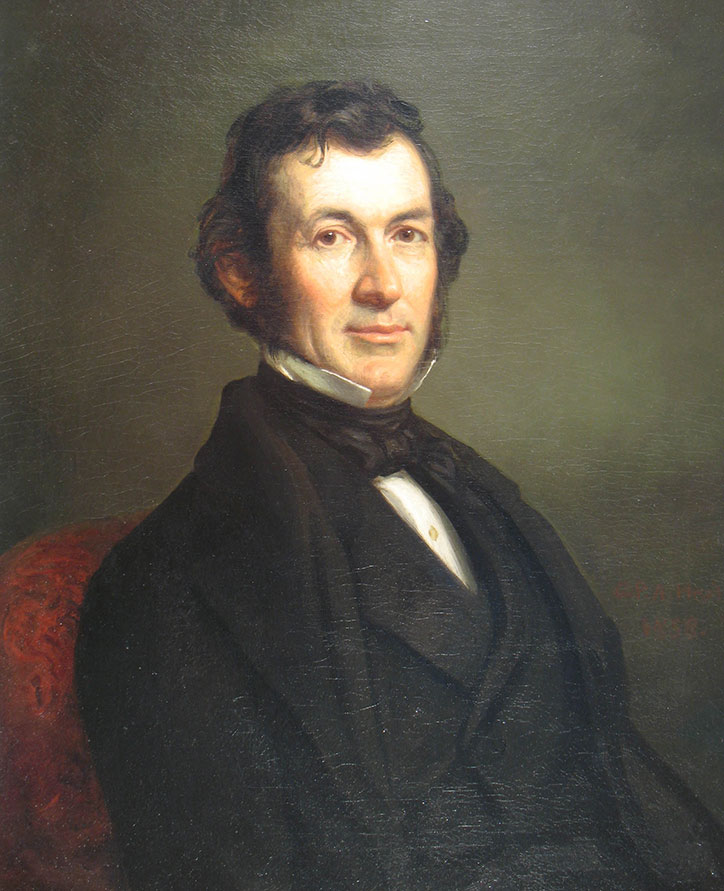
Historical · U.S. House · Maryland · District 4
Robert McLane
Former U.S. Representative · Maryland District 4 · 1847–1883 · Democratic
Robert McLane represented Maryland's District 4 in the United States House of Representatives (1847–1883) for the Democratic party. The page below collects sourced biographical facts, term history, committee roles, and provenance for McLane.
Bioguide ID: M000537
Key facts
- Full name
- Robert McLane
- State
- Maryland
- District
- District 4
- Party
- Democratic
- House service
- 1847–1883
- First House term
- 1847
- Status
- Left office
- Current term ends
- —
- Born
- 1815
- Bioguide ID
- M000537
- Committee assignments
- —
- Dataset version
- 1.20260606
Biographical narrative
989 words · sourced from the Wikipedia REST extract
Robert McLane was a prominent American politician, military officer, and diplomat who served as a U.S. Representative for Maryland's 4th congressional district. A member of the Democratic Party, McLane's political career spanned several decades, during which he held various significant positions, including serving as the U.S. minister to multiple countries and as the chairman of the Democratic National Committee. His tenure in the U.S. House of Representatives lasted from 1847 to 1851 and again from 1879 to 1883. McLane's contributions to American politics were marked by his eloquence as an orator and his involvement in key legislative matters during a tumultuous period in U.S. history.
Early life and career
Robert Milligan McLane was born on June 23, 1815, in Wilmington, Delaware. He was the son of Louis McLane, a notable political figure who held various high-ranking positions, including Secretary of the Treasury, and Catherine Mary Milligan. The McLane family was well-connected, and Robert was educated at a private school run by a Quaker named John Bullock. His early education laid the groundwork for his later academic pursuits. After his family relocated to Europe due to his father's diplomatic appointment as ambassador to England, McLane continued his education at St. Mary's College in Baltimore, Maryland, before moving to Paris. There, he attended Collège Bourbon, where he became acquainted with influential figures, including the Marquis de Lafayette.
In 1833, the McLane family returned to the United States, coinciding with his father's appointment as Secretary of the Treasury. That same year, Robert McLane was appointed as a cadet at the United States Military Academy at West Point by President Andrew Jackson. He graduated in July 1837, receiving a commission as a second lieutenant in the Artillery branch of the United States Army. His military service began with deployment to Florida during the Seminole War, where he served under General Thomas S. Jesup. In 1838, he was reassigned to the western front under General Winfield Scott and later transferred to the Corps of Topographical Engineers, where he worked under General Zachary Taylor.
McLane's military career included significant survey work in the Northern Lakes and a trip to Europe to study the dikes and drainage systems in the Netherlands and Italy. It was during this time in Europe that he met Georgine Urquhart, who would become his wife. McLane resigned from the military in 1843 to pursue a legal career, gaining admission to the bar the same year and beginning his practice in Baltimore.
House tenure
McLane's entry into politics began in earnest in 1845 when he was elected as a representative of Baltimore City to the Maryland House of Delegates. His political career gained momentum after he successfully campaigned for President James K. Polk in the 1844 election. In 1846, he ran for a seat in the U.S. House of Representatives and won against his Whig opponent, John P. Kennedy, by a narrow margin. McLane's first term in Congress commenced on March 4, 1847, and he served until March 3, 1851. During this period, he was recognized for his exceptional oratory skills and was appointed chairman of the Committee on Commerce during his second term.
After completing his first congressional term, McLane chose not to seek renomination in 1850. He then moved to the Western United States, where he worked as a counsel for a mining corporation involved in legal matters related to property in California. He remained in this role until 1852, when he returned to Maryland to serve as a presidential elector for Franklin Pierce.
Following his initial congressional tenure, McLane's diplomatic career began to take shape. In 1853, he was appointed by President Pierce as commissioner to China during the Taiping Rebellion, with the authority of Minister Plenipotentiary. His mission involved securing commercial relations between the United States and China while navigating the complexities of the ongoing civil conflict. McLane successfully renewed trade relations but returned to the United States in 1854 due to health issues.
Legislative focus and committees
After a period of absence from politics, McLane re-engaged in public service during the Democratic National Convention in 1856, where he supported James Buchanan for the presidency. In 1859, he was appointed as Envoy Extraordinary and Minister Plenipotentiary to Mexico, where he was tasked with assessing the legitimacy of the government led by Benito Juárez amid the Mexican Civil War. During his time in Mexico, he negotiated the McLane-Ocampo Treaty, which aimed to enhance U.S. transit rights across the Isthmus of Tehuantepec. However, the treaty ultimately failed to gain ratification from the U.S. Senate, leading to McLane's retirement from the ambassadorship in December 1860.
The American Civil War brought significant challenges to Maryland, a border state. McLane was part of a delegation that questioned the federal government's actions in preventing Maryland from seceding. He believed that the federal government lacked the constitutional authority to impose such measures but ultimately agreed that Maryland should remain in the Union. Following the war, McLane returned to his law practice, where he served as counsel for the Western Pacific Railroad.
His political career resumed in 1876 when he participated in the Democratic National Convention. In 1877, he was elected to the Maryland State Senate, representing Baltimore City, and served until 1879. That year, he successfully ran for Congress again, serving two additional terms from March 4, 1879, to March 3, 1883. During his second stint in Congress, he chaired the Committee on Pacific Railroads, focusing on issues related to transportation and infrastructure.
McLane's legislative career was characterized by his commitment to his constituents and his involvement in significant national issues. His tenure in the House of Representatives concluded in 1883, marking the end of a notable chapter in his long and varied career in public service. After leaving Congress, McLane continued to engage in various pursuits until his passing on April 16, 1898. His legacy includes contributions to both domestic policy and international diplomacy during a transformative period in American history.
Notable legislation
Sponsored and co-sponsored legislation for Robert McLane is pending operator curation. The biographical narrative above carries the same provenance trail until per-bill rows are written.
Sources
- [1]https://en.wikipedia.org/wiki/Robert_Milligan_McLaneWikipedia · retrieved 2026-06-06
Notable quotes
Sourced quotes for Robert McLane are pending operator curation. Narrative-scope provenance remains attached below.
Sources
- [1]https://en.wikipedia.org/wiki/Robert_Milligan_McLaneWikipedia · retrieved 2026-06-06
Key positions
Curated policy positions for Robert McLane are pending operator review. The biographical narrative above carries the same provenance trail until per-topic positions are written.
Sources
- [1]https://en.wikipedia.org/wiki/Robert_Milligan_McLaneWikipedia · retrieved 2026-06-06
Terms served
- 1847–1849U.S. House · Term 1 · Democratic
- 1849–1851U.S. House · Term 2 · Democratic
- 1879–1881U.S. House · Term 3 · Democratic
- 1881–1883U.S. House · Term 4 · Democratic
Sources & provenance
Every attributable claim above carries a per-section [N] marker that resolves to the corresponding URL below. Each entry records the upstream provider, the canonical URL, and the timestamp at which the source was retrieved by the ingest pipeline.
Key facts
- https://bioguide.congress.gov/search/bio/M000537bioguide · retrieved 2026-06-06
- https://www.govtrack.us/congress/members/407529govtrack · retrieved 2026-06-06
Biographical narrative
- https://en.wikipedia.org/wiki/Robert_Milligan_McLanewikipedia · retrieved 2026-06-06
Find your representative
Every U.S. state elects representatives by district. Browse Maryland’s delegation, the full former-representative roster, or explore the role and term length.
Related on The Candidate
- Preceded by William GilesEarlier holder of the Maryland District 4 House seat · Democratic.Open
- Succeeded by John FindlayLater holder of the Maryland District 4 House seat · Democratic.Open
- Clement DorseyFormer U.S. Representative · Maryland District 1Open
- Daniel HenryFormer U.S. Representative · Maryland District 1 · DemocraticOpen
- David WardFormer U.S. Representative · Maryland District 1 · DemocraticOpen
- Dudley RoeFormer U.S. Representative · Maryland District 1 · DemocraticOpen