
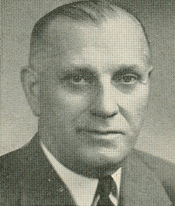
Historical · U.S. House · Maryland · District 5
Frank Small Jr.
Former U.S. Representative · Maryland District 5 · 1953–1955 · Republican
Frank Small Jr. represented Maryland's District 5 in the United States House of Representatives (1953–1955) for the Republican party. The page below collects sourced biographical facts, term history, committee roles, and provenance for Jr..
Bioguide ID: S000499
Key facts
- Full name
- Frank Small Jr.
- State
- Maryland
- District
- District 5
- Party
- Republican
- House service
- 1953–1955
- First House term
- 1953
- Status
- Left office
- Current term ends
- —
- Born
- 1896
- Bioguide ID
- S000499
- Committee assignments
- —
- Dataset version
- 1.20260605
Biographical narrative
849 words · sourced from the Wikipedia REST extract
Frank Small Jr. was a Republican politician who served as a U.S. Representative for Maryland's fifth congressional district from 1953 to 1955. His career spanned various sectors, including agriculture, banking, and public service, reflecting a diverse professional background that contributed to his political endeavors. Small's tenure in Congress was marked by his involvement in local governance and state committees prior to his election to the House of Representatives.
Early life and career
Frank Small Jr. was born on July 15, 1896, on a farm in Temple Hills, Maryland. Growing up in a rural environment, he attended local public schools, where he laid the foundation for his future pursuits. Seeking to enhance his technical skills, Small enrolled at the National Automobile College, where he studied in 1914 and 1915. This education would later inform his engagements in the automobile industry.
Following his education, Small entered the workforce, initially focusing on agriculture by operating several farms. His professional journey expanded in 1923 when he ventured into the banking sector and the automobile business, which he continued until 1957. His involvement in these industries not only provided him with practical experience but also established his reputation within the community.
Small's political career began in the late 1920s when he served in the Maryland House of Delegates for two years, from 1927 to 1928. This early experience in state politics paved the way for further public service. He was elected as a member of the board of county commissioners, a position he held from 1930 to 1934, where he contributed to local governance and community development.
In addition to his roles in the Maryland House of Delegates and as a county commissioner, Small was active in the Republican Party. From 1934 to 1942, he served on the Republican State Central Committee, eventually becoming its chairman for a portion of that time. His leadership within the party was further demonstrated through his participation as a delegate to the Republican National Conventions in 1940, 1944, and 1956.
Small's involvement in state governance continued with his appointment to the Maryland Racing Commission, where he served from 1937 to 1952. During his tenure, he held the position of chairman in 1951 and 1952, overseeing the regulation of horse racing in the state. His diverse experiences in both the public and private sectors positioned him as a well-rounded candidate for higher office.
House tenure
Frank Small Jr. was elected to the United States House of Representatives in 1952, representing Maryland's fifth congressional district. His term in Congress commenced on January 3, 1953, and concluded on January 3, 1955. During this period, Small participated in the legislative process, contributing to discussions and decisions that affected his constituents and the broader national landscape.
Despite his efforts in Congress, Small faced challenges in securing re-election. He was unsuccessful in his bid for a second term in 1954, which marked the end of his congressional career. The reasons for his defeat are not detailed in the available records, but it is common for incumbents to face various political dynamics that can influence election outcomes.
Following his departure from Congress, Small continued to engage in public service and business. He transitioned into real estate, a field he remained involved in until 1973. His experience in banking also continued, as he served as the president of the Clinton Bank of Clinton, Maryland, from 1928 until 1972. This long tenure in banking underscored his commitment to financial services and community development.
Legislative focus and committees
During his time in the House of Representatives, Frank Small Jr. was involved in various legislative activities, although specific details regarding the bills he sponsored or supported are not provided in the available records. His background in agriculture, banking, and local governance likely informed his legislative priorities, which may have included issues pertinent to his constituents in Maryland's fifth district.
Small's experience on the Maryland Racing Commission and his leadership roles within the Republican Party may also have influenced his legislative focus. It is reasonable to assume that he advocated for policies that aligned with his professional background and the interests of his constituents, particularly in areas related to economic development, transportation, and local governance.
In addition to his congressional duties, Small's involvement in the Maryland Commissioner of Motor Vehicles from April 29, 1955, to April 15, 1957, after his congressional term, indicates his ongoing commitment to public service. This role allowed him to influence transportation policies and regulations within the state, further extending his impact beyond his time in Congress.
After his political career, Small continued to engage in various business ventures, including his position as vice president of the Equitable Trust Company of Baltimore, Maryland. His diverse professional experiences reflect a commitment to both public service and private enterprise, illustrating the multifaceted nature of his career.
Frank Small Jr. passed away on October 24, 1973, in Washington, D.C. He is interred in Resurrection Cemetery in Clinton, Maryland. His life and career exemplify the journey of a local leader who transitioned into national politics, contributing to the governance of his community and the state of Maryland.
Notable legislation
Sponsored and co-sponsored legislation for Frank Small Jr. is pending operator curation. The biographical narrative above carries the same provenance trail until per-bill rows are written.
Sources
- [1]https://en.wikipedia.org/wiki/Frank_Small_Jr.Wikipedia · retrieved 2026-06-05
Notable quotes
Sourced quotes for Frank Small Jr. are pending operator curation. Narrative-scope provenance remains attached below.
Sources
- [1]https://en.wikipedia.org/wiki/Frank_Small_Jr.Wikipedia · retrieved 2026-06-05
Key positions
Curated policy positions for Frank Small Jr. are pending operator review. The biographical narrative above carries the same provenance trail until per-topic positions are written.
Sources
- [1]https://en.wikipedia.org/wiki/Frank_Small_Jr.Wikipedia · retrieved 2026-06-05
Terms served
- 1953–1955U.S. House · Term 1 · Republican
Sources & provenance
Every attributable claim above carries a per-section [N] marker that resolves to the corresponding URL below. Each entry records the upstream provider, the canonical URL, and the timestamp at which the source was retrieved by the ingest pipeline.
Key facts
- https://bioguide.congress.gov/search/bio/S000499bioguide · retrieved 2026-06-05
- https://www.govtrack.us/congress/members/409986govtrack · retrieved 2026-06-05
Biographical narrative
- https://en.wikipedia.org/wiki/Frank_Small_Jr.wikipedia · retrieved 2026-06-05
Find your representative
Every U.S. state elects representatives by district. Browse Maryland’s delegation, the full former-representative roster, or explore the role and term length.
Related on The Candidate
- Preceded by Lansdale SasscerEarlier holder of the Maryland District 5 House seat · Democratic.Open
- Succeeded by Richard LankfordLater holder of the Maryland District 5 House seat · Democratic.Open
- Clement DorseyFormer U.S. Representative · Maryland District 1Open
- Daniel HenryFormer U.S. Representative · Maryland District 1 · DemocraticOpen
- David WardFormer U.S. Representative · Maryland District 1 · DemocraticOpen
- Dudley RoeFormer U.S. Representative · Maryland District 1 · DemocraticOpen