
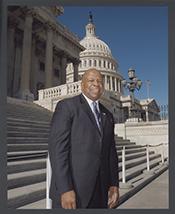
Historical · U.S. House · Maryland · District 7
Elijah Cummings
Former U.S. Representative · Maryland District 7 · 1996–2019 · Democratic
Elijah Cummings represented Maryland's District 7 in the United States House of Representatives (1996–2019) for the Democratic party. The page below collects sourced biographical facts, term history, committee roles, and provenance for Cummings.
Bioguide ID: C000984
Key facts
- Full name
- Elijah Cummings
- State
- Maryland
- District
- District 7
- Party
- Democratic
- House service
- 1996–2019
- First House term
- 1996
- Status
- Left office
- Current term ends
- —
- Born
- 1951
- Bioguide ID
- C000984
- Committee assignments
- —
- Dataset version
- 1.20260605
Biographical narrative
954 words · sourced from the Wikipedia REST extract
Elijah E. Cummings was an American politician and lawyer who served as a U.S. Representative for Maryland's 7th congressional district from 1996 until his death in 2019. A member of the Democratic Party, Cummings was known for his leadership roles in various committees, particularly as the chair of the Committee on Oversight and Reform. His congressional district encompassed significant portions of Baltimore and surrounding areas, reflecting a diverse constituency. Prior to his tenure in the U.S. House of Representatives, Cummings served in the Maryland House of Delegates, where he established a foundation for his political career.
Early life and career
Elijah Eugene Cummings was born on January 18, 1951, in Baltimore, Maryland. He was the son of Ruth Elma Cochran and Robert Cummings, who worked as sharecroppers. Growing up in a family of seven children, Cummings was exposed to the challenges faced by African Americans in the segregated South. At the age of 11, he participated in efforts to integrate a segregated swimming pool in South Baltimore, an early indication of his commitment to civil rights and social justice.
Cummings attended Baltimore City College high school, where he graduated with honors in 1969. He then enrolled at Howard University in Washington, D.C., where he became actively involved in student government, serving as sophomore class president, treasurer, and eventually president. He graduated in 1973 with a bachelor's degree in political science and was inducted into the Phi Beta Kappa honor society.
Following his undergraduate education, Cummings pursued a legal career at the University of Maryland School of Law, earning his Juris Doctor in 1976. He was admitted to the Maryland bar the same year and practiced law for 19 years. His political career began in earnest when he was elected to the Maryland House of Delegates in 1983, a position he held until 1996. During his time in the Maryland General Assembly, Cummings served as Chairman of the Legislative Black Caucus and became the first African American to hold the position of Speaker Pro Tempore.
In addition to his legislative work, Cummings was involved in various boards and commissions, including the SEED Schools of Maryland Board of Directors and the University of Maryland Law School Board of Advisors. He also participated in the Board of Visitors to the United States Naval Academy and was involved with the Elijah Cummings Youth Program in Israel. Cummings contributed to public discourse through a biweekly column for the Baltimore Afro-American newspaper and was a member of Phi Beta Sigma and a Prince Hall Mason.
House tenure
Elijah Cummings was first elected to the U.S. House of Representatives in 1996, representing Maryland's 7th congressional district. His district included a significant portion of Baltimore and parts of Baltimore County and Howard County, making him a prominent figure in Maryland politics. Over the course of his 13 terms in office, Cummings became known for his advocacy on issues affecting his constituents and for his leadership within the Democratic Party.
Cummings served on several important committees during his time in Congress. He was a member of the Committee on Transportation and Infrastructure, where he participated in subcommittees focusing on Coast Guard and maritime transportation, as well as railroads, pipelines, and hazardous materials. His most notable role was as the chair of the Committee on Oversight and Government Reform, a position he held from January 2019 until his death in October of the same year. In this capacity, he presided over significant hearings, including the public testimony of President Donald Trump's former lawyer, Michael Cohen, and played a key role in the impeachment inquiry against Trump.
In addition to his committee assignments, Cummings was involved in various caucuses, including the Task Force on Health Care Reform, the Congressional Caucus on Drug Policy, and the Congressional Arts Caucus. He was also a member of the Congressional Progressive Caucus and served as chairman of the Congressional Black Caucus during the 108th Congress. His leadership and advocacy earned him recognition, particularly during the congressional hearings on steroid use in sports in 2008, where he became known for his pointed questioning of witnesses.
Legislative focus and committees
Throughout his congressional career, Elijah Cummings focused on a range of legislative issues that reflected his commitment to social justice, civil rights, and government accountability. He was particularly active in matters related to health care, drug policy, and civil rights legislation. Cummings co-founded and chaired the Congressional Caucus on Drug Policy, advocating for reforms aimed at addressing the opioid crisis and promoting public health initiatives.
Cummings introduced significant legislation, including the Presidential and Federal Records Act Amendments of 2014, which modernized the definition of federal records to include electronic documents. This bipartisan bill was signed into law by then-President Barack Obama. He also supported the Smart Savings Act, which aimed to improve retirement savings options for federal employees by adjusting the default investment in the Thrift Savings Plan.
His tenure on the Committee on Oversight and Government Reform allowed him to address issues of transparency and accountability within the federal government. Cummings was known for his efforts to investigate matters of public concern, including government spending and the integrity of federal programs. His leadership in the committee was marked by a commitment to ensuring that government officials were held accountable for their actions.
Cummings's legacy in the U.S. House of Representatives is characterized by his dedication to his constituents and his unwavering commitment to civil rights and social justice. His work in Congress reflected a deep understanding of the challenges faced by marginalized communities and a determination to advocate for policies that would promote equity and justice. Following his death on October 17, 2019, he was succeeded by Kweisi Mfume, who had previously held the seat before Cummings.
Notable legislation
Sponsored and co-sponsored legislation for Elijah Cummings is pending operator curation. The biographical narrative above carries the same provenance trail until per-bill rows are written.
Sources
- [1]https://en.wikipedia.org/wiki/Elijah_CummingsWikipedia · retrieved 2026-06-05
Notable quotes
Sourced quotes for Elijah Cummings are pending operator curation. Narrative-scope provenance remains attached below.
Sources
- [1]https://en.wikipedia.org/wiki/Elijah_CummingsWikipedia · retrieved 2026-06-05
Key positions
Curated policy positions for Elijah Cummings are pending operator review. The biographical narrative above carries the same provenance trail until per-topic positions are written.
Sources
- [1]https://en.wikipedia.org/wiki/Elijah_CummingsWikipedia · retrieved 2026-06-05
Terms served
- 1996–1997U.S. House · Term 1 · Democratic
- 1997–1999U.S. House · Term 2 · Democratic
- 1999–2001U.S. House · Term 3 · Democratic
- 2001–2003U.S. House · Term 4 · Democratic
- 2003–2005U.S. House · Term 5 · Democratic
- 2005–2007U.S. House · Term 6 · Democratic
- 2007–2009U.S. House · Term 7 · Democratic
- 2009–2011U.S. House · Term 8 · Democratic
- 2011–2013U.S. House · Term 9 · Democratic
- 2013–2015U.S. House · Term 10 · Democratic
- 2015–2017U.S. House · Term 11 · Democratic
- 2017–2019U.S. House · Term 12 · Democratic
- 2019–2019U.S. House · Term 13 · Democratic
Sources & provenance
Every attributable claim above carries a per-section [N] marker that resolves to the corresponding URL below. Each entry records the upstream provider, the canonical URL, and the timestamp at which the source was retrieved by the ingest pipeline.
Key facts
- https://bioguide.congress.gov/search/bio/C000984bioguide · retrieved 2026-06-05
- https://cummings.house.govhouse.gov · retrieved 2026-06-05
Biographical narrative
- https://en.wikipedia.org/wiki/Elijah_Cummingswikipedia · retrieved 2026-06-05
Find your representative
Every U.S. state elects representatives by district. Browse Maryland’s delegation, the full former-representative roster, or explore the role and term length.
Related on The Candidate
- Preceded by Parren MitchellEarlier holder of the Maryland District 7 House seat · Democratic.Open
- Clement DorseyFormer U.S. Representative · Maryland District 1Open
- Daniel HenryFormer U.S. Representative · Maryland District 1 · DemocraticOpen
- David WardFormer U.S. Representative · Maryland District 1 · DemocraticOpen
- Dudley RoeFormer U.S. Representative · Maryland District 1 · DemocraticOpen
- Democratic PartyFederal candidates and office holders on the Democratic line.Open