
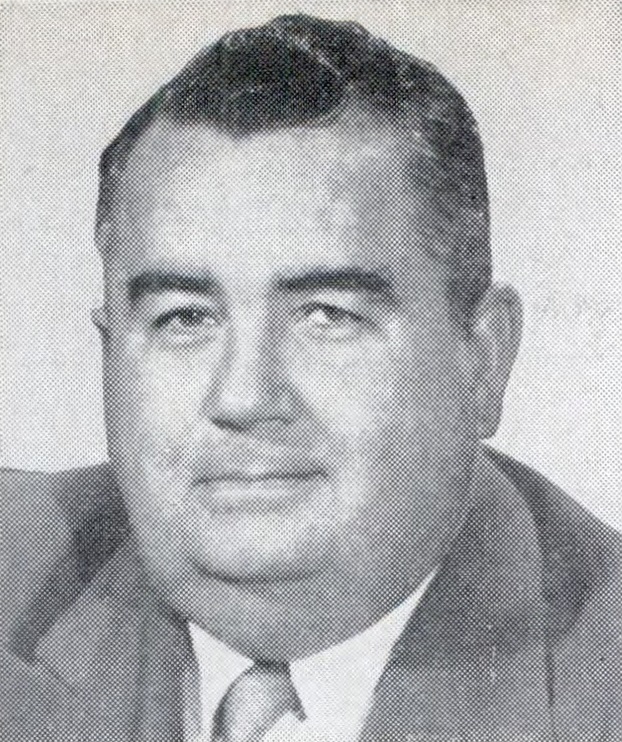
Historical · U.S. House · Mississippi · District 3
Frank Smith
Former U.S. Representative · Mississippi District 3 · 1951–1963 · Democratic
Frank Smith represented Mississippi's District 3 in the United States House of Representatives (1951–1963) for the Democratic party. The page below collects sourced biographical facts, term history, committee roles, and provenance for Smith.
Bioguide ID: S000533
Key facts
- Full name
- Frank Smith
- State
- Mississippi
- District
- District 3
- Party
- Democratic
- House service
- 1951–1963
- First House term
- 1951
- Status
- Left office
- Current term ends
- —
- Born
- 1918
- Bioguide ID
- S000533
- Committee assignments
- —
- Dataset version
- 1.20260605
Biographical narrative
927 words · sourced from the Wikipedia REST extract
Frank Smith was a prominent American politician and World War II veteran who served as a U.S. Representative for Mississippi's 3rd congressional district from 1951 until 1962. A member of the Democratic Party, Smith was known for his involvement in various legislative issues, particularly those affecting his constituents in Mississippi. His political career was marked by a commitment to civil rights and a focus on economic issues relevant to the agricultural sector, including support for the cotton industry and federal flood control legislation.
Early life and career
Frank Ellis Smith was born on February 21, 1918, in Sidon, Mississippi, to immigrant parents. He spent his formative years in Greenwood, Mississippi, where he faced personal tragedy at a young age when his father, a deputy sheriff, was killed by a prisoner when Smith was only eight years old. This early experience likely shaped his perspectives on justice and community service.
Smith attended public schools in Mississippi before enrolling at Sunflower Junior College in Moorhead, where he became involved in student journalism. As a student editor of the college newspaper, he often wrote from a liberal viewpoint on contentious issues such as race relations, which were particularly sensitive topics in the South during that era. After graduating from junior college in 1936, he pursued a career in writing, working as a freelance writer before continuing his education at the University of Mississippi, where he graduated in 1941. While at the university, he was a member of the Beta Theta Pi fraternity.
With the onset of World War II, Smith enlisted in the United States Army on February 9, 1942. He completed training at the Field Artillery Officers Candidate School and served in Europe as a captain with the 243rd Field Artillery Battalion, part of the Third Army. His military service included participation in the Normandy invasion in 1944, a pivotal moment in the war. After the war, Smith was discharged to the Reserves as a major in Field Artillery on February 13, 1946.
Following his military service, Smith returned to journalism, serving as the managing editor of the Greenwood Morning Call, a liberal newspaper, from 1946 to 1947. He also attended American University in Washington, D.C., during this time. His political career began to take shape when he worked as a legislative assistant to U.S. Senator John Stennis from 1947 to 1949. Smith's political aspirations led him to the Mississippi State Senate, where he served from 1948 to 1950.
House tenure
In 1950, Frank Smith was elected as a Democrat to the U.S. House of Representatives, marking the beginning of a significant legislative career. He was elected to the Eighty-second Congress and subsequently re-elected to five additional terms, serving from January 3, 1951, until his resignation on November 14, 1962. During his time in Congress, Smith was involved in various legislative initiatives and was known for his moderate voting record on issues important to his constituents.
Smith's tenure in the House was characterized by his focus on issues that directly impacted the agricultural community in Mississippi, particularly the cotton industry. He supported federal flood control legislation, which was crucial for protecting the livelihoods of many farmers in his district. Additionally, he advocated for tariff reductions, which were seen as beneficial for the agricultural sector. His support for the United Nations also reflected a broader commitment to international cooperation and diplomacy.
In 1962, Smith faced a challenging political landscape when Mississippi lost a congressional seat due to reapportionment. This change forced him to run in the Democratic primary against Jamie Whitten, a long-serving congressman known for his segregationist views. Smith was unsuccessful in this primary election, which marked the end of his congressional career. Following his defeat, he was appointed by President John F. Kennedy to the governing board of the Tennessee Valley Authority, a position he held until 1972.
Legislative focus and committees
Throughout his congressional career, Frank Smith's legislative focus encompassed a range of issues that were significant to his constituents and the broader national landscape. His support for the cotton industry was a central theme of his legislative agenda, reflecting the economic realities of Mississippi's rural communities. Smith's advocacy for federal flood control measures demonstrated his commitment to protecting agricultural interests and ensuring the sustainability of farming in his district.
In addition to agricultural issues, Smith's voting record indicated a moderate stance on various social and economic matters. He was known to support tariff reductions, which were intended to enhance the competitiveness of American goods in the global market. His endorsement of the United Nations highlighted his belief in the importance of international collaboration and peacekeeping efforts.
Smith's involvement in civil rights issues was also notable, particularly as he navigated the complex political landscape of the South during the 1950s and 1960s. While he faced challenges within his party and constituency regarding race relations, his earlier writings and political activities suggested a commitment to addressing these issues, albeit in a manner that was often cautious given the prevailing attitudes of the time.
After leaving Congress, Smith continued to engage in public service and politics. He served on the board of the Tennessee Valley Authority, where he advocated for conservationist policies. His later career included roles in education and state government, reflecting his ongoing commitment to public service. Smith's retirement in 1983 marked the end of an extensive career in politics, but he remained active in local organizations and continued to write for a local newspaper until his death on August 2, 1997. He was buried in Sidon Cemetery in his hometown of Sidon, Mississippi.
Notable legislation
Sponsored and co-sponsored legislation for Frank Smith is pending operator curation. The biographical narrative above carries the same provenance trail until per-bill rows are written.
Sources
- [1]https://en.wikipedia.org/wiki/Frank_Ellis_SmithWikipedia · retrieved 2026-06-05
Notable quotes
Sourced quotes for Frank Smith are pending operator curation. Narrative-scope provenance remains attached below.
Sources
- [1]https://en.wikipedia.org/wiki/Frank_Ellis_SmithWikipedia · retrieved 2026-06-05
Key positions
Curated policy positions for Frank Smith are pending operator review. The biographical narrative above carries the same provenance trail until per-topic positions are written.
Sources
- [1]https://en.wikipedia.org/wiki/Frank_Ellis_SmithWikipedia · retrieved 2026-06-05
Terms served
- 1951–1953U.S. House · Term 1 · Democratic
- 1953–1955U.S. House · Term 2 · Democratic
- 1955–1957U.S. House · Term 3 · Democratic
- 1957–1959U.S. House · Term 4 · Democratic
- 1959–1961U.S. House · Term 5 · Democratic
- 1961–1963U.S. House · Term 6 · Democratic
Sources & provenance
Every attributable claim above carries a per-section [N] marker that resolves to the corresponding URL below. Each entry records the upstream provider, the canonical URL, and the timestamp at which the source was retrieved by the ingest pipeline.
Key facts
- https://bioguide.congress.gov/search/bio/S000533bioguide · retrieved 2026-06-05
- https://www.govtrack.us/congress/members/410016govtrack · retrieved 2026-06-05
Biographical narrative
- https://en.wikipedia.org/wiki/Frank_Ellis_Smithwikipedia · retrieved 2026-06-05
Find your representative
Every U.S. state elects representatives by district. Browse Mississippi’s delegation, the full former-representative roster, or explore the role and term length.
Related on The Candidate
- Preceded by William WhittingtonEarlier holder of the Mississippi District 3 House seat · Democratic.Open
- Succeeded by Charles GriffinLater holder of the Mississippi District 3 House seat · Democratic.Open
- Alan NunneleeFormer U.S. Representative · Mississippi District 1 · RepublicanOpen
- Benjamin NabersFormer U.S. Representative · Mississippi District 1 · UnionistOpen
- Christopher RankinFormer U.S. Representative · Mississippi District 1 · JacksonOpen
- Daniel WrightFormer U.S. Representative · Mississippi District 1 · DemocraticOpen