
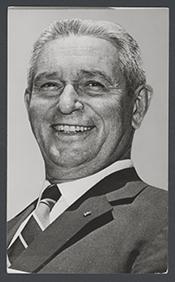
Historical · U.S. House · New Jersey · District 1
John Hunt
Former U.S. Representative · New Jersey District 1 · 1967–1975 · Republican
John Hunt represented New Jersey's District 1 in the United States House of Representatives (1967–1975) for the Republican party. The page below collects sourced biographical facts, term history, committee roles, and provenance for Hunt.
Bioguide ID: H000972
Key facts
- Full name
- John Hunt
- State
- New Jersey
- District
- District 1
- Party
- Republican
- House service
- 1967–1975
- First House term
- 1967
- Status
- Left office
- Current term ends
- —
- Born
- 1908
- Bioguide ID
- H000972
- Committee assignments
- —
- Dataset version
- 1.20260605
Biographical narrative
908 words · sourced from the Wikipedia REST extract
John E. Hunt was an American politician and member of the Republican Party who served as a U.S. Representative for New Jersey's 1st congressional district from 1967 until 1975. His tenure in the House of Representatives was marked by a focus on law enforcement issues and a conservative political stance. Prior to his congressional career, Hunt had a distinguished background in law enforcement and military service, which influenced his legislative priorities and public service.
Early life and career
John E. Hunt was born on November 25, 1908, in Lambertville, New Jersey. He pursued his education at Newark Business School, where he studied for three years. Following his time in business education, Hunt attended several prestigious institutions, including the New Jersey State Police Academy, the Federal Bureau of Investigation National Academy, and the Harvard School of Police Science. He also completed training at the United States Army Intelligence School.
Hunt began his professional career in law enforcement when he became a trooper with the New Jersey State Police in 1930. His commitment to public service extended beyond state law enforcement; during World War II, he served in the United States Army from 1942 to 1946. In the Army, he held the position of Combat Intelligence Officer with the 456th Bomb Group, where he earned several commendations, including the Bronze Star, the Air Medal with two oak leaf clusters, and the Purple Heart. He concluded his military service with the rank of major in 1946.
After returning from military service, Hunt resumed his career with the New Jersey State Police, where he eventually led the narcotics squad in South Jersey. He retired from the state police in 1959, after which he transitioned into politics. That same year, he was elected as the sheriff of Gloucester County, a position he held until 1963. Following his tenure as sheriff, Hunt was elected to the New Jersey Senate, where he served from 1964 to 1966. During his time in the Senate, he represented Gloucester County and was instrumental in advocating for the construction of the Commodore Barry Bridge, a significant infrastructure project that began in 1969.
House tenure
In 1966, Hunt was elected to the United States House of Representatives, representing New Jersey's 1st congressional district. He began his first term in Congress in 1967 and served a total of four terms until his departure from the House on January 3, 1975. Throughout his congressional career, Hunt was known for his conservative Republican views, particularly regarding law enforcement and criminal justice. He was a proponent of policies such as no-knock warrants and pre-trial detention, reflecting his background in law enforcement and his belief in strong measures to combat crime.
Hunt's political career in the House was characterized by his staunch support for President Richard Nixon, particularly during the Watergate scandal, which ultimately contributed to his electoral defeat in 1974. His alignment with Nixon's administration and the controversies surrounding it were significant factors in the changing political landscape of the time. In the 1974 election, Hunt was defeated by James Florio, who would later become the Governor of New Jersey.
After leaving Congress, Hunt continued to engage in public service. He served as the acting director of the Defense Civil Preparedness Agency from 1976 to 1977, where he contributed to national preparedness efforts during a time of heightened concern about civil defense.
Legislative focus and committees
During his time in the House of Representatives, John E. Hunt's legislative focus was heavily influenced by his background in law enforcement and public safety. He was an advocate for policies that aimed to enhance law enforcement capabilities and address issues related to crime. His support for measures such as no-knock warrants indicated a belief in the necessity of aggressive law enforcement tactics to combat criminal activity.
Hunt's tenure in Congress also reflected the broader political climate of the late 1960s and early 1970s, a period marked by significant social change and increasing public concern about crime and safety. His conservative stance resonated with constituents who prioritized law and order, and he often articulated a perspective that emphasized the need for stronger measures to support police and law enforcement agencies.
In addition to his focus on law enforcement, Hunt's legislative activities included participation in various committees that dealt with issues pertinent to his district and the nation. While specific committee assignments during his tenure are not detailed, it is common for members of Congress to serve on committees that align with their interests and expertise, particularly in areas related to public safety, infrastructure, and defense.
Hunt's political career was shaped by his experiences in law enforcement and the military, which informed his views on governance and public policy. His commitment to conservative principles and his advocacy for law enforcement left a mark on his legislative work and contributed to the political discourse of his time.
After his congressional career, Hunt remained active in his community. He was a resident of Pitman, New Jersey, where he worked as vice president of a real estate firm from 1978 to 1981. In 1983, he ran for the position of mayor in Pitman but was unsuccessful in that bid.
John E. Hunt passed away on September 22, 1989, at the age of 80, in a hospital in Woodbury, New Jersey. His life and career reflect a dedication to public service through law enforcement and politics, and his contributions to New Jersey's political landscape during a transformative era are notable.
Notable legislation
Sponsored and co-sponsored legislation for John Hunt is pending operator curation. The biographical narrative above carries the same provenance trail until per-bill rows are written.
Sources
- [1]https://en.wikipedia.org/wiki/John_E._HuntWikipedia · retrieved 2026-06-05
Notable quotes
Sourced quotes for John Hunt are pending operator curation. Narrative-scope provenance remains attached below.
Sources
- [1]https://en.wikipedia.org/wiki/John_E._HuntWikipedia · retrieved 2026-06-05
Key positions
Curated policy positions for John Hunt are pending operator review. The biographical narrative above carries the same provenance trail until per-topic positions are written.
Sources
- [1]https://en.wikipedia.org/wiki/John_E._HuntWikipedia · retrieved 2026-06-05
Terms served
- 1967–1969U.S. House · Term 1 · Republican
- 1969–1971U.S. House · Term 2 · Republican
- 1971–1973U.S. House · Term 3 · Republican
- 1973–1975U.S. House · Term 4 · Republican
Sources & provenance
Every attributable claim above carries a per-section [N] marker that resolves to the corresponding URL below. Each entry records the upstream provider, the canonical URL, and the timestamp at which the source was retrieved by the ingest pipeline.
Key facts
- https://bioguide.congress.gov/search/bio/H000972bioguide · retrieved 2026-06-05
- https://www.govtrack.us/congress/members/405816govtrack · retrieved 2026-06-05
Biographical narrative
- https://en.wikipedia.org/wiki/John_E._Huntwikipedia · retrieved 2026-06-05
Find your representative
Every U.S. state elects representatives by district. Browse New Jersey’s delegation, the full former-representative roster, or explore the role and term length.
Related on The Candidate
- Preceded by Charles WolvertonEarlier holder of the New Jersey District 1 House seat · Republican.Open
- Succeeded by James FlorioLater holder of the New Jersey District 1 House seat · Democratic.Open
- Andrew HayFormer U.S. Representative · New Jersey District 1 · WhigOpen
- Christopher BergenFormer U.S. Representative · New Jersey District 1 · RepublicanOpen
- Clement SinnicksonFormer U.S. Representative · New Jersey District 1 · RepublicanOpen
- Republican PartyFederal candidates and office holders on the Republican line.Open