
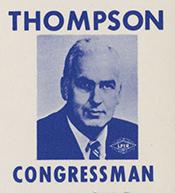
Historical · U.S. House · New Jersey · District 4
Frank Thompson Jr.
Former U.S. Representative · New Jersey District 4 · 1955–1981 · Democratic
Frank Thompson Jr. represented New Jersey's District 4 in the United States House of Representatives (1955–1981) for the Democratic party. The page below collects sourced biographical facts, term history, committee roles, and provenance for Jr..
Bioguide ID: T000200
Key facts
- Full name
- Frank Thompson Jr.
- State
- New Jersey
- District
- District 4
- Party
- Democratic
- House service
- 1955–1981
- First House term
- 1955
- Status
- Left office
- Current term ends
- —
- Born
- 1918
- Bioguide ID
- T000200
- Committee assignments
- —
- Dataset version
- 1.20260605
Biographical narrative
902 words · sourced from the Wikipedia REST extract
Frank Thompson Jr. was an American politician who served as a Democratic U.S. Representative for New Jersey's 4th congressional district from 1955 until 1980. He was a notable figure in the House of Representatives, where he held various leadership positions, including chairman of the House Administration Committee. His political career was marked by significant legislative contributions, particularly in the areas of arts and humanities, as well as a controversial end due to his involvement in the Abscam scandal, which ultimately led to his resignation and imprisonment.
Early life and career
Frank Thompson Jr. was born on July 26, 1918, in Trenton, New Jersey. He pursued higher education at Wake Forest University, where he earned a law degree from the Wake Forest University School of Law. Thompson's early career was interrupted by World War II, during which he served in the United States Navy from 1941 to 1948. His military service included distinguished participation in key battles such as Iwo Jima and Okinawa, for which he received three combat decorations.
After the war, Thompson returned to civilian life and began practicing law. However, he re-entered military service from August 1950 to January 1952, commanding the United States Navy Reserve Battalion 4-68. His military career included a seventeen-month active duty tour on the staff of the commander of the Eastern Sea Frontier.
In addition to his military and legal careers, Thompson was involved in politics at the state level. Between 1950 and 1954, he served as a member of the New Jersey General Assembly representing Mercer County. During his second term, he held the position of minority leader, which provided him with valuable experience in legislative processes and governance.
House tenure
Thompson's congressional career began in 1955 when he successfully ran as a Democrat for a seat in the U.S. House of Representatives. Over the course of his 13 terms in office, he became known as a liberal voice within the House. He was a strong supporter of President John F. Kennedy and played a significant role in the 1960 presidential election by overseeing Kennedy's voter registration operations.
Throughout his tenure, Thompson held several important leadership roles. From 1969 to 1971, he chaired the House Subcommittee on Libraries and Memorials, where he conducted groundbreaking hearings into the operations of the Smithsonian Institution. His efforts in this role contributed to greater transparency and accountability within the institution. Additionally, from 1975 to 1978, he chaired the Joint Committee on Printing, further demonstrating his influence in legislative matters.
Thompson was instrumental in sponsoring significant legislation that shaped American cultural policy. He was a key figure in the establishment of both the National Endowment for the Arts and the National Endowment for the Humanities, organizations that support artistic and scholarly endeavors across the nation. Furthermore, he authored the legislation that led to the creation of the John F. Kennedy Center for the Performing Arts, a major cultural institution in Washington, D.C.
In his later years in Congress, Thompson served as the chairman of the Committee on House Administration, a position he held during his final three terms. His leadership in this committee allowed him to influence various administrative and procedural aspects of the House, further solidifying his legacy as a prominent member of Congress.
Legislative focus and committees
Throughout his time in the House of Representatives, Frank Thompson Jr. was known for his commitment to the arts, education, and public service. His legislative focus included a strong advocacy for funding and support for cultural institutions and programs that benefited the public. His efforts in establishing the National Endowment for the Arts and the National Endowment for the Humanities reflected his belief in the importance of arts and education as fundamental components of American society.
Thompson's work on the House Subcommittee on Libraries and Memorials was particularly notable for its impact on national cultural policy. By conducting comprehensive hearings on the Smithsonian Institution, he aimed to improve the management and accessibility of one of the nation's most important cultural resources. This initiative demonstrated his dedication to enhancing public engagement with the arts and history.
As chairman of the Committee on House Administration, Thompson played a crucial role in overseeing the operations of the House and ensuring that it functioned effectively. His leadership in this capacity allowed him to address various administrative challenges and implement reforms that improved the legislative process. His tenure in this committee was characterized by a focus on transparency and efficiency, which were essential for maintaining public trust in government institutions.
Despite his significant contributions to American politics and culture, Thompson's career was marred by controversy due to his involvement in the Abscam scandal. In 1980, he was implicated in a federal investigation that uncovered bribery and corruption among several members of Congress. Although he maintained his innocence, the scandal overshadowed his legislative achievements and ultimately led to his conviction on bribery and conspiracy charges. Following his resignation from Congress, Thompson served two years in federal prison before being released on parole.
Thompson's life after politics was relatively quiet. He lived in Alexandria, Virginia, until his death on July 22, 1989, just days before his 71st birthday. He was survived by his wife, Evelina Van Metre Thompson, and their two daughters, as well as three granddaughters. Thompson's legacy remains a complex one, marked by both his significant contributions to American culture and the controversies that ultimately defined the end of his political career.
Notable legislation
Sponsored and co-sponsored legislation for Frank Thompson Jr. is pending operator curation. The biographical narrative above carries the same provenance trail until per-bill rows are written.
Sources
- [1]https://en.wikipedia.org/wiki/Frank_ThompsonWikipedia · retrieved 2026-06-05
Notable quotes
Sourced quotes for Frank Thompson Jr. are pending operator curation. Narrative-scope provenance remains attached below.
Sources
- [1]https://en.wikipedia.org/wiki/Frank_ThompsonWikipedia · retrieved 2026-06-05
Key positions
Curated policy positions for Frank Thompson Jr. are pending operator review. The biographical narrative above carries the same provenance trail until per-topic positions are written.
Sources
- [1]https://en.wikipedia.org/wiki/Frank_ThompsonWikipedia · retrieved 2026-06-05
Terms served
- 1955–1957U.S. House · Term 1 · Democratic
- 1957–1959U.S. House · Term 2 · Democratic
- 1959–1961U.S. House · Term 3 · Democratic
- 1961–1963U.S. House · Term 4 · Democratic
- 1963–1965U.S. House · Term 5 · Democratic
- 1965–1967U.S. House · Term 6 · Democratic
- 1967–1969U.S. House · Term 7 · Democratic
- 1969–1971U.S. House · Term 8 · Democratic
- 1971–1973U.S. House · Term 9 · Democratic
- 1973–1975U.S. House · Term 10 · Democratic
- 1975–1977U.S. House · Term 11 · Democratic
- 1977–1979U.S. House · Term 12 · Democratic
- 1979–1981U.S. House · Term 13 · Democratic
Sources & provenance
Every attributable claim above carries a per-section [N] marker that resolves to the corresponding URL below. Each entry records the upstream provider, the canonical URL, and the timestamp at which the source was retrieved by the ingest pipeline.
Key facts
- https://bioguide.congress.gov/search/bio/T000200bioguide · retrieved 2026-06-05
- https://www.govtrack.us/congress/members/410779govtrack · retrieved 2026-06-05
Biographical narrative
- https://en.wikipedia.org/wiki/Frank_Thompsonwikipedia · retrieved 2026-06-05
Find your representative
Every U.S. state elects representatives by district. Browse New Jersey’s delegation, the full former-representative roster, or explore the role and term length.
Related on The Candidate
- Preceded by Charles HowellEarlier holder of the New Jersey District 4 House seat · Democratic.Open
- Andrew HayFormer U.S. Representative · New Jersey District 1 · WhigOpen
- Charles WolvertonFormer U.S. Representative · New Jersey District 1 · RepublicanOpen
- Christopher BergenFormer U.S. Representative · New Jersey District 1 · RepublicanOpen
- Clement SinnicksonFormer U.S. Representative · New Jersey District 1 · RepublicanOpen
- Democratic PartyFederal candidates and office holders on the Democratic line.Open