
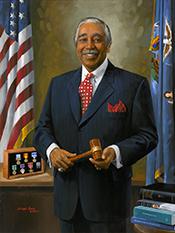
Historical · U.S. House · New York · District 13
Charlie Rangel
Former U.S. Representative · New York District 13 · 1971–2017 · Democratic
Charlie Rangel represented New York's District 13 in the United States House of Representatives (1971–2017) for the Democratic party. The page below collects sourced biographical facts, term history, committee roles, and provenance for Rangel.
Bioguide ID: R000053
Key facts
- Full name
- Charlie Rangel
- State
- New York
- District
- District 13
- Party
- Democratic
- House service
- 1971–2017
- First House term
- 1971
- Status
- Left office
- Current term ends
- —
- Born
- 1930
- Bioguide ID
- R000053
- Committee assignments
- —
- Dataset version
- 1.20260605
Biographical narrative
1,031 words · sourced from the Wikipedia REST extract
Charles B. Rangel was a prominent American politician who served as a U.S. Representative for New York's 13th congressional district for 46 years, making him one of the longest-serving members in the history of the House of Representatives. A member of the Democratic Party, Rangel's tenure in Congress began in 1971 and concluded in 2017. He was known for his influential role in various legislative matters, particularly as the first African American chair of the House Ways and Means Committee and as a founding member of the Congressional Black Caucus. His career was marked by significant legislative achievements, as well as controversies that ultimately led to his censure by the House Ethics Committee.
Early life and career
Charles Bernard Rangel was born on June 11, 1930, in Harlem, New York City. He was the second of three children in a family with diverse roots; his father, Ralph Rangel, was of Puerto Rican descent, while his mother, Blanche Mary Wharton Rangel, was African American. Rangel's early life was shaped by the challenges of growing up in a single-parent household after his father left the family when Rangel was six years old. His mother worked as a maid and seamstress to support the family, and Rangel was raised with the help of his maternal grandfather, who served as a significant role model.
Rangel's education began in local schools, where he demonstrated academic promise. However, his high school years at DeWitt Clinton High School were tumultuous; he struggled with attendance and eventually dropped out during his junior year at the age of sixteen. Following his departure from school, he took on various low-paying jobs, including selling shoes, to support himself.
In 1948, Rangel enlisted in the United States Army, where he served until 1952. His military service included participation in the Korean War, during which he was assigned to the 503rd Field Artillery Battalion. Rangel's unit faced intense combat, particularly during the Battle of Kunu-ri, where he played a crucial role in leading his fellow soldiers to safety amid encirclement by enemy forces. His bravery earned him a Purple Heart and a Bronze Star.
After completing his military service, Rangel pursued higher education. He graduated from New York University in 1957 and later earned a law degree from St. John's University School of Law in 1960. Following his graduation, he worked as a private attorney and served as an assistant U.S. attorney. Rangel's political career began in earnest when he was elected to the New York State Assembly, where he served two terms from 1967 to 1971. His political ascent continued when he defeated long-time incumbent Congressman Adam Clayton Powell Jr. in a primary election, paving the way for his election to the U.S. House of Representatives.
House tenure
Rangel was first elected to the U.S. House of Representatives in 1971, marking the beginning of a lengthy and influential career in Congress. Over the course of his 23 terms, he became known for his solidly liberal views and pragmatic approach to legislation. Rangel quickly rose through the ranks of the Democratic Party, becoming a prominent figure in both New York and national politics.
Throughout his tenure, Rangel was actively involved in various legislative initiatives and served on several important committees. He was particularly noted for his leadership on issues related to drug policy, having chaired the House Select Committee on Narcotics during the 1980s. His work in this area helped shape national policy on drug-related issues, reflecting his long-standing concern about the impact of illegal drugs on communities.
Rangel's influence extended beyond drug policy; he played a key role in the establishment of the Upper Manhattan Empowerment Zone Development Corporation in 1995, which aimed to stimulate economic development in Harlem and surrounding areas. He was also instrumental in the passage of the national Empowerment Zone Act, which sought to provide federal assistance to economically distressed urban areas.
Rangel's political career was not without challenges. Beginning in 2008, he faced allegations of ethical violations related to his financial dealings and use of congressional resources. These allegations culminated in a censure by the House Ethics Committee in 2010, following a finding of guilt on multiple counts of violating House ethics rules. Despite these controversies, Rangel continued to win re-election in subsequent cycles, although he faced increasingly competitive primary challenges as his district demographics shifted.
In 2016, Rangel announced that he would not seek re-election, concluding his long tenure in Congress in January 2017. At the time of his retirement, he was the dean of New York's congressional delegation and one of the longest-serving members in the history of the House.
Legislative focus and committees
During his time in the House of Representatives, Rangel's legislative focus encompassed a wide range of issues, reflecting his commitment to social justice, economic development, and community empowerment. His work on the House Ways and Means Committee, where he served as chair, was particularly significant. This committee is one of the most powerful in Congress, overseeing taxation and revenue generation, as well as social programs such as Social Security and Medicare.
Rangel's leadership on the committee allowed him to influence major tax legislation and advocate for policies aimed at reducing economic inequality. He was known for his ability to navigate complex political landscapes, often seeking bipartisan support for his initiatives. His pragmatic approach enabled him to find common ground with colleagues across the aisle, which was essential in advancing his legislative agenda.
In addition to his work on the Ways and Means Committee, Rangel was involved in various other committees and caucuses throughout his career. As a founding member of the Congressional Black Caucus, he played a vital role in advocating for the interests of African Americans and other marginalized communities. His commitment to civil rights and social justice was evident in his legislative priorities, which often included efforts to address systemic inequalities in education, healthcare, and economic opportunity.
Rangel's tenure was characterized by a blend of legislative accomplishments and public service, as he sought to uplift his constituents and address pressing social issues. His legacy includes not only his long service in Congress but also his contributions to shaping policy and advocating for the needs of his community.
Notable legislation
Sponsored and co-sponsored legislation for Charlie Rangel is pending operator curation. The biographical narrative above carries the same provenance trail until per-bill rows are written.
Sources
- [1]https://en.wikipedia.org/wiki/Charles_RangelWikipedia · retrieved 2026-06-05
Notable quotes
Sourced quotes for Charlie Rangel are pending operator curation. Narrative-scope provenance remains attached below.
Sources
- [1]https://en.wikipedia.org/wiki/Charles_RangelWikipedia · retrieved 2026-06-05
Key positions
Curated policy positions for Charlie Rangel are pending operator review. The biographical narrative above carries the same provenance trail until per-topic positions are written.
Sources
- [1]https://en.wikipedia.org/wiki/Charles_RangelWikipedia · retrieved 2026-06-05
Terms served
- 1971–1973U.S. House · Term 1 · Democratic
- 1973–1975U.S. House · Term 2 · Democratic
- 1975–1977U.S. House · Term 3 · Democratic
- 1977–1979U.S. House · Term 4 · Democratic
- 1979–1981U.S. House · Term 5 · Democratic
- 1981–1983U.S. House · Term 6 · Democratic
- 1983–1985U.S. House · Term 7 · Democratic
- 1985–1987U.S. House · Term 8 · Democratic
- 1987–1989U.S. House · Term 9 · Democratic
- 1989–1991U.S. House · Term 10 · Democratic
- 1991–1993U.S. House · Term 11 · Democratic
- 1993–1995U.S. House · Term 12 · Democratic
- 1995–1997U.S. House · Term 13 · Democratic
- 1997–1999U.S. House · Term 14 · Democratic
- 1999–2001U.S. House · Term 15 · Democratic
- 2001–2003U.S. House · Term 16 · Democratic
- 2003–2005U.S. House · Term 17 · Democratic
- 2005–2007U.S. House · Term 18 · Democratic
- 2007–2009U.S. House · Term 19 · Democratic
- 2009–2011U.S. House · Term 20 · Democratic
- 2011–2013U.S. House · Term 21 · Democratic
- 2013–2015U.S. House · Term 22 · Democratic
- 2015–2017U.S. House · Term 23 · Democratic
Sources & provenance
Every attributable claim above carries a per-section [N] marker that resolves to the corresponding URL below. Each entry records the upstream provider, the canonical URL, and the timestamp at which the source was retrieved by the ingest pipeline.
Key facts
- https://bioguide.congress.gov/search/bio/R000053bioguide · retrieved 2026-06-05
- http://rangel.house.govhouse.gov · retrieved 2026-06-05
Biographical narrative
- https://en.wikipedia.org/wiki/Charles_Rangelwikipedia · retrieved 2026-06-05
Find your representative
Every U.S. state elects representatives by district. Browse New York’s delegation, the full former-representative roster, or explore the role and term length.
Related on The Candidate
- Preceded by Abraham MulterEarlier holder of the New York District 13 House seat · Democratic.Open
- Abel HuntingtonFormer U.S. Representative · New York District 1 · JacksonOpen
- Alfred ChapinFormer U.S. Representative · New York District 1 · DemocraticOpen
- Cadwallader ColdenFormer U.S. Representative · New York District 1 · FederalistOpen
- Charles FloydFormer U.S. Representative · New York District 1 · DemocraticOpen
- Democratic PartyFederal candidates and office holders on the Democratic line.Open