
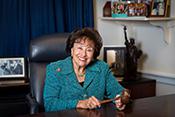
Historical · U.S. House · New York · District 17
Nita Lowey
Former U.S. Representative · New York District 17 · 1989–2021 · Democratic
Nita Lowey represented New York's District 17 in the United States House of Representatives (1989–2021) for the Democratic party. The page below collects sourced biographical facts, term history, committee roles, and provenance for Lowey.
Bioguide ID: L000480
Key facts
- Full name
- Nita Lowey
- State
- New York
- District
- District 17
- Party
- Democratic
- House service
- 1989–2021
- First House term
- 1989
- Status
- Left office
- Current term ends
- —
- Born
- 1937
- Bioguide ID
- L000480
- Committee assignments
- —
- Dataset version
- 1.20260604
Biographical narrative
869 words · sourced from the Wikipedia REST extract
Nita M. Lowey was a prominent American politician who served as a U.S. Representative for New York's 17th congressional district from 1989 until 2021. A member of the Democratic Party, Lowey was known for her extensive legislative work and leadership roles, including becoming the first woman to chair the House Appropriations Committee. Throughout her 16 terms in Congress, she represented a significant portion of New York City's northern suburbs, advocating for various issues such as women's health, environmental protection, and foreign aid.
Early life and career
Nita M. Lowey was born on July 5, 1937, in the Bronx, New York City. She was the daughter of Beatrice Fleisher and Jack Melnikoff. Lowey demonstrated academic excellence from an early age, graduating as valedictorian from the Bronx High School of Science in 1955. She furthered her education at Mount Holyoke College, where she earned a bachelor's degree.
Following her graduation, Lowey began her career in public service and politics. She worked on Mario Cuomo's campaign for lieutenant governor of New York in 1974, which marked her entry into the political arena. Subsequently, she served as an assistant secretary of state for New York for 13 years, gaining valuable experience in governance and public policy. This early involvement in politics laid the groundwork for her future endeavors in the U.S. House of Representatives.
House tenure
Lowey's political career took a significant turn when she ran for the United States House of Representatives in 1988, seeking to represent New York's 20th congressional district. She successfully defeated the incumbent, Joe DioGuardi, marking the beginning of her long tenure in Congress. Following the 1990 U.S. Census, her district was renumbered as the 18th and later as the 17th after the 2010 Census. Throughout her time in Congress, Lowey represented a large area that included many of New York City's northern suburbs, such as White Plains, Purchase, Tarrytown, Mount Kisco, and Armonk.
During her tenure, Lowey was involved in various legislative initiatives and was known for her advocacy on several key issues. Early in her congressional career, she sponsored an earmark aimed at dredging Mamaroneck Harbor, addressing local concerns about the harbor's depth for larger yachts. Her commitment to public broadcasting was also evident when she appeared at a congressional hearing alongside characters from Sesame Street to advocate for the Public Broadcasting Service.
In addition to her legislative work, Lowey held leadership positions within the Democratic Party. She served as the first female chair of the Democratic Congressional Campaign Committee from 2001 to 2002. Her influence within the party continued to grow, and in 2018, she became the first woman to chair the House Appropriations Committee. This role allowed her to play a crucial part in shaping federal spending and budgetary priorities.
Lowey's congressional career was marked by her involvement in significant national issues. In early 2009, she introduced the Transportation Security Workforce Enhancement Act, which aimed to secure collective bargaining rights for federal workers at the Transportation Security Administration and the Department of Homeland Security. She also took a strong stance on health care reform, expressing her opposition to the Stupak-Pitts Amendment, which sought to limit taxpayer-funded abortions in the context of the Affordable Care Act.
Throughout her time in office, Lowey was a vocal advocate for women's health issues, environmental protection, and foreign aid to developing nations. She was particularly critical of the 2015 nuclear deal with Iran, expressing concerns about the potential risks associated with the agreement. Her advocacy extended to addressing budgetary issues in Puerto Rico, where she voiced disappointment over Congress's failure to adequately respond to the territory's financial challenges.
In the 2018 elections, the Democratic Party regained a majority in the House of Representatives, and Lowey's leadership as chairwoman of the House Appropriations Committee became instrumental in negotiating key legislation, including an end to a 35-day government shutdown in 2019. However, in October 2019, she announced her decision not to seek re-election in 2020, marking the end of her 16 terms in Congress.
Legislative focus and committees
Throughout her congressional career, Lowey was involved in numerous committees and caucuses that reflected her legislative priorities. In the 116th Congress, she served as the chairwoman of the Committee on Appropriations, a role that placed her at the forefront of federal budgetary decisions. As chairwoman, she also served as an ex officio member of all subcommittees, allowing her to influence a wide range of legislative issues.
Lowey's focus on women's issues was evident through her membership in the Congressional Women's Caucus and the House Pro-Choice Caucus. These affiliations underscored her commitment to advocating for women's rights and reproductive health. Additionally, she was a member of the Hudson River Caucus, which aimed to address environmental concerns and promote the health of the Hudson River and its surrounding communities.
Over her extensive career, Lowey's legislative efforts and leadership roles contributed to significant advancements in various policy areas. Her dedication to public service and her ability to navigate complex political landscapes made her a notable figure in the U.S. House of Representatives. After concluding her final term on January 3, 2021, Lowey left a legacy of advocacy and leadership that reflected her commitment to her constituents and the broader goals of her party.
Notable legislation
Sponsored and co-sponsored legislation for Nita Lowey is pending operator curation. The biographical narrative above carries the same provenance trail until per-bill rows are written.
Sources
- [1]https://en.wikipedia.org/wiki/Nita_LoweyWikipedia · retrieved 2026-06-04
Notable quotes
Sourced quotes for Nita Lowey are pending operator curation. Narrative-scope provenance remains attached below.
Sources
- [1]https://en.wikipedia.org/wiki/Nita_LoweyWikipedia · retrieved 2026-06-04
Key positions
Curated policy positions for Nita Lowey are pending operator review. The biographical narrative above carries the same provenance trail until per-topic positions are written.
Sources
- [1]https://en.wikipedia.org/wiki/Nita_LoweyWikipedia · retrieved 2026-06-04
Terms served
- 1989–1991U.S. House · Term 1 · Democratic
- 1991–1993U.S. House · Term 2 · Democratic
- 1993–1995U.S. House · Term 3 · Democratic
- 1995–1997U.S. House · Term 4 · Democratic
- 1997–1999U.S. House · Term 5 · Democratic
- 1999–2001U.S. House · Term 6 · Democratic
- 2001–2003U.S. House · Term 7 · Democratic
- 2003–2005U.S. House · Term 8 · Democratic
- 2005–2007U.S. House · Term 9 · Democratic
- 2007–2009U.S. House · Term 10 · Democratic
- 2009–2011U.S. House · Term 11 · Democratic
- 2011–2013U.S. House · Term 12 · Democratic
- 2013–2015U.S. House · Term 13 · Democratic
- 2015–2017U.S. House · Term 14 · Democratic
- 2017–2019U.S. House · Term 15 · Democratic
- 2019–2021U.S. House · Term 16 · Democratic
Sources & provenance
Every attributable claim above carries a per-section [N] marker that resolves to the corresponding URL below. Each entry records the upstream provider, the canonical URL, and the timestamp at which the source was retrieved by the ingest pipeline.
Key facts
- https://bioguide.congress.gov/search/bio/L000480bioguide · retrieved 2026-06-04
- https://lowey.house.govhouse.gov · retrieved 2026-06-04
Biographical narrative
- https://en.wikipedia.org/wiki/Nita_Loweywikipedia · retrieved 2026-06-04
Find your representative
Every U.S. state elects representatives by district. Browse New York’s delegation, the full former-representative roster, or explore the role and term length.
Related on The Candidate
- Preceded by John MurphyEarlier holder of the New York District 17 House seat · Democratic.Open
- Succeeded by Mondaire JonesLater holder of the New York District 17 House seat · Democratic.Open
- Abel HuntingtonFormer U.S. Representative · New York District 1 · JacksonOpen
- Alfred ChapinFormer U.S. Representative · New York District 1 · DemocraticOpen
- Cadwallader ColdenFormer U.S. Representative · New York District 1 · FederalistOpen
- Charles FloydFormer U.S. Representative · New York District 1 · DemocraticOpen