
Historical · U.S. House · New York · District 17
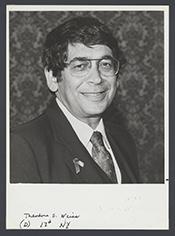
Theodore Weiss
Former U.S. Representative · New York District 17 · 1977–1992 · Democratic
Theodore Weiss represented New York's District 17 in the United States House of Representatives (1977–1992) for the Democratic party. The page below collects sourced biographical facts, term history, committee roles, and provenance for Weiss.
Bioguide ID: W000258
Key facts
- Full name
- Theodore Weiss
- State
- New York
- District
- District 17
- Party
- Democratic
- House service
- 1977–1992
- First House term
- 1977
- Status
- Left office
- Current term ends
- —
- Born
- 1927
- Bioguide ID
- W000258
- Committee assignments
- —
- Dataset version
- 1.20260605
Biographical narrative
971 words · sourced from the Wikipedia REST extract
Theodore S. Weiss was an American politician and member of the Democratic Party who served as a U.S. Representative for New York's 17th congressional district from 1977 until his death in 1992. Throughout his political career, Weiss was known for his commitment to liberal causes, including civil rights, healthcare access, and environmental issues. He played a significant role in various legislative initiatives and was an influential figure in the House of Representatives during his tenure.
Early life and career
Ted Weiss was born on September 17, 1927, in the village of Gáva, located in Hungary, which is now known as Gávavencsellő. In 1938, Weiss and his family immigrated to the United States, settling in South Amboy, New Jersey. He completed his high school education at H.G. Hoffman High School in 1946. Following his graduation, he served in the United States Army from 1946 to 1947. After his military service, Weiss pursued higher education, earning a Bachelor of Arts degree from Syracuse University in 1951. He continued his studies at the university's College of Law, where he obtained his LL.B. in 1952. Weiss became a naturalized U.S. citizen in 1953.
Weiss began his professional career as an assistant district attorney in New York County, a position he held from 1955 to 1959. Afterward, he transitioned to private legal practice. His early career in law laid the groundwork for his later political aspirations. In addition to his legal work, Weiss was involved in local politics and served on the New York City Council from 1962 until 1976. His experience in the city council provided him with valuable insights into governance and public policy, which he would later apply in his congressional role.
Weiss was also active in national politics, serving as a delegate to the 1972 Democratic National Convention. His growing prominence in the Democratic Party culminated in his election to the U.S. House of Representatives in 1976, where he would represent a significant portion of Manhattan's West Side.
House tenure
Ted Weiss officially began his tenure in the U.S. House of Representatives on January 3, 1977. Over the course of his political career, he was re-elected multiple times, serving a total of eight terms in Congress. Weiss's legislative work was characterized by his dedication to a range of progressive issues, including civil rights, healthcare reform, and environmental protection.
During his time in the House, Weiss was a member of several important committees, including the House Committee on Banking, Finance, and Urban Affairs, the House Committee on Government Operations, and the House Committee on Foreign Affairs. His involvement in these committees allowed him to influence legislation on a variety of critical issues affecting both his constituents and the nation as a whole.
Weiss was particularly noted for his leadership in addressing the HIV/AIDS epidemic. He was an early advocate for increased federal funding to combat the disease and was instrumental in holding the first congressional hearing on the government's response to the AIDS crisis in 1983. This initiative highlighted his commitment to public health and the welfare of marginalized communities.
In addition to his work on health issues, Weiss was involved in various other significant legislative efforts. In 1985, he led a committee that uncovered serious regulatory failures by the Food and Drug Administration (FDA) regarding the approval of new drugs for farm animals. The committee's findings indicated that a substantial percentage of these drugs had not received proper FDA approval, raising concerns about public health and safety.
Weiss was also an outspoken opponent of U.S. military actions abroad. In 1983, he co-sponsored a resolution to impeach President Ronald Reagan in response to the invasion of Grenada, reflecting his stance on foreign policy and military intervention. His advocacy extended to local issues as well, as he fought against the proposed Westway highway project and opposed plans to station nuclear-capable vessels in Staten Island.
Legislative focus and committees
Throughout his congressional career, Ted Weiss was recognized for his strong advocacy on a variety of issues that aligned with liberal values. His legislative focus included civil rights, healthcare access, labor rights, and environmental protection. Weiss was a staunch supporter of open government and transparency, believing that citizens should have access to information about their government and its operations.
Weiss's commitment to civil rights was evident in his support for legislation aimed at promoting equality and justice for all individuals. He championed workers' rights and was a proponent of union initiatives, recognizing the importance of collective bargaining and fair labor practices in improving the lives of working Americans.
In addition to his domestic policy initiatives, Weiss was involved in foreign affairs, advocating for a more humane approach to international relations. He called for the removal of the embargo on Cuba and supported policies that promoted cultural exchange and understanding.
Weiss's contributions to the arts were also notable; he believed in the importance of cultural enrichment and supported initiatives that fostered artistic expression. His dedication to these causes reflected a comprehensive understanding of the interconnectedness of social, economic, and cultural issues.
Ted Weiss passed away on September 14, 1992, from heart failure at Columbia Presbyterian Medical Center. His death occurred just three days before the primary election for the newly renumbered 8th congressional district, which would have coincided with his sixty-fifth birthday. Despite his declining health, Weiss posthumously won the primary election by a significant margin. Following his passing, State Assemblyman Jerry Nadler was selected to replace him on the ballot. Nadler subsequently won both a special election to complete Weiss's term and a regular election for a full two-year term, continuing the legacy of representation in the district.
In recognition of his contributions, the Ted Weiss Federal Building in Lower Manhattan was named in his honor in 2003, serving as a lasting tribute to his service and dedication to the community he represented.
Notable legislation
Sponsored and co-sponsored legislation for Theodore Weiss is pending operator curation. The biographical narrative above carries the same provenance trail until per-bill rows are written.
Sources
- [1]https://en.wikipedia.org/wiki/Ted_WeissWikipedia · retrieved 2026-06-05
Notable quotes
Sourced quotes for Theodore Weiss are pending operator curation. Narrative-scope provenance remains attached below.
Sources
- [1]https://en.wikipedia.org/wiki/Ted_WeissWikipedia · retrieved 2026-06-05
Key positions
Curated policy positions for Theodore Weiss are pending operator review. The biographical narrative above carries the same provenance trail until per-topic positions are written.
Sources
- [1]https://en.wikipedia.org/wiki/Ted_WeissWikipedia · retrieved 2026-06-05
Terms served
- 1977–1979U.S. House · Term 1 · Democratic
- 1979–1981U.S. House · Term 2 · Democratic
- 1981–1983U.S. House · Term 3 · Democratic
- 1983–1985U.S. House · Term 4 · Democratic
- 1985–1987U.S. House · Term 5 · Democratic
- 1987–1989U.S. House · Term 6 · Democratic
- 1989–1991U.S. House · Term 7 · Democratic
- 1991–1992U.S. House · Term 8 · Democratic
Sources & provenance
Every attributable claim above carries a per-section [N] marker that resolves to the corresponding URL below. Each entry records the upstream provider, the canonical URL, and the timestamp at which the source was retrieved by the ingest pipeline.
Key facts
- https://bioguide.congress.gov/search/bio/W000258bioguide · retrieved 2026-06-05
- https://www.govtrack.us/congress/members/411426govtrack · retrieved 2026-06-05
Biographical narrative
- https://en.wikipedia.org/wiki/Ted_Weisswikipedia · retrieved 2026-06-05
Find your representative
Every U.S. state elects representatives by district. Browse New York’s delegation, the full former-representative roster, or explore the role and term length.
Related on The Candidate
- Preceded by Theodore KupfermanEarlier holder of the New York District 17 House seat · Republican.Open
- Succeeded by Mondaire JonesLater holder of the New York District 17 House seat · Democratic.Open
- Abel HuntingtonFormer U.S. Representative · New York District 1 · JacksonOpen
- Alfred ChapinFormer U.S. Representative · New York District 1 · DemocraticOpen
- Cadwallader ColdenFormer U.S. Representative · New York District 1 · FederalistOpen
- Charles FloydFormer U.S. Representative · New York District 1 · DemocraticOpen