
Historical · U.S. House · New York · District 17
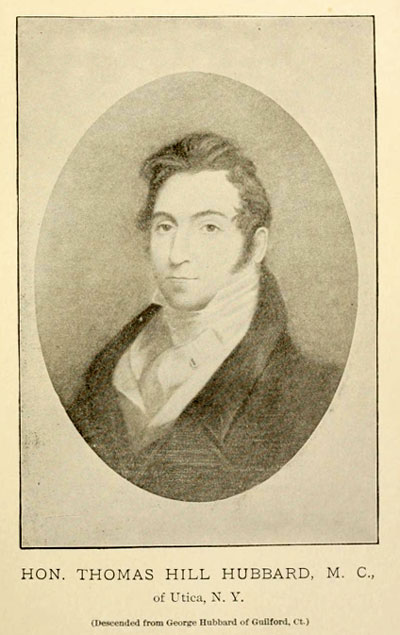
Thomas Hubbard
Former U.S. Representative · New York District 17 · 1817–1823 · Republican
Thomas Hubbard represented New York's District 17 in the United States House of Representatives (1817–1823) for the Republican party. The page below collects sourced biographical facts, term history, committee roles, and provenance for Hubbard.
Bioguide ID: H000890
Key facts
- Full name
- Thomas Hubbard
- State
- New York
- District
- District 17
- Party
- Republican
- House service
- 1817–1823
- First House term
- 1817
- Status
- Left office
- Current term ends
- —
- Born
- 1781
- Bioguide ID
- H000890
- Committee assignments
- —
- Dataset version
- 1.20260606
Biographical narrative
911 words · sourced from the Wikipedia REST extract
Thomas Hubbard was an American lawyer and politician who served as a U.S. Representative for New York's 17th congressional district. A member of the Republican Party, he held office during the early 19th century, contributing to the legislative process in a time of significant national development. His career spanned various roles, including serving as a district attorney and a presidential elector. Hubbard's legal and political work was rooted in his education and early career in New York, where he became an influential figure in both local and state governance.
Early life and career
Thomas Hubbard was born on December 5, 1781, in New Haven, Connecticut. He pursued a classical education, culminating in his graduation from Yale College in 1799. Following his academic achievements, Hubbard relocated to New York, where he began studying law under the guidance of John Woodworth. He was admitted to the bar in 1804 and subsequently began his legal practice in Hamilton, New York. His early career in law laid the foundation for his later political endeavors.
In addition to his legal practice, Hubbard held the position of Surrogate of Madison County from 1806 until 1816. This role involved overseeing the probate of wills and the administration of estates, which provided him with valuable experience in public service and governance. His involvement in local politics continued to grow, and in 1812, he served as a presidential elector, casting his vote for the DeWitt Clinton ticket during the presidential election.
Hubbard's legal and political careers were intertwined, as he also served concurrently as District Attorney for the Sixth District from 1816 to 1818 and as District Attorney of Madison County from 1818 to 1821. These roles further established his reputation as a dedicated public servant and legal professional in his community.
House tenure
Hubbard's political career in the U.S. House of Representatives began when he was elected as a Democratic-Republican to the 15th United States Congress, where he served from 1817 to 1819. During his first term, he was appointed Chairman of the Committee on Expenditures in the Post Office Department, a position that allowed him to influence matters related to postal services and expenditures at a time when the postal system was crucial for communication and commerce across the growing nation.
After completing his first term, Hubbard returned to local politics and continued his legal practice. However, he was elected again to the 17th United States Congress, serving from 1821 until 1823. His second term in Congress was marked by ongoing political developments in the United States, as the nation was navigating the complexities of post-war expansion and internal governance.
Following the conclusion of his second term, Hubbard relocated to Utica, New York, which is situated in Oneida County. This move marked a new chapter in his career, as he transitioned from federal politics to local legal and civic engagements. He formed a partnership with Greene C. Bronson, further solidifying his standing in the legal community of Utica.
Legislative focus and committees
During his time in Congress, Thomas Hubbard's legislative focus was primarily on matters related to the postal service, reflecting the significant role that communication played in the expanding United States. As Chairman of the Committee on Expenditures in the Post Office Department, he was responsible for overseeing the financial aspects of the postal system, ensuring that funds were allocated efficiently and effectively. This role was particularly important during a period when the postal service was essential for connecting distant communities and facilitating commerce.
In addition to his congressional responsibilities, Hubbard's career included various roles in local governance and civic organizations. After his time in Congress, he was appointed Clerk of the New York Supreme Court, a position he held from 1825 to 1835. This role allowed him to remain actively involved in the legal system and contribute to the administration of justice in New York.
Hubbard's commitment to education and public service extended beyond his legal and political careers. He was one of the founders of Hamilton College and Hamilton Academy in Clinton, New York, demonstrating his dedication to fostering education in his community. He also served as a trustee of Utica Free Academy, further emphasizing his belief in the importance of education for future generations.
In addition to his educational contributions, Hubbard played a significant role in the establishment of the New York State Lunatic Asylum at Utica, where he served as the first president of the board of directors. This institution, which opened in 1843, was one of the early efforts in the United States to provide care and treatment for individuals with mental health issues, reflecting the evolving understanding of mental health during that era.
Hubbard's political career continued to intersect with presidential elections, as he served as a presidential elector on two additional occasions in 1844 and 1852, both times supporting Democratic candidates James K. Polk and Franklin Pierce, respectively. These roles highlighted his ongoing engagement in the political landscape of the United States.
Thomas Hubbard passed away on May 21, 1857, in Utica, New York, at the age of 75. He was interred in Forest Hill Cemetery in Utica. His family continued to be involved in various civic and professional endeavors, with his son Frederick taking on significant roles in railroad construction and his son Bela becoming a noted geologist and civic leader in Michigan. Hubbard's legacy is marked by his contributions to law, politics, and education in New York, reflecting the multifaceted nature of his public service.
Notable legislation
Sponsored and co-sponsored legislation for Thomas Hubbard is pending operator curation. The biographical narrative above carries the same provenance trail until per-bill rows are written.
Sources
- [1]https://en.wikipedia.org/wiki/Thomas_H._HubbardWikipedia · retrieved 2026-06-06
Notable quotes
Sourced quotes for Thomas Hubbard are pending operator curation. Narrative-scope provenance remains attached below.
Sources
- [1]https://en.wikipedia.org/wiki/Thomas_H._HubbardWikipedia · retrieved 2026-06-06
Key positions
Curated policy positions for Thomas Hubbard are pending operator review. The biographical narrative above carries the same provenance trail until per-topic positions are written.
Sources
- [1]https://en.wikipedia.org/wiki/Thomas_H._HubbardWikipedia · retrieved 2026-06-06
Terms served
- 1817–1819U.S. House · Term 1 · Republican
- 1821–1823U.S. House · Term 2 · Republican
Sources & provenance
Every attributable claim above carries a per-section [N] marker that resolves to the corresponding URL below. Each entry records the upstream provider, the canonical URL, and the timestamp at which the source was retrieved by the ingest pipeline.
Key facts
- https://bioguide.congress.gov/search/bio/H000890bioguide · retrieved 2026-06-06
- https://www.govtrack.us/congress/members/405736govtrack · retrieved 2026-06-06
Biographical narrative
- https://en.wikipedia.org/wiki/Thomas_H._Hubbardwikipedia · retrieved 2026-06-06
Find your representative
Every U.S. state elects representatives by district. Browse New York’s delegation, the full former-representative roster, or explore the role and term length.
Related on The Candidate
- Preceded by Westel Willoughby Jr.Earlier holder of the New York District 17 House seat · Republican.Open
- Succeeded by Joel TurrillLater holder of the New York District 17 House seat · Jackson.Open
- Abel HuntingtonFormer U.S. Representative · New York District 1 · JacksonOpen
- Alfred ChapinFormer U.S. Representative · New York District 1 · DemocraticOpen
- Cadwallader ColdenFormer U.S. Representative · New York District 1 · FederalistOpen
- Charles FloydFormer U.S. Representative · New York District 1 · DemocraticOpen